


Italy has deployed a Persian Gulf task force combining fighter jets, airborne early warning, radars, missiles and anti-drone systems, according to Italian Defense Ministry data. The deployment is not the largest Italian mission of recent years, but it includes recently introduced equipment that exists only in limited quantities, raising the stakes of the operation.
The force numbers about 660 troops, roughly 400 from the Air Force and 260 from the Army. They are spread across Saudi Arabia, Kuwait, Bahrain and the United Arab Emirates.
The mission has become a point of public debate in Italy after opposition lawmakers accused the government of deploying forces without adequate parliamentary oversight. The government has responded that a resolution approved on March 5 authorized the assistance.
Four Eurofighters and a SAMP/T battery
The air component includes four Eurofighter F-2000A jets, one E-550A early warning aircraft, C-130J and KC-130J transport planes, an AN/TPS-77 radar and the ACUS-E anti-drone system, according to the Defense Ministry.
The ground component adds a SAMP/T battery, the Skynex gun and Kronos radars, according to the operation's fact sheet. The SAMP/T is designed to intercept aircraft and missiles, while Skynex targets closer threats, including drones.
Limited stock raises the stakes
Matteo Mazziotti di Celso, a visiting researcher at the Center for Maritime Military Studies, which is linked to the Italian Navy, told Breaking Defense that some of the systems have only recently entered service and exist in limited numbers. He said their loss or damage would therefore be significant.
Mazziotti described the deployment as one of the most significant Italian missions of recent years because of the quality of the equipment, and he placed it among the riskiest active missions. He did not suggest a loss was imminent, but he pointed to the cost that an unlikely strike would carry against equipment that is difficult to replace.
A military mission and an industrial showcase
The Eurofighters depend on early warning and refueling to make full use of their range. The E-550A provides a wide aerial picture, the AN/TPS-77 radar watches from the ground, and the C-130 transports sustain logistics.
Mixed attacks complicate that coordination, since an adversary can combine fast missiles with slow, cheap devices to saturate sensors and force defenders to expend ammunition. An account of an Iranian drone swarm illustrated how a confusing formation can overwhelm situational awareness, though details of that episode remain unconfirmed.
The Gulf deployment also serves as a showcase for Italian defense companies. Leonardo takes part in the Eurofighter program and manufactures the E-550A and the Kronos radars, MBDA is involved in the SAMP/T, and Rheinmetall Italia supplies part of the Skynex system.
Part of a wider international defense
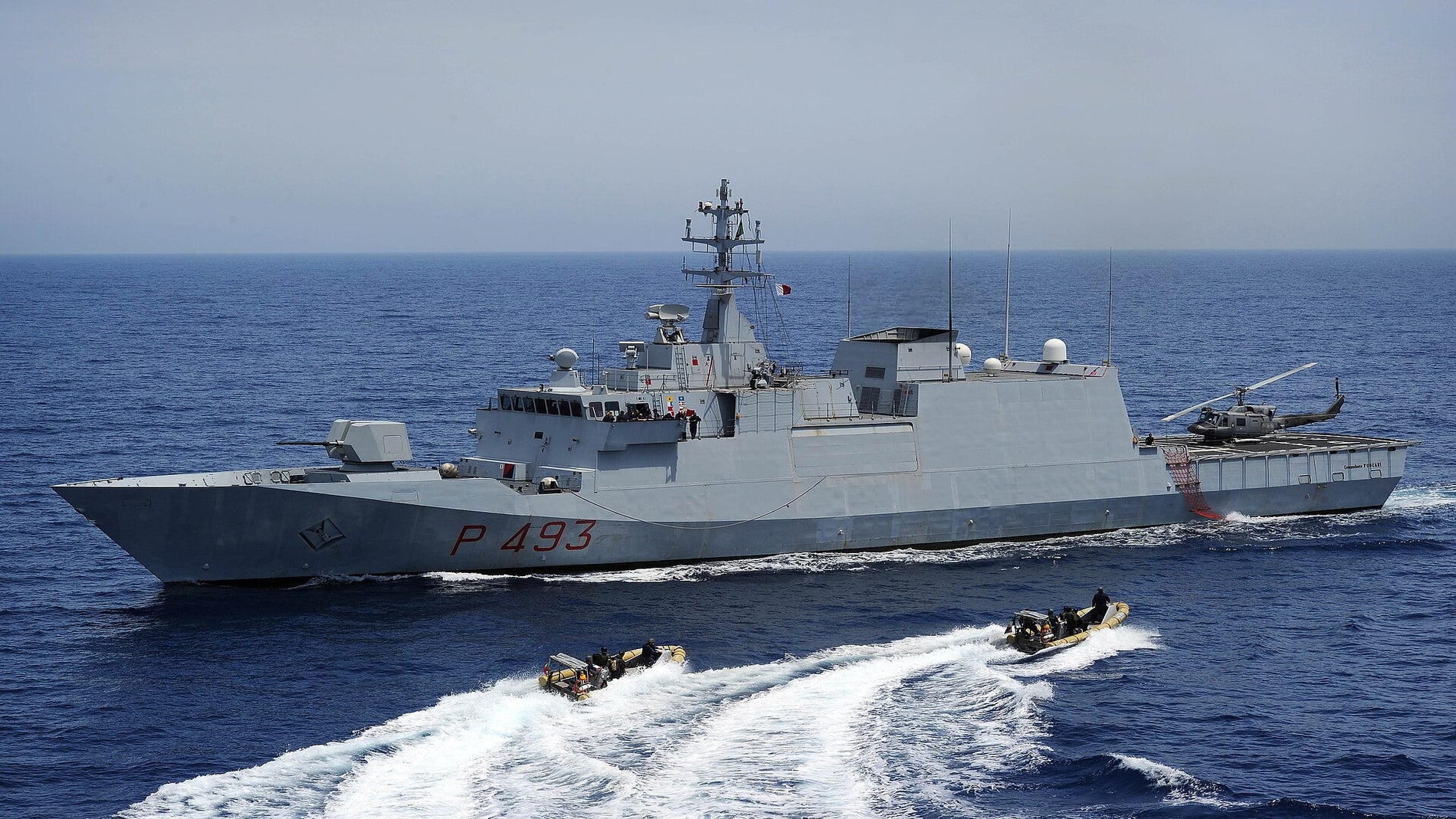
The Gulf defenses protect bases, populations and energy infrastructure that have already been targeted. Ships sent to the Strait of Hormuz cover other threats, from mines to naval attacks, making the Italian force one piece of a larger international defense rather than an independent shield.
The parliamentary debate is expected to clarify the mission's duration, its rules of engagement and the conditions for withdrawal, as well as which equipment remains under Italian national command and which supports allied structures. Mazziotti pointed to what he called the most sensitive issue: Italy has sent valuable capabilities that it would not be able to replace quickly.


