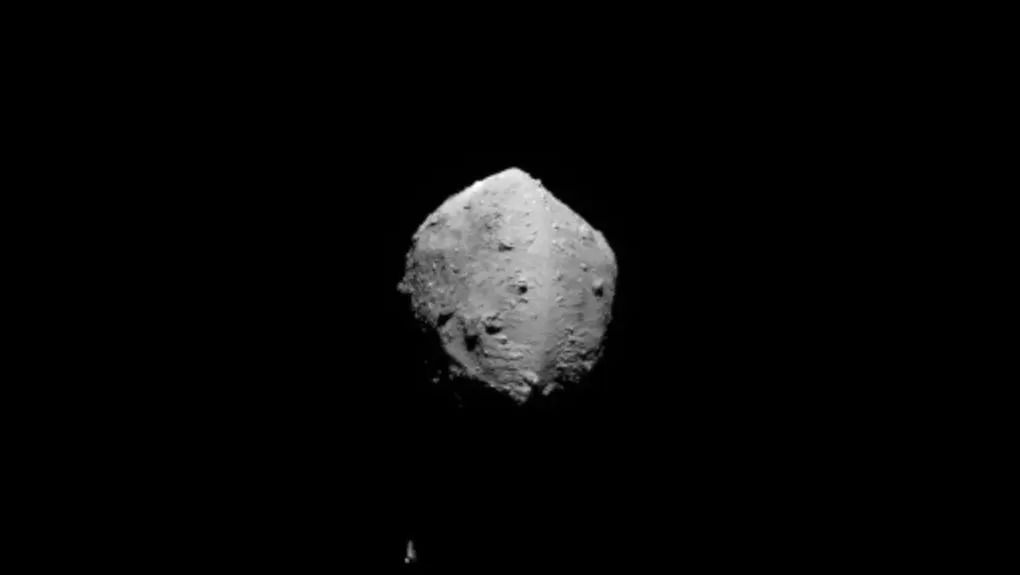
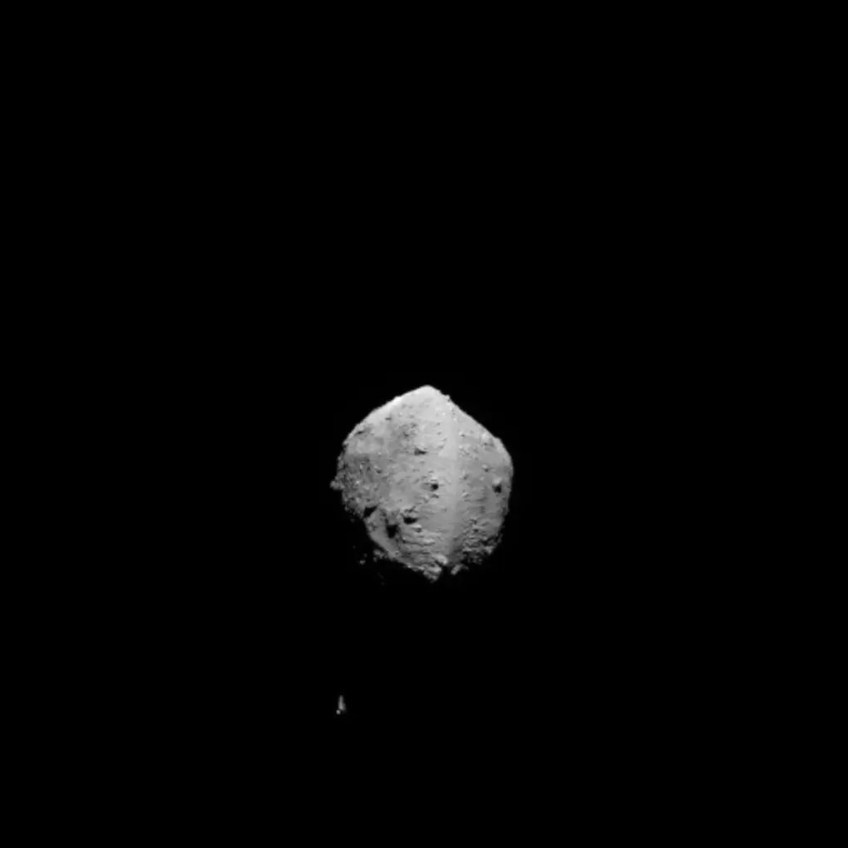
The European Space Agency's Hera spacecraft has captured an unprecedented close-up photograph of the asteroid Didymos from a distance of roughly 60 kilometres.
Captured by the onboard camera of the European probe, the newly released photograph reveals a side of Didymos that astronomers had never previously observed at close range. The image shows intricate geological details across the rocky surface, including large boulders, impact craters and possible surface markings.
The target forms the larger component of a binary asteroid system. Didymos measures approximately 780 metres in diameter, while its orbiting moonlet, Dimorphos, spans roughly 151 metres across.
Binary systems make up a notable fraction of the near-Earth asteroid population and consist of two gravitationally bound bodies orbiting a common centre of mass. In this pair, Dimorphos completes regular orbits around Didymos, creating a natural laboratory for studying asteroid physics.
NASA planetary defence test
The binary pair became the focus of an international scientific effort in September 2022, when the National Aeronautics and Space Administration carried out an unprecedented deflection test. NASA deliberately launched its DART spacecraft on a collision course with Dimorphos.
The primary goal of the collision was to determine whether a kinetic impact could successfully alter the trajectory of an asteroid in space. Planetary defence researchers view kinetic impactors as a primary technique to safeguard Earth from potential celestial hazards, relying on the momentum transfer of an uncrewed spacecraft rather than nuclear devices to nudge a threatening object off course.
The mission succeeded in altering the orbit of Dimorphos around Didymos, reducing its orbital period by approximately 33 minutes. That measurable shift provided scientists with the first real-world demonstration that human technology can intentionally change the orbital motion of an astronomical body.
Hera post-collision investigation
Following that milestone, the European Space Agency launched the Hera mission to carry out a comprehensive post-impact investigation. Hera spent two years travelling through deep space to reach the Didymos system and begin an exhaustive assessment of the collision site.
The spacecraft is tasked with studying the physical characteristics of both asteroids and examining the crater formed by the DART impact. Among its suite of scientific instruments, Hera uses a laser altimeter to map surface topography and calculate the precise shape and mass distribution of Dimorphos.
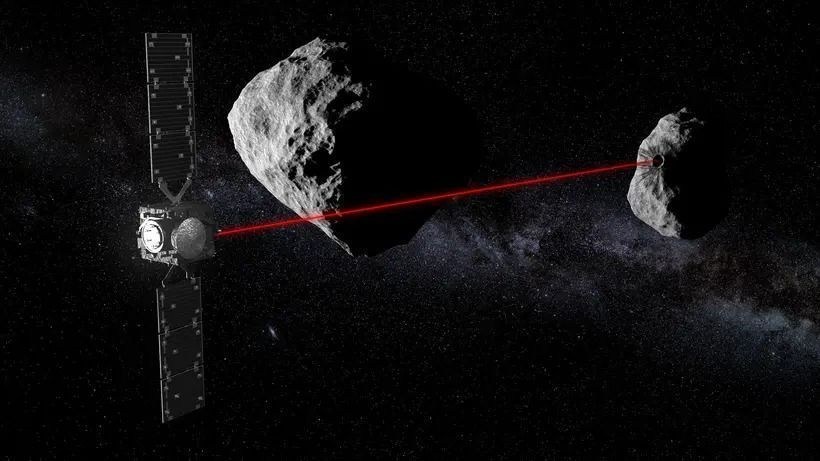
The new image taken by Hera depicts a region of Didymos distinct from the terrain recorded by DART shortly before the American spacecraft was destroyed upon impact. According to Patrick Michel, principal investigator of the Hera mission, the photograph revealed a landscape with features that still require thorough investigation.
Debris and surface formations
Scientists are particularly interested in learning whether some of the surface features observed on Didymos were influenced by material blasted into space during the 2022 collision. The collision threw vast amounts of rock and dust outwards, and researchers suspect some of this debris may have settled back onto Didymos.
Hera will continue its investigation by collecting high-resolution data on the physical properties of both celestial bodies, helping researchers determine how kinetic impacts alter asteroid surfaces and internal structures.