

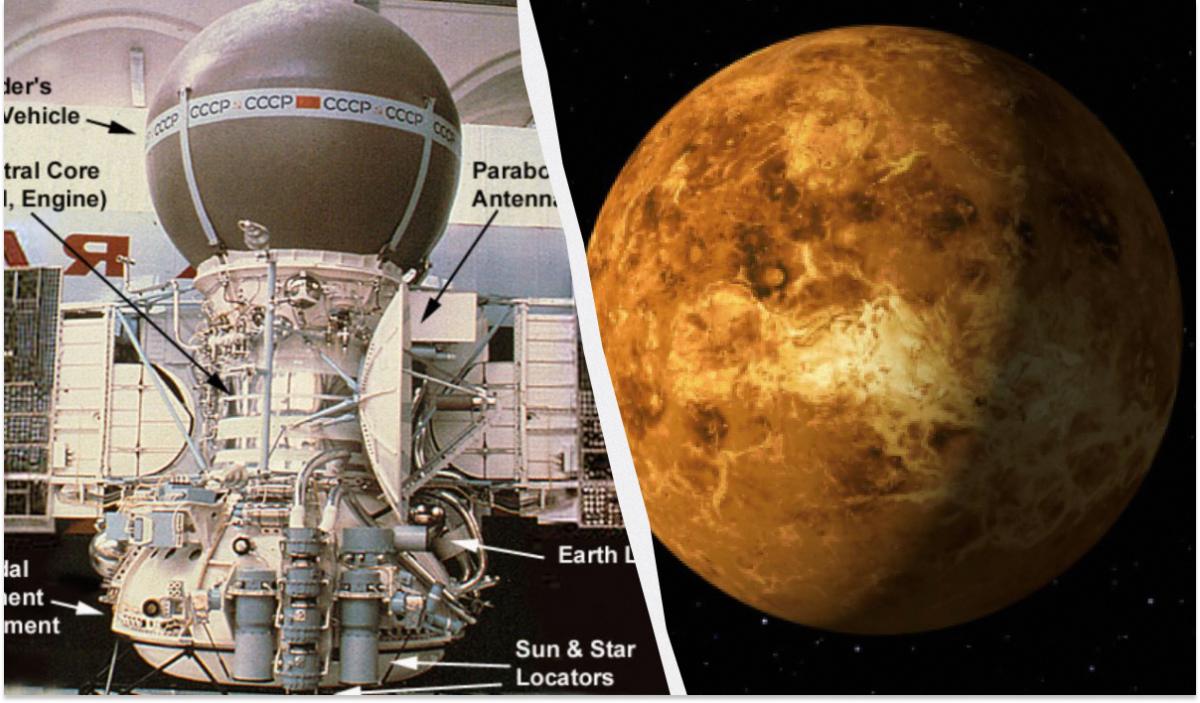
The Soviet space station Venera 13 landed on Venus on March 1, 1982, surviving severe surface heat to transmit data for 127 minutes. The spacecraft touched down at 3:57 a.m. Kyiv time after descending through an extreme atmospheric environment with temperatures reaching 465 degrees Celsius.
Space Daily reported that the probe operated nearly four times longer than the 32 minutes engineers originally expected. During its operational window, the spacecraft drilled into the surface, analyzed sample chemistry, and returned the first color panoramas of another planet.
Venus is the second planet from the Sun and Earth's closest planetary neighbor. Its heavy atmosphere creates an intense greenhouse effect where surface pressure is 89 times higher than on Earth, equivalent to depths of nearly 900 meters under ocean water. Conditions on the ground are hot enough to melt lead, creating one of the most hostile surface environments in the Solar System.
To survive the landing, engineers housed sensitive instruments inside a titanium capsule protected by heavy thermal insulation. The descent module was pre-cooled prior to launch, but heat dissipation became impossible once inside the atmosphere because exterior temperatures far exceeded internal conditions. Mission scientists had previously considered 32 minutes the absolute operating limit for onboard electronics.
Flight timeline and descent
Flight chronicles show the mission began on October 30, 1981, when the station launched alongside the main carrier spacecraft. The lander detached from the main vessel on February 27, 1982, and entered the dense Venusian clouds two days later.
A heat shield initially slowed the atmospheric entry, after which a parachute deployed to allow instruments time to measure cloud and atmospheric conditions. The lander completed a soft touchdown in the Phoebe Regio region at a speed of approximately 7.5 meters per second. Meanwhile, the carrier spacecraft flew past Venus at a distance of 36,000 kilometers, receiving surface transmissions and relaying data back to Earth.
Phoebe Regio is a prominent volcanic highland area located near the equator of Venus. The mission was part of the Soviet Venera program, a series of robotic space probes launched between 1961 and 1984 to investigate the atmosphere and surface conditions of Venus.
First color images of Venus
Earlier Soviet exploration missions had previously opened a window on Venus. Venera 9 delivered the first image from the surface of another celestial body in 1975, followed by Venera 10, though both missions returned only black and white panoramas. Subsequent Venera 11 and Venera 12 craft carried color cameras but failed to shed their protective lens covers upon landing.
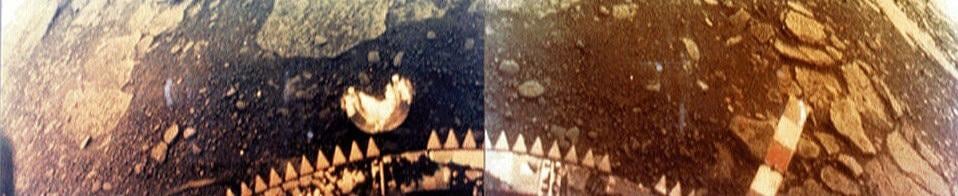
Venera 13 successfully ejected the lens covers from its two panoramic telephotometers, which pointed in opposite directions. The cameras scanned the landscape line by line through color filters, revealing angular rock slabs beneath an orange-brown sky, alongside parts of the landing ring and probe structure in the foreground.
The NASA Space Science Data Coordinated Archive catalog notes that 14 images were preserved from the 127-minute session, though counts vary across sources depending on how complete panoramas are tallied.
Surface rock and atmospheric analysis
Photography was only one component of the scientific mission. Onboard equipment included a small drill paired with an X-ray fluorescence spectrometer scanner. Immediately after landing, the apparatus collected a rock sample and pulled it into a sealed internal chamber for testing.
Inside the sealed chamber, X-ray examination revealed that the surface rock closely resembles potassium-rich volcanic basalt found on Earth. Historical records from NASA credit Venera 13 with performing the first soil analysis on Venus, alongside measurements of atmospheric composition, cloud characteristics, and electrical discharges in the atmosphere.
Researchers note that soil is a conditional term in this context, referring to loose surface material and crushed rock rather than biological Earth soil. Basalt is a fine-grained volcanic rock formed by cooling lava, common in volcanic oceanic crusts on Earth. Later missions including Venera 14 and Vega 2 studied surface composition at other locations, while orbital radar provided regional data. However, scientists still lack an extensive surface observation network on Venus comparable to the network established on Mars.
Future comet observations
In other space exploration news, Halley's Comet is traveling back toward the inner Solar System and will reach perihelion, its closest point to the Sun, on July 28, 2061. The following close approach will not occur until March 27, 2134, making the 2061 event the only opportunity for many people alive today to view the comet with the naked eye.
NASA records show that human observations of Halley's Comet span more than two thousand years. While the comet is widely known for a 76-year orbital cycle, scientists note that figure is approximate, with actual intervals between appearances ranging from 74 to 79 years due to gravitational influences from major planets.


