


An international team of scientists observing magnetar 1E 1547.0-5408 has detected evidence that extreme magnetic fields can alter how light travels through empty space.
The observations offer one of the clearest signals yet for a quantum phenomenon predicted by physicists Werner Heisenberg and Hans Euler nearly 90 years ago in 1936.
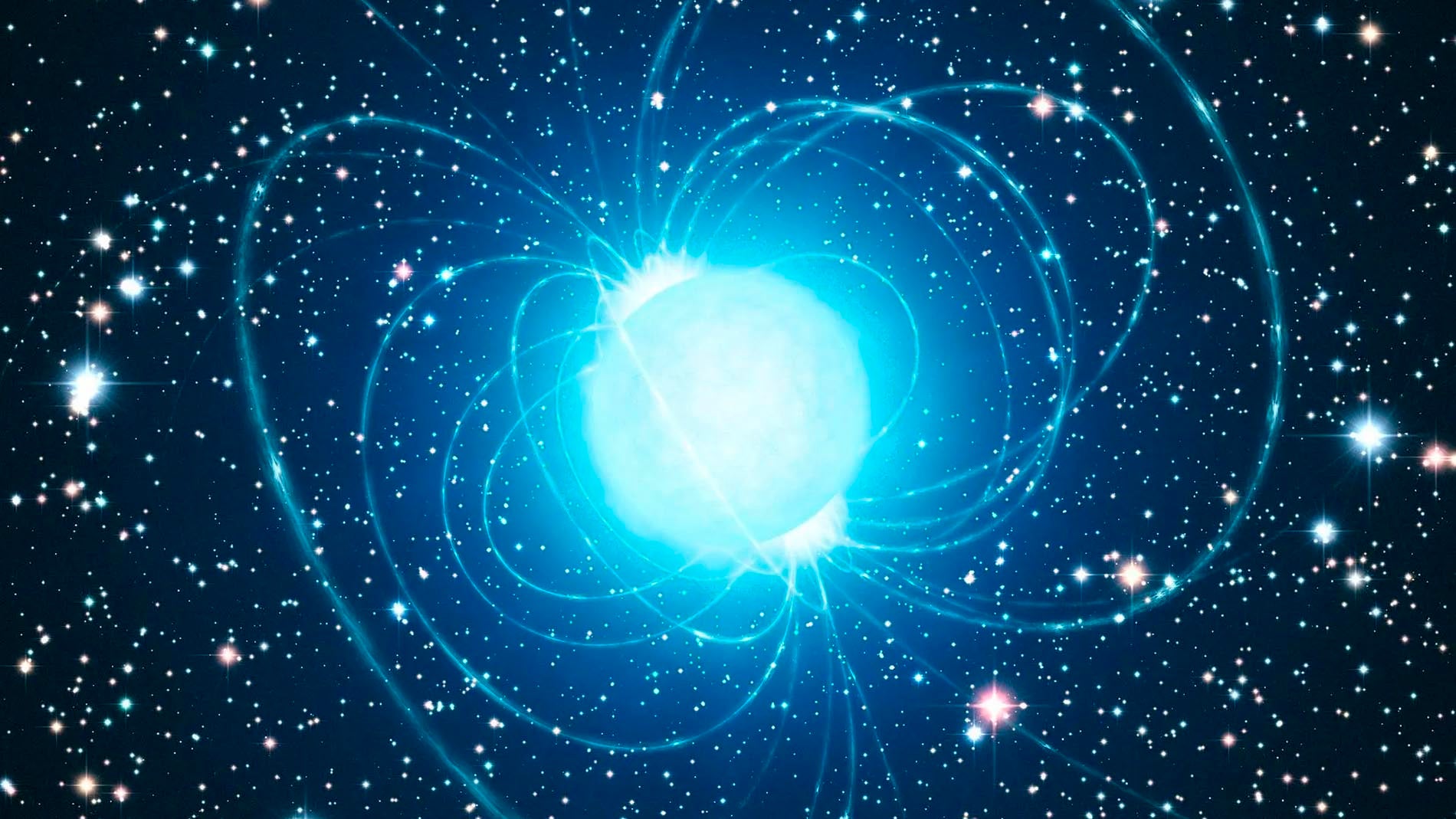
Magnetar 1E 1547.0-5408 is a neutron star possessing a magnetic field that exceeds 100 trillion gauss. Neutron stars are the collapsed, hyper-dense cores of massive stars that exploded in supernovas, while magnetars represent an exceptionally rare subset defined by magnetic fields trillions of times stronger than that of the Earth.
Because conditions of such immense magnetic intensity are impossible to recreate in laboratories on Earth, researchers treat the star as a natural laboratory to test fundamental predictions of quantum physics.
Vacuum birefringence theory
The physical effect under investigation is known as vacuum birefringence. Under classical physics, empty space is considered a complete void through which light passes completely unaltered.
Quantum electrodynamics theory predicts that a seemingly empty vacuum contains virtual particle fluctuations. Under a massive magnetic field, these quantum fluctuations cause the vacuum to behave like a physical material, altering the polarization and direction of passing photons depending on their alignment.
The theoretical framework established by Heisenberg and Euler described how extreme electromagnetic fields could modify light propagation through what had previously been viewed as empty space.
Telescope measurements of magnetar X-rays
To test the prediction, the international research team gathered measurements using NASA's Imaging X-ray Polarimetry Explorer, known as IXPE. The space telescope was launched to measure the polarization of X-rays emitted by extreme cosmic objects.
The researchers combined IXPE observations with data from NASA's Neutron star Interior Composition Explorer, or NICER, and the Parkes radio telescope located in Australia.
IXPE targeted magnetar 1E 1547.0-5408 for more than 140 hours between March and April 2025. During the observation window, the instruments tracked the orientation of X-ray light emitted as the neutron star completed a full rotation roughly every two seconds.
X-ray polarization results
Data analysis revealed notable polarization patterns in the star's radiation. The average polarization of softer X-rays reached 65 percent, rising to nearly 80 percent at specific points during the star's rotation.
The orientation of the X-rays closely tracked the geometry of the star's massive magnetic field. Conventional physical models, which assume that light travels through an unchanging vacuum without alteration, struggle to explain the measured orientation patterns.
The finding adds to recent astronomical observations challenging simple models of the universe, including discoveries of large-scale spatial structures that question existing assumptions about how matter is distributed across the cosmos.
Future research and scientific verification
Scientists involved in the study cautioned that the findings do not yet represent a definitive confirmation. Complex physical processes occurring around magnetars can also influence light polarization, requiring further observation and refined computer simulations to rule out alternative explanations.
NASA described the result as the strongest signal obtained to date rather than a conclusive resolution of the case.
If verified by subsequent measurements, the data will provide direct proof that empty space possesses measurable physical properties. Such a confirmation would align with modern physical models that diverge from everyday intuition, supporting theoretical efforts to re-examine the fundamental nature of space and time.


