


NASA researcher Kelsey Young has confirmed that the second stage of a SpaceX Falcon 9 rocket crashed unexpectedly onto the surface of the Moon early on Wednesday morning.
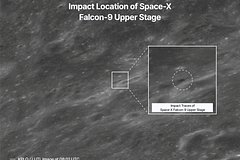
A video clip containing her statement was published by news agency Reuters. The confirmation follows a report by the BBC on Wednesday, August 5, which first stated that a stage from the heavy rocket collided with the Earth's natural satellite.
The European Southern Observatory also confirmed the impact to Reuters. Representatives at the astronomy organization noted that the crash generated a cloud containing fragments of rocket components mixed with displaced lunar soil.
Mission background and orbital decay
The rocket stage originated from a mission launched in January 2025. The Falcon 9 rocket successfully sent two commercial landing modules toward the Moon before its remaining upper stage ran out of fuel.
Left adrift in an unstable orbit, the depleted rocket stage was eventually caught by lunar gravity, which pulled the vehicle into its final unplanned collision course with the lunar surface.
SpaceX and lunar exploration context
SpaceX, an American aerospace manufacturer, regularly utilizes the Falcon 9 as a launch vehicle for commercial, government, and scientific missions. While the lower booster stage of a Falcon 9 is engineered to return to Earth for recovery and reuse, upper stages complete their engine burns in orbit after deploying their payloads.
NASA, the United States government agency responsible for civil space exploration, routinely tracks hardware remaining in cislunar space. Defunct rocket bodies floating without propulsion in high orbits can remain in space for extended periods before gravitational interactions alter their trajectory.
Astronomical observation of lunar collisions
The European Southern Observatory is an intergovernmental astronomy organization operating observational facilities to study celestial bodies. Ground-based observatories can sometimes detect high-velocity lunar impacts by observing the resulting debris cloud ejected from the surface of the Moon.


