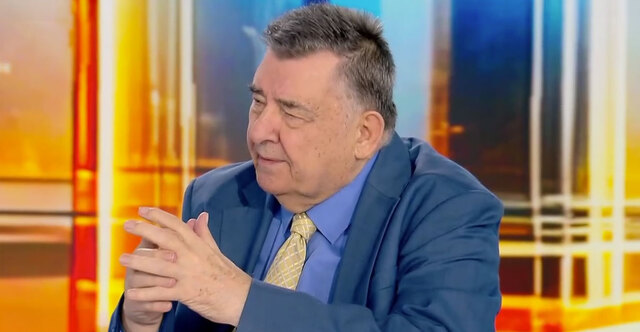
European Parliament member Raphaël Glucksmann announced his candidacy for the 2027 French presidential election during TF1's evening news bulletin on Sunday evening. The leader of the centre left Place Publique party joins a growing series of political figures using traditional prime time broadcasts to launch their presidential bids.
On May 3, his left wing rival Jean-Luc Mélenchon chose the same private channel studio to formalise his fourth campaign for the Élysée Palace, repeating the strategy he used ahead of the 2022 presidential race.
Other French politicians have followed similar paths. Marine Tondelier, head of The Ecologists party, and lawmaker François Ruffin both selected TF1's news broadcast to launch candidacies for the left wing primary before that initiative was abandoned. Tondelier had announced her decision hours earlier to the weekly news magazine Le Nouvel Obs. Conservative politician Bruno Retailleau published a social media video before confirming his bid on TF1, while Cannes mayor David Lisnard used the France 2 evening news on April 1 to confirm his departure from Les Républicains and his presidential candidacy.
Prime time viewership and audience reach
Alexandre Eyries, a researcher in information and communication sciences at CHUS Université Catholique de l'Ouest, said candidates face a crucial decision when choosing how and when to enter a campaign. He stated that candidates must balance timing with communication channels, noting that traditional evening news bulletins remain the primary information source for millions of French voters. He added that despite being an older broadcast format, the 8 PM news remains a heavily watched media event.
Ratings figures highlight the broad reach of French evening television news. During the 2024-2025 season, TF1 averaged 5.2 million viewers for its evening bulletin, while public broadcaster France 2 drew an average of 3.8 million viewers. According to ratings agency Puremédias, Mélenchon's Sunday evening announcement on TF1 attracted 5.36 million viewers, representing a 26.9 percent audience share.
Low risk and controlled political messaging
Political communication experts note that the evening news format offers candidates a controlled environment with minimal risk. Eyries explained that the structured broadcast provides a calm setting aimed at a general audience, contrasting it with the intense questioning typical of morning radio or television interviews with specialized political journalists.
Mélenchon reflected on this media strategy in a blog post published shortly after his broadcast appearance. He wrote that his campaign chose to accept invitations from both TF1 and digital outlet Brut to maintain a presence across traditional television and online media. He said the primary criterion for choosing those outlets was the respect shown by interviewers, describing the decision as a strategic move to control political messaging rather than face aggressive questioning.
Risks of alternative launch strategies
While candidate control is easier during news interviews, analysts say alternative platforms carry higher risks. Eyries noted that an innovative launch can help a candidate stand out, but he emphasized that the 8 PM news remains a central ritual in French politics, comparing a prime time broadcast appearance to publishing a campaign book in the months leading up to an election.
Attempts to bypass traditional television networks have previously run into legal complications. In November 2021, far right Reconquête party founder Éric Zemmour launched his presidential bid with a video posted on YouTube, styled as a tribute to General Charles de Gaulle's famous 1940 radio appeal from London. YouTube later removed the video after French courts convicted Zemmour of copyright infringement for using archived media footage without authorization.