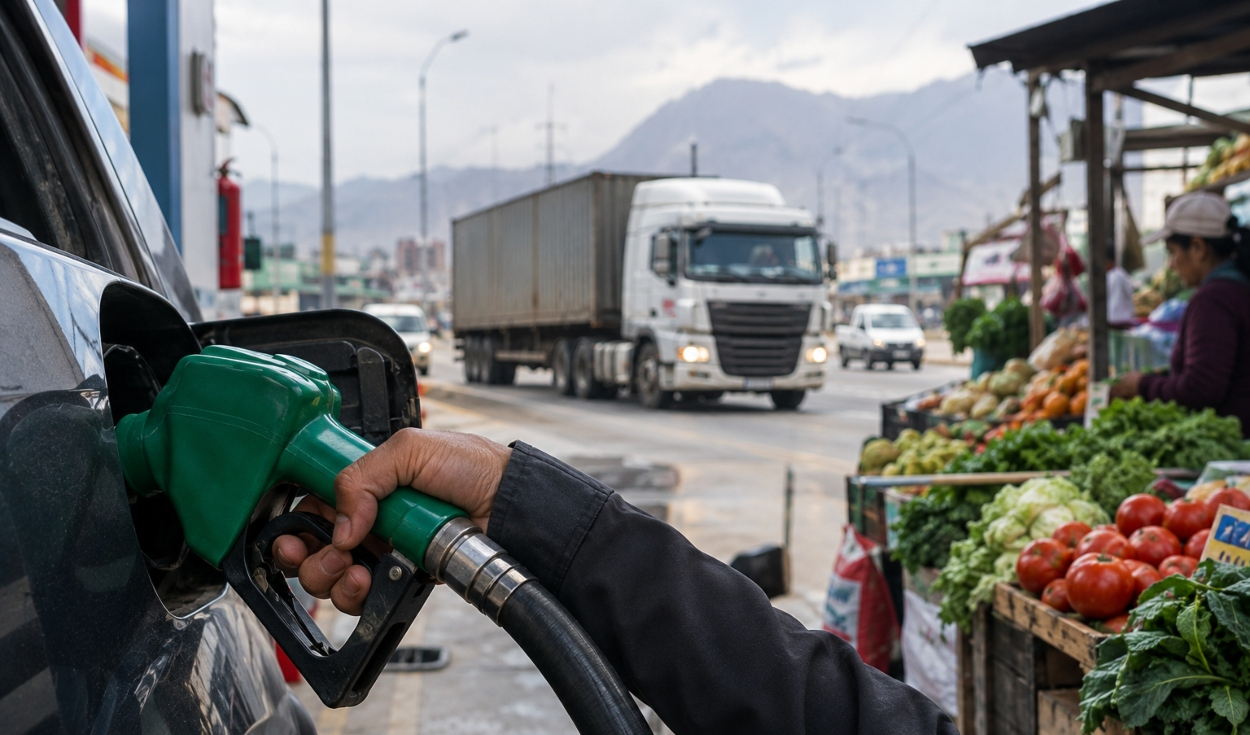
Peruvian fuel consumers face rising prices after international oil benchmarks Brent and West Texas Intermediate closed above US$100 per barrel despite logging three straight sessions of declines. Brent crude finished at US$103.87 per barrel and West Texas Intermediate ended at US$100.30 per barrel on Friday as international energy markets continued monitoring supply disruptions stemming from conflict in the Middle East.
In Peru, movements in raw crude oil prices do not directly determine what drivers and commercial transport operators pay at retail pumps. Central bank officials and energy market experts noted that crude oil and refined petroleum derivatives trade on separate markets governed by distinct supply and demand conditions. Factors such as global refinery capacity, international transport logistics, and available inventories dictate finished fuel costs, causing refined products like diesel to surge faster than unrefined crude.
Central Reserve Bank of Peru President Julio Velarde explained during the presentation of the institution's latest Inflation Report that refined fuel prices climbed at a faster rate than crude oil because the Middle East conflict damaged and disrupted processing facilities worldwide. Velarde said that international conflicts had directly impaired refining infrastructure, putting extra cost pressure on finished fuels delivered to importing nations.
This market divergence is particularly critical for Peru because domestic crude production cannot satisfy internal fuel demand. Velarde noted that when refinery output drops globally, derivative shortages raise fuel prices even if crude oil benchmarks begin to moderate. He added that Peruvian fuel prices rose more than in neighboring South American countries because Peru did not use public stabilization funds or state-owned enterprises to subsidize oil price increases for consumers.
Refinery bottlenecks and local market pressures
Official data from the National Institute of Statistics and Informatics showed that diesel prices in Metropolitan Lima jumped 11.5 percent in August, while gasohol prices increased 8.4 percent. Over the same 12-month period, annual consumer price inflation reached 4.44 percent in Lima and 4.06 percent across Peru nationwide. Velarde attributed part of the local price surge to commercial anxiety regarding oil import financing by a Peruvian public company, explaining that international sellers demanded higher prices due to concerns over potential non-payment.
In response to global energy volatility, the central bank adjusted its economic projections in September. The institution raised its forecast for average West Texas Intermediate crude prices in 2026 from US$80 to US$82 per barrel, while projecting an average price of US$74 per barrel for 2027. The central bank also increased its annual inflation projection for Peru in 2026 to 4.2 percent, linking higher fuel prices directly to increased transportation costs across the domestic economy.
Import dependence and transport sector impact
Former Vice Minister of Hydrocarbons Víctor Murillo stated that crude oil and processed derivative markets do not always move in tandem. Murillo explained that if refining output drops, diesel becomes scarce even when crude oil is plentiful globally. He highlighted that Peru relies far more heavily on imported finished fuels than on raw crude imports, noting that the country's two domestic refiners, Petroperú's Talara facility and Repsol's La Pampilla refinery, process crude input but produce less than half of national fuel consumption.
Because domestic refineries cannot fulfill domestic demand, Peru relies heavily on direct imports of refined diesel. Murillo emphasized that diesel is vital to freight transportation, public transit, heavy machinery, and industrial operations across the country. Consequently, a sustained increase in international derivative prices directly inflates the cost of transporting food, raw materials, and commercial goods throughout Peru.
The speed and extent to which international price hikes reach Peruvian gas stations depend on several commercial variables. Market analysts and officials noted that local price transmission varies according to existing inventory reserves, import contract costs, distributor profit margins, and the specific dates when individual importing companies secured their shipments. Velarde noted that this chain reaction caused transport-sector inflation in Peru to outpace levels seen in neighboring countries.
Middle East conflict and global supply routes
International fuel supplies remain constrained by logistical bottlenecks and security threats along major maritime trade corridors. Maritime transit through the Strait of Hormuz remains disrupted, tightening global diesel availability. However, crude benchmark prices experienced slight relief late in the week following reports that Saudi Arabia is working to partially restore its East-West pipeline, an overland infrastructure route that transports crude oil to Red Sea ports while bypassing the vulnerable Strait of Hormuz.
Despite the end-of-week drop in crude futures, energy analysts stress that the long-term outlook for Peruvian fuel prices remains tied to the Middle East conflict. Velarde emphasized that the main market uncertainty is whether geopolitical tensions will escalate further, potentially triggering renewed crude and derivative price spikes. Murillo added that if international supply constraints persist for several months, elevated derivative costs will continue flowing into Peru, keeping diesel prices high for domestic consumers even if crude oil prices temporarily soften.