
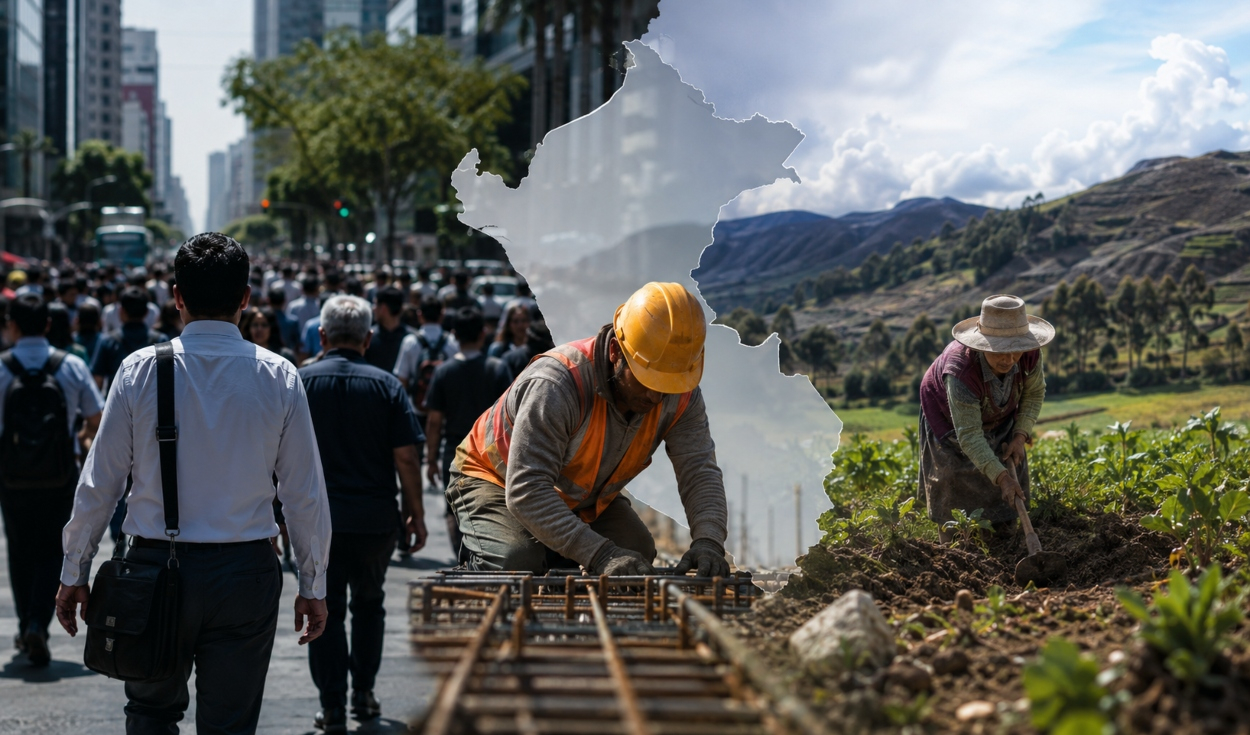
Employment in Peru grew by 1.8 percent during the second quarter of 2026 as the nation added 315,900 jobs, official statistics show.
The National Institute of Statistics and Informatics (INEI) reported that the overall expansion between April and June hid severe geographic divides across the country.
The net increase was driven entirely by job creation in urban centers, which offset a sharp drop in rural employment and workforce contractions in nine major cities.
The National Institute of Statistics and Informatics is Peru's central government statistics agency, responsible for producing official data on population, economic activity, and employment across the South American country.
Sharp Job Losses in Cajamarca and Regional Cities
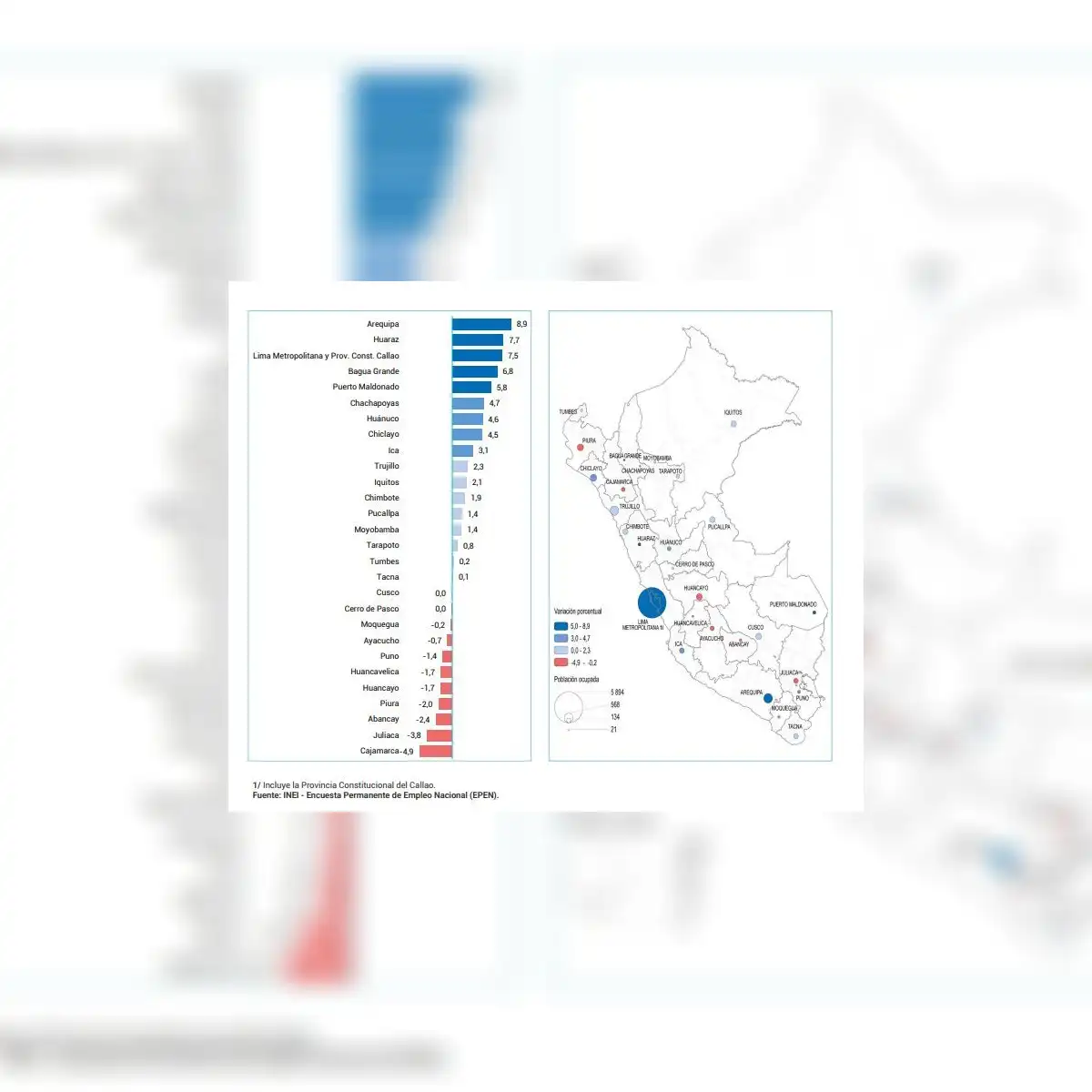
Cajamarca recorded the sharpest decline in employment among all 28 cities evaluated by the statistical institute, with its employed population dropping by 4.9 percent compared to the same quarter in 2025.
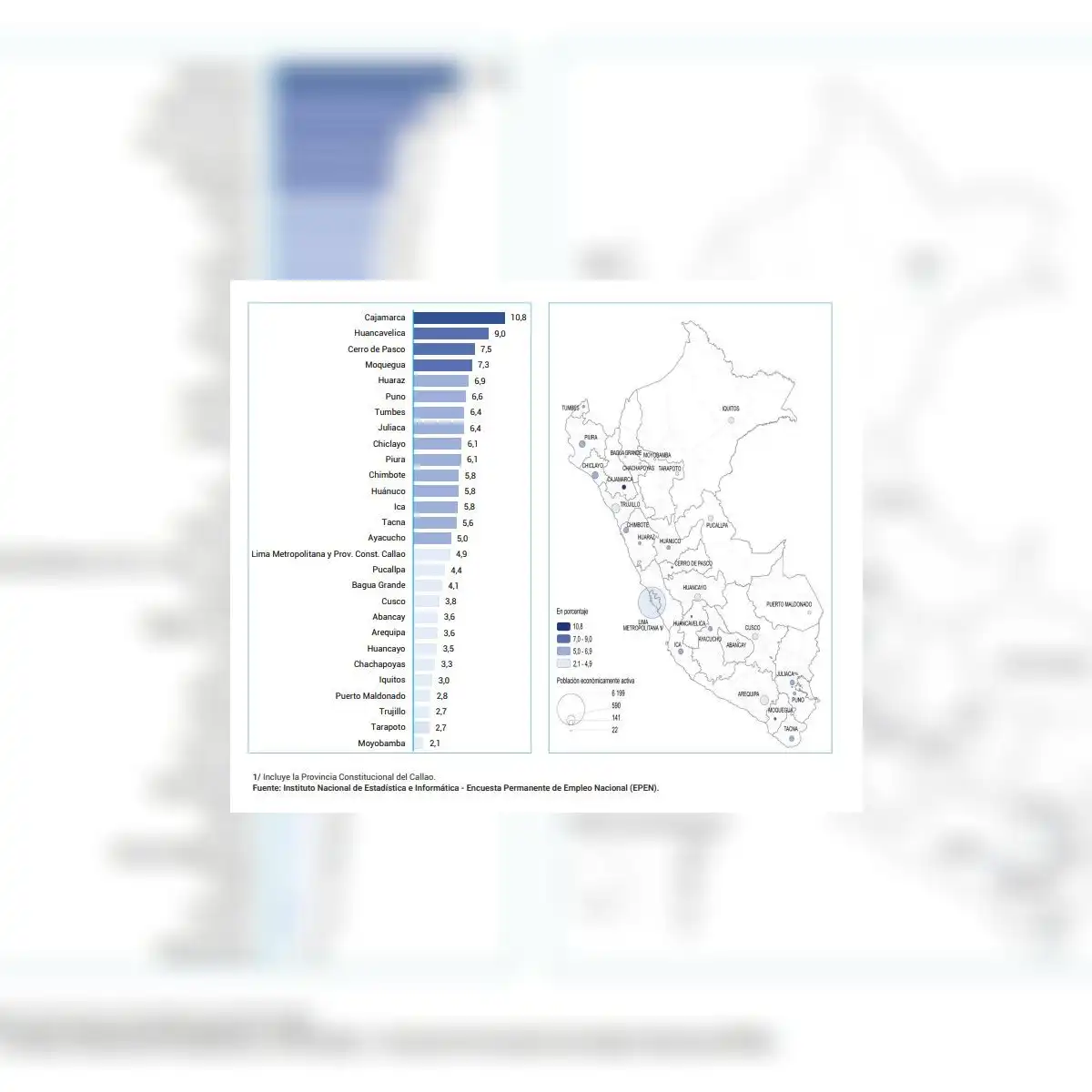
The northern highland city also registered the highest unemployment rate in the country at 10.8 percent between April and June.
Cajamarca, located in Peru's northern Andes, serves as a major agricultural and mining region, but local economic activity has struggled to generate stable employment.
Juliaca posted the second-largest drop in employment among urban areas, with its workforce shrinking by 3.8 percent year-on-year.
Abancay recorded the third-steepest contraction, with the number of employed residents falling by 2.4 percent over the same period.
In total, nine of the 28 urban centers evaluated by INEI ended the second quarter of 2026 with fewer employed workers than they had a year earlier.
The cities experiencing workforce contractions were Cajamarca, Juliaca, Abancay, Piura, Huancayo, Huancavelica, Puno, Ayacucho, and Moquegua.
High Informal Labor and Low Wages in Juliaca
Alongside its 3.8 percent job decline, the southern city of Juliaca faced severe challenges with informal employment and low earnings.
The INEI reported that Juliaca registered a labor informality rate of 82.3 percent, the highest figure recorded among all 28 evaluated cities.
The high informality rate means that more than eight out of every ten workers in Juliaca held informal jobs that lacked employment benefits, health coverage, or formal labor contracts.
Informal labor is widespread in Peru, particularly in commercial transit cities like Juliaca in the Puno region, where small-scale trading and unregistered businesses dominate the local economy.
Juliaca also recorded the lowest average monthly labor income in the nation between July 2025 and June 2026, with workers earning an average of S/1,408.9 per month.
The Peruvian sol, abbreviated as S/, is the national currency of Peru. The monthly average in Juliaca stood far below earnings in major coastal and mining centers.
Employment Expansions in Arequipa, Huaraz, and Lima
While several inland cities lost jobs, other major urban centers recorded robust growth in their employed populations during the second quarter.
Arequipa led all Peruvian cities in employment growth, recording an 8.9 percent increase in its employed workforce compared to the second quarter of 2025.
Arequipa is Peru's second-most populous city and a major economic hub in the southern Andes, known for its commercial, manufacturing, and agricultural industries.
Huaraz achieved the second-highest growth rate at 7.7 percent, followed by Metropolitan Lima and Callao, where employment expanded by 7.5 percent.
Significant workforce expansions were also recorded in Bagua Grande, which grew by 6.8 percent, and Puerto Maldonado, which increased by 5.8 percent.
The divergence between top-performing Arequipa and bottom-ranked Cajamarca created a job growth gap of nearly 14 percentage points, specifically 13.8 percentage points.
Unemployment Disparities and City Wage Rankings
Unemployment rates varied widely across urban areas, reflecting unequal economic conditions across Peru's regions.
Behind Cajamarca's national high of 10.8 percent, Huancavelica registered the second-highest unemployment rate at 9 percent, while Cerro de Pasco recorded 7.5 percent.
Huaraz reported an unemployment rate of 6.9 percent, Metropolitan Lima and Callao reached 4.9 percent, and Arequipa stood at 3.6 percent.
The lowest unemployment rates in the country were recorded in Moyobamba at 2.1 percent, Tarapoto at 2.7 percent, and Trujillo at 2.7 percent.
The statistical report revealed that cities with the fastest job growth did not necessarily offer the highest monthly earnings.
Moquegua recorded the highest average monthly labor income among all evaluated cities, reaching S/2,544.6 per month between July 2025 and June 2026.
Chachapoyas recorded the second-highest monthly average at S/2,501.6, followed by Puerto Maldonado at S/2,365.4 and Ica at S/2,290 per month.
In Metropolitan Lima and Callao, which forms Peru's central economic region and capital territory, average monthly labor income reached S/2,580.3 per worker.
Urban Growth Offsets Rural Job Losses Nationally
The overall national increase of 315,900 jobs resulted from strong urban hiring offsetting a significant downturn in rural areas.
Urban employment grew by 3 percent during the second quarter of 2026, adding 428,800 workers across the country's towns and cities.
In contrast, rural employment dropped by 3.4 percent, representing a loss of 112,900 jobs in agricultural and countryside regions over the same timeframe.
Nationwide average monthly labor income rose by 8.9 percent, increasing from S/1,805.7 in the July 2024 to June 2025 period to S/1,966.3 in the July 2025 to June 2026 period.
Labor income in the construction sector reached an average of S/2,344.6 per month, while workers in the services sector averaged S/2,328.3 per month.
The INEI data demonstrates that while Peru's broader labor market continues to expand, recovery remains uneven across regions, industries, and urban-rural divides.