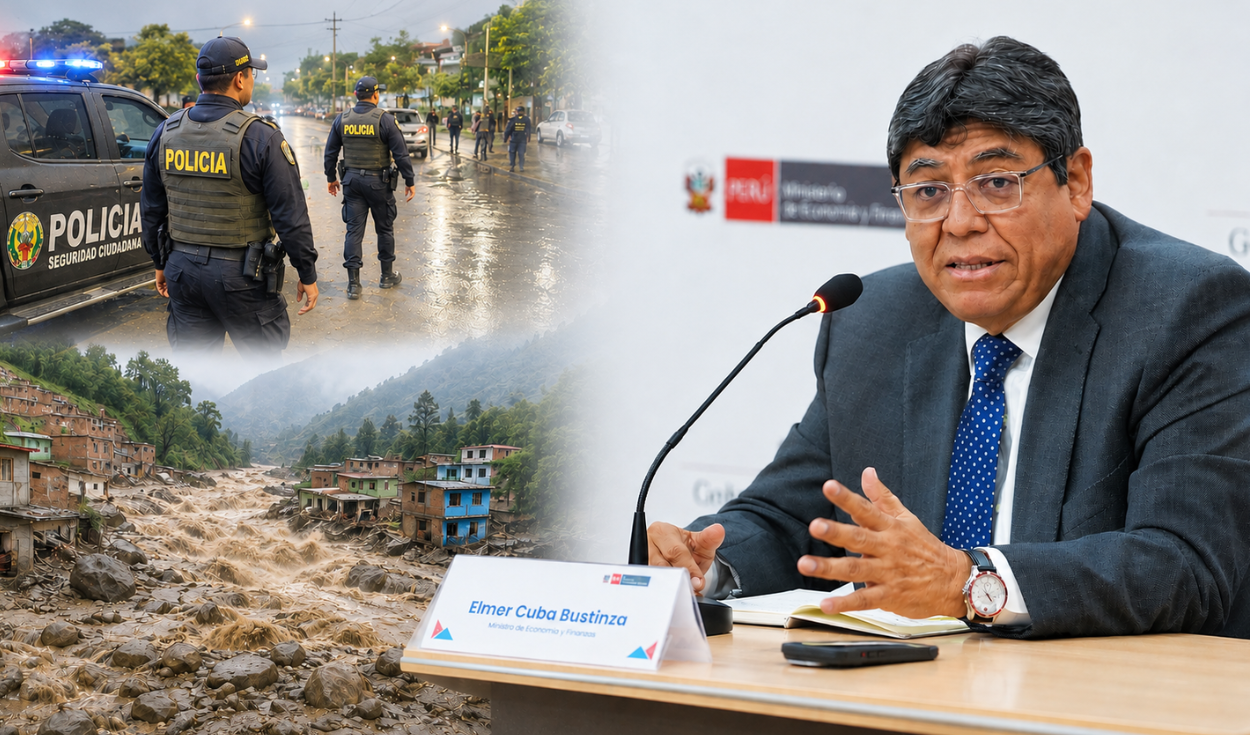
Peru's Ministry of Economy and Finance has begun defining the 2027 public sector budget, which could exceed S/257,000 million soles as government ministries submit competing spending requests ahead of a key end-of-month legislative deadline.
Minister of Economy and Finance Elmer Cuba has been holding evaluation meetings with cabinet ministers and technical teams since August 17 to review requests before the Executive branch submits its formal bill to Congress prior to August 30.
Public safety demands and preventive measures against the El Niño climate phenomenon have emerged as the primary spending pressures for the upcoming fiscal year, alongside funding claims for health, education, and social assistance programs.
Fiscal baseline and mandatory commitments
The final amount for the 2027 budget has not yet been officially presented, as the Ministry of Economy and Finance evaluates revenue projections, economic growth, and state operational costs. Under Law No. 32513, Peru's total public sector budget for 2026 was set at S/257,561 million soles, covering allocations for the national government, regional governments, and local municipalities.
A nominal increase over the 2026 figure does not mean the state will possess equivalent additional funding for new initiatives. A major portion of annual revenue is pre-committed to fixed obligations, including civil service salaries, pensions, intergovernmental transfers, operational goods and services, debt service, and ongoing capital investment projects.
Because these mandatory expenses absorb a significant share of revenue, the effective margin for establishing new spending lines remains restricted. Allocating larger amounts to permanent operational costs further shrinks the discretionary space available for new public infrastructure or social programs.
Public safety and prison expansion funding
Citizen security arrives at the budget negotiations with high resource expectations, following policy commitments by the government of Keiko Fujimori to combat rising crime across the South American nation.
Prime Minister Luis Galarreta presented a package of security proposals to Congress that features the construction of new high-security penitentiary facilities and an expanded operational role for the Armed Forces in specific security duties. The fiscal impact of these proposals will depend on which measures pass legislative review and proceed to execution.
Evaluating requests from the Ministry of the Interior, the Ministry of Justice, and the Ministry of Defense requires factoring in long-term operational consequences. Initial capital investments in prison expansion, police equipment, vehicle acquisitions, and operational technology generate recurring annual costs for maintenance, supplies, and personnel.
Climate prevention and infrastructure protection
Preparing for the El Niño weather phenomenon constitutes the second major fiscal pressure on the national treasury. El Niño is a recurring Pacific Ocean warming pattern that frequently triggers severe rainstorms, flooding, and landslides along Peru's western coast.
Budget requirements involve funding both emergency response capacity and preventive engineering works designed to protect highways, bridges, water treatment plants, agricultural land, and public utilities. Severe weather events can force mid-year budget reallocations to repair unbudgeted structural damage.
Ministry officials have instructed all sectors to incorporate climate risks directly into fiscal planning. Former Economy Minister Rodolfo Acuña noted in July that supplementary credit legislation permitted the government to reallocate nearly S/3,000 million soles toward El Niño mitigation based on emerging fiscal conditions.
While incorporating prevention into the initial 2027 budget proposal allows the state to prepare in advance, it also locks up funds that would otherwise be directed toward new capital projects.
Sectoral demands across cabinet ministries
Funding requests from public safety and climate readiness compete directly with core social and development sectors across the cabinet. The Ministry of Health, the Ministry of Education, and the Ministry of Development and Social Inclusion are actively negotiating their budget shares.
Additional spending claims have been submitted by the Ministry of Transport, the Ministry of Housing, the Ministry of Production, the Ministry of Labor, the Ministry of Environment, the Ministry of Culture, the Ministry of Women, the Ministry of Agriculture, and the Ministry of Energy and Mines.
Because state revenues do not expand at the same pace as agency requests, the Ministry of Economy and Finance must establish a strict hierarchy of expenditure. Any extra allocation granted to law enforcement or prison construction directly reduces the resources available for school renovations, hospital equipment, road building, or social welfare payouts.
Fiscal deficit limits and GDP targets
All sectoral requests remain bound by Peru's strict fiscal rule framework, which mandates a progressive reduction in the public deficit over the coming years.
Fiscal rules mandate that the national deficit must drop to 1.4 percent of Gross Domestic Product in 2027, following a maximum cap of 1.8 percent of GDP in 2026. The fiscal target shrinks further to 1.0 percent of GDP starting in 2028.
Ministry data showed that the annualized fiscal deficit stood at 1.3 percent of GDP as of June 2026. Although this figure fell below the 1.8 percent ceiling allowed for 2026, ministry officials emphasized that the unused fiscal room cannot be automatically transferred into expanded spending for 2027.
The government must align its spending limits with tax collection trends, broader economic growth, and debt servicing obligations. If tax receipts fall short of forecasts, the room for overall spending expansion will narrow further.
Congressional review and next steps
The Ministry of Economy and Finance is completing its technical review to select which ministerial requests have sufficient justification to be included in the executive draft bill.
Once the bill is submitted to Congress before the August 30 deadline, lawmakers will begin debating the Executive's proposed resource distribution. Congressional debates typically introduce additional spending demands from regional governors, municipal mayors, and parliamentary caucuses seeking funding for local public works.
The final budget composition will determine whether any expansion past the S/257,561 million soles baseline will fund new government priorities during its first full year in office, or whether the increment will be absorbed by mandatory payroll, debt service, and emergency reserves.