


Researchers at Meta AI, PSL University, and the Adolphe de Rothschild Hospital Foundation have developed Brain2Qwerty, an artificial intelligence system that converts brain signals into written text without surgical implants. The technology uses external sensors placed outside the skull to decode sentences, providing an alternative to surgical brain computer interfaces such as those developed by Neuralink.
Brain computer interfaces help people who cannot speak, write, or move their limbs to communicate. While high precision systems typically require surgeons to implant electrodes into the brain, researchers demonstrated that noninvasive sensors can decode written characters with relevant accuracy. The system is still far from becoming a commercial medical product.
Decoding Brain Activity into Text
Scientists tested Brain2Qwerty on 35 completely healthy volunteers who had no brain or mobility issues. During the experiment, participants watched sentences appear word by word on a screen, memorized them, and typed them on a standard keyboard. Researchers recorded their neural activity throughout the process using electroencephalography (EEG) and magnetoencephalography (MEG).
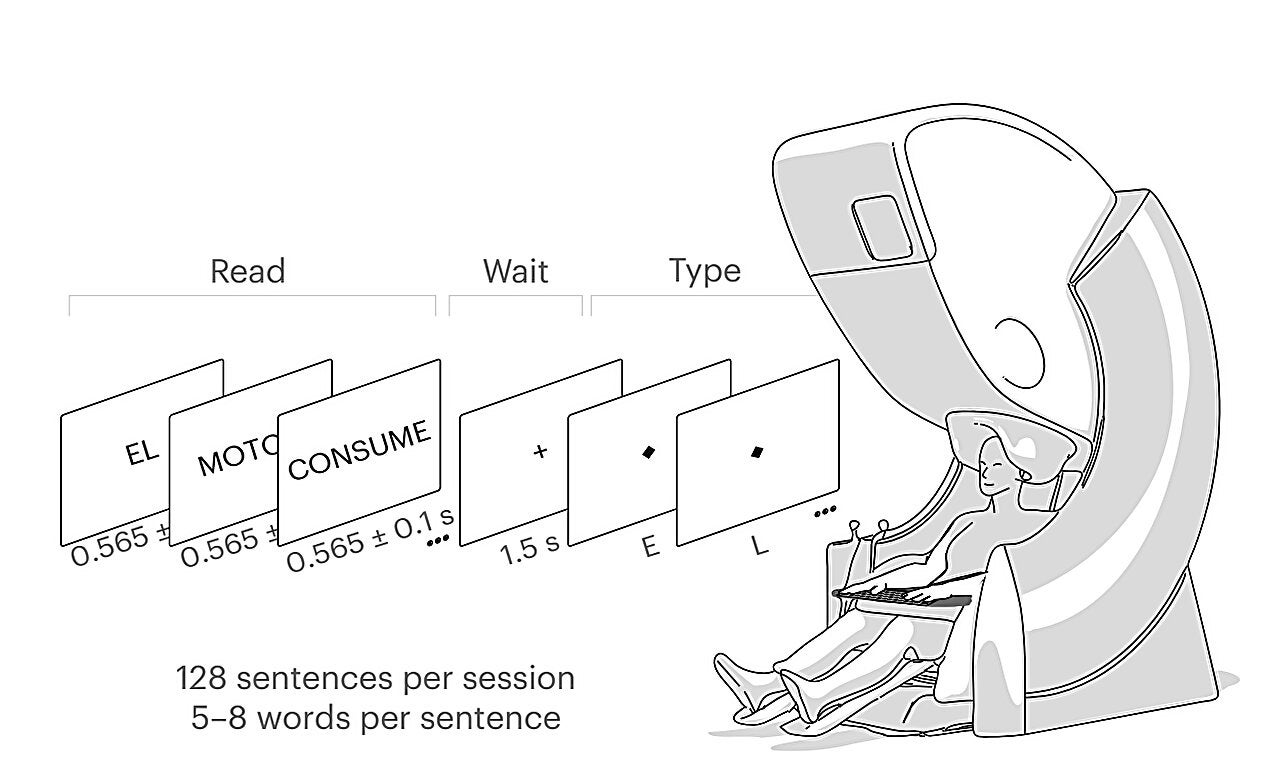
Electroencephalography captures electrical activity through electrodes placed on the scalp. Magnetoencephalography uses highly sensitive sensors to measure small magnetic fields generated by neurons. MEG produces a cleaner signal than EEG, but requires large, expensive equipment that is difficult to transport.
Three-Stage Artificial Intelligence Architecture
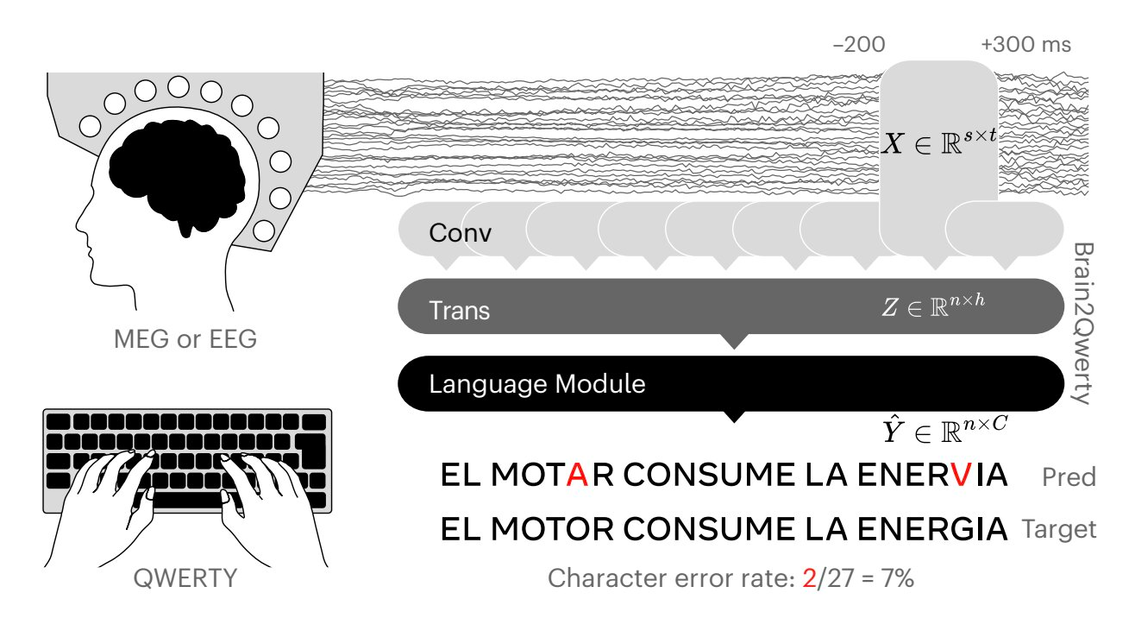
Brain2Qwerty analyzes brain activity measurements through three distinct stages. First, a neural network examines half-second fragments of brain activity. Next, a model based on transformer architecture studies the full sequence to predict written characters. Finally, a language model corrects errors by evaluating which words and phrases make sense.
Magnetoencephalography produced the best results, recording an average character error rate of 29 percent compared to 65 percent for EEG. Among the top performing participants, the error rate dropped to 18 percent. The artificial intelligence system successfully reconstructed some sentences that were not included in its training data.
Scope and Future Clinical Applications
Researchers emphasized that the system cannot read thoughts. Brain2Qwerty only interprets neural activity linked to typing previously memorized sentences. However, it reduces the distance between external sensors and surgical brain implants that are also researched to translate neural signals into digital commands.
The long-term objective is developing safer communication tools for patients with paralysis or other severe motor limitations. Before clinical application, researchers must improve precision, test the technology on people who cannot write, and reduce equipment size. Brain2Qwerty serves as proof that brain activity can transform into text without placing sensors inside the skull.


