Peruvian jurist Marianella Ledesma has criticized the Constitutional Tribunal for ordering the closure of the money laundering case against former President Ollanta Humala, arguing the court acted as a criminal judge and overstepped its authority.
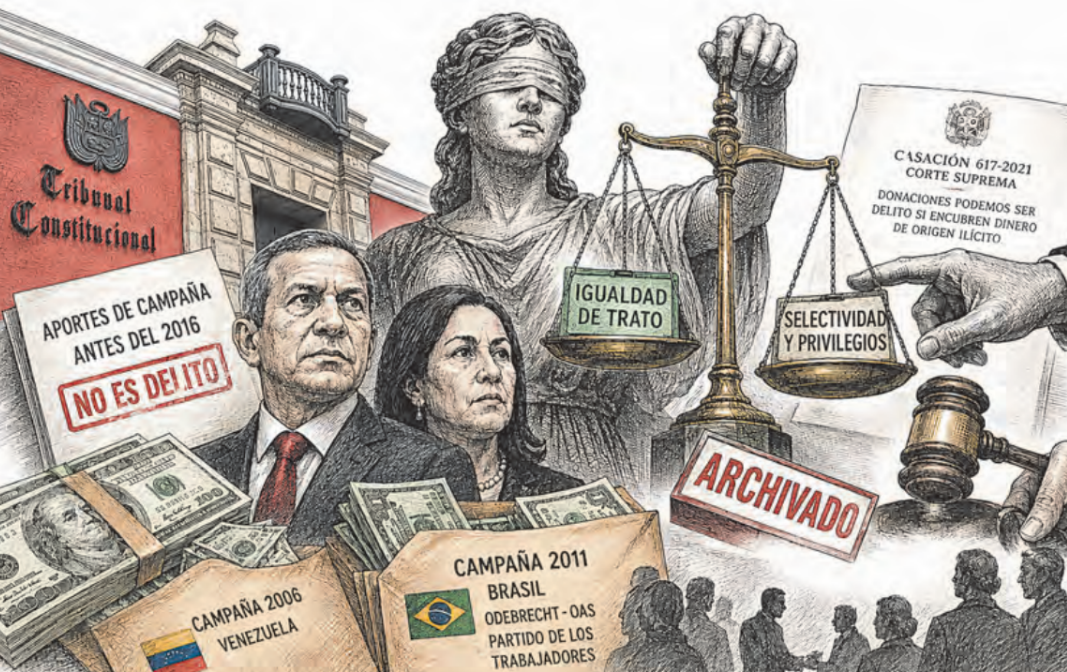
In an opinion piece, Ledesma wrote that the tribunal's 2025 ruling in the case against Keiko Fujimori, tied to the so-called cocteles case, established that campaign contributions received before 2016 do not constitute a crime. She said the tribunal used the Humala case to reinforce that message, since the Humala-Heredia case was the first in which the Supreme Court, through Casación 617-2021, set out the conditions under which campaign contributions can amount to a crime.
According to Ledesma, that Supreme Court ruling held that donations to political parties are not inherently criminal, but become so if they conceal tainted money from prior criminal activity, whether domestic or international. She said this rule guided the judges who handled the Humala-Heredia trial.
Prosecutors' allegations
Ledesma wrote that prosecutors determined the 2006 and 2011 campaigns of Humala and his wife, Nadine Heredia, were financed with money from corruption schemes, in the 2006 case involving the Venezuelan government and in 2011 involving the Brazilian companies OAS and Odebrecht along with Brazil's Workers' Party.
She said the sentencing rulings described funds for the 2006 campaign as presumed illicit, transferred through diplomatic pouches to avoid identifying their origin. Heredia allegedly signed fictitious service contracts with several companies, made prepayments on a mortgage loan using the tainted funds, and bought a vehicle, Ledesma wrote. For the 2011 campaign, she said, simulated cash contributions were used to give the appearance of legality to money that ultimately entered the economy, including funds used to buy a property in the Lima district of Surco.
Ledesma said the judges who convicted Humala and Heredia, in the ruling the Constitutional Tribunal has now annulled, found grounds to presume the 2006 and 2011 campaigns were financed with assets tied to corruption, concluding Humala was responsible for money laundering.
Procedural objections
Ledesma argued the tribunal should only intervene when a final sentence violates a petitioner's rights, but said Humala's case remains under appeal, where such questions should be examined. She noted the tribunal's ruling did not review a final sentence but instead took up a procedural incident known as an exception of the nature of the action, which she said has no direct link to Humala's detention. She said Humala's imprisonment stems from his criminal conviction, not from the procedural exception the tribunal used to take up the case.
Selective treatment
Ledesma accused the tribunal of applying different standards to different litigants. She cited the tribunal's own ruling in case STC 04305-2022-H/TC as an example where it told other litigants it was not the tribunal's role to determine whether conduct constitutes a crime, since that falls to ordinary judges. She said the Fujimori and Humala cases were treated differently.
Ledesma noted the ruling was not unanimous. Two tribunal members, Pacheco and Monteagudo, dissented, she said. She wrote that Monteagudo argued constitutional justice should not reassess actions belonging to ordinary courts within a money laundering investigation and that the tribunal should avoid interfering in pending criminal proceedings.
Ledesma closed her piece by questioning what benefit is exchanged for large, unbanked sums of money funneled into political campaigns, arguing that those who benefit from such contributions will keep trying to avoid that question as long as the current tribunal remains in place.