


Ancient eclipse records kept by Chinese and Babylonian astronomers have allowed NASA scientists to measure how Earth's rotation has changed over thousands of years, according to NASA.
For most of human history, eclipses were read as signs from the gods, omens of war, or warnings tied to the fate of kings. NASA's research shows they were also something else: clocks.
Every eclipse a person recorded centuries ago left a small mark on the history of how the planet moves. When modern astronomers compare where and when an eclipse should have occurred with the place and time someone once wrote down seeing it, they can uncover something no telescope shows directly, which is how Earth rotated in the past.
Why Earth's spin is not constant
Earth does not rotate at a perfectly constant speed. The main long-term cause of the slowdown is tidal friction caused by the Moon, according to NASA. The gravitational pull between Earth and the Moon slowly transfers energy and angular momentum from Earth's rotation into the Moon's orbit.
Over very long timescales, this makes Earth spin increasingly slowly. On a human scale the difference is tiny, but over hundreds or thousands of years, those small changes add up enough to shift considerably where an eclipse's shadow should have appeared.
That shift is what lets ancient astronomers function, without knowing it, as timekeepers. To reconstruct an eclipse's path, scientists calculate the orbital positions of the Moon and Earth and combine them with an assumed rotation speed. The difficulty is that for an eclipse from two or three thousand years ago, they also need to know what time Earth's rotation was actually keeping.
Astronomers call that difference between uniform astronomical time and time based on Earth's rotation "delta T." The further back in time researchers look, the greater the uncertainty. NASA explains that delta T values from before the era of telescopes have been reconstructed specifically from historical observations of eclipses and occultations. In other words, to know how Earth was rotating thousands of years ago, scientists need to read what people who were there wrote down.
Eclipses carved in oracle bones
One striking example comes from China. More than 3,000 years ago, Chinese astronomers recorded eclipses on animal bones and turtle shells used for oracle bone inscriptions. Some described the event with a vivid phrase: "the Sun has been eaten."
Long afterward, those records took on an entirely different value. Astronomers at NASA's Jet Propulsion Laboratory studied eclipses recorded at Anyang, including ones dated to 1226, 1198, 1172, 1163 and 1161 BCE.
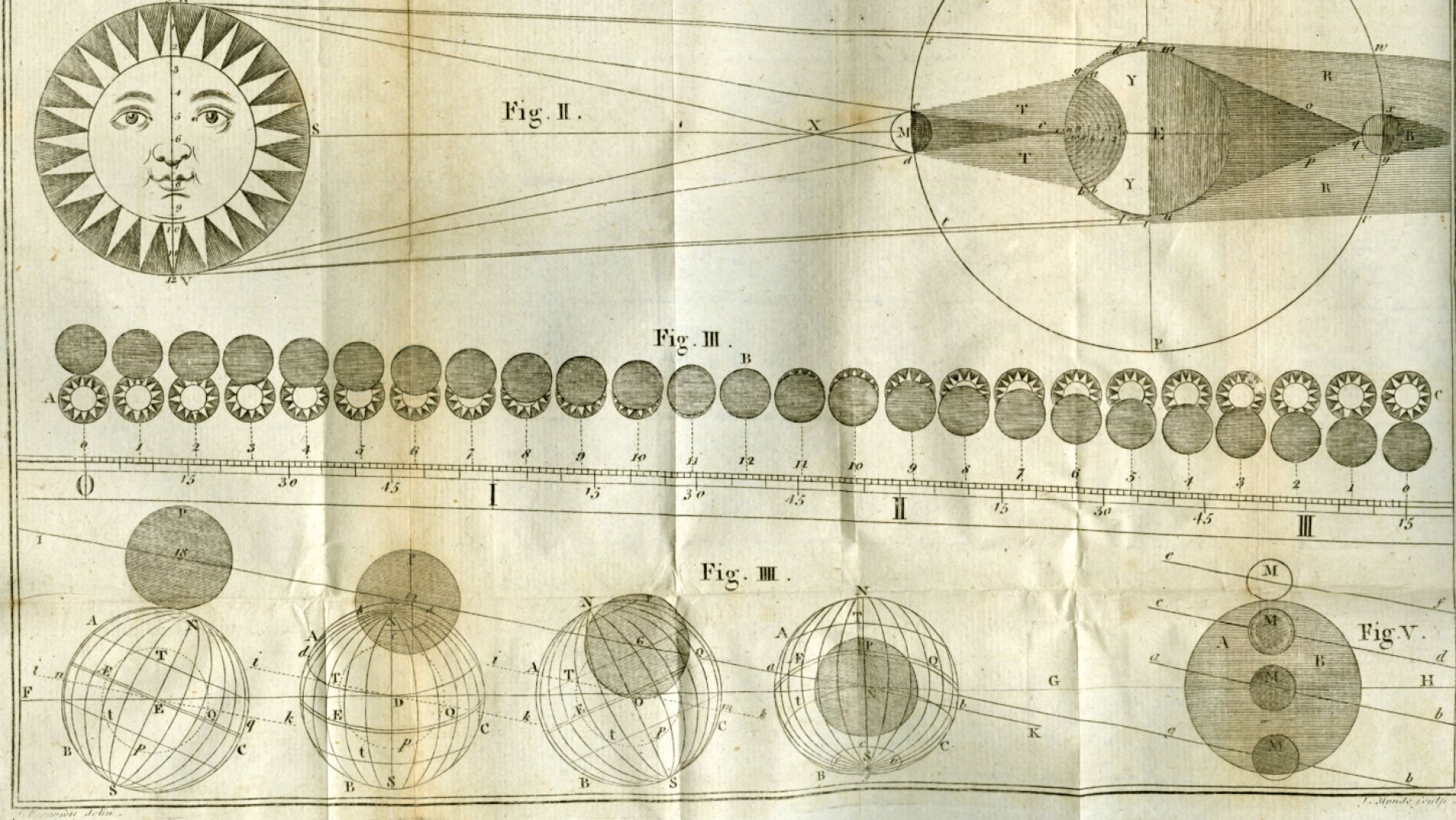
Had Earth been rotating at exactly the same speed it does today, the shadow of those eclipses would have fallen thousands of kilometers from where observers said they saw them. But the eclipses did occur there. The explanation is that Earth was spinning slightly faster back then.
Using these records, scientists were able to estimate how Earth's rotation had changed over the past 3,200 years. NASA calculates that, over that span, the length of a day has increased by roughly 47 thousandths of a second. That sounds insignificant, but multiplied across thousands of years it is enough to move an eclipse's shadow by thousands of kilometers.
Babylonian tablets and the Saros cycle
Before telescopes, modern observatories or mechanical clocks existed, another civilization turned the sky into a vast astronomical archive: the Babylonians. Their tablets recorded the movements of the Sun, the Moon and other celestial bodies for centuries. Over time, those records allowed astronomers to recognize patterns in eclipses and develop methods to predict them.
One of those patterns is known as the Saros cycle, roughly 223 synodic months, or about 18 years and 11 days, after which the geometry of the Sun, Earth and Moon lines up again to produce a similarly structured eclipse.
The Saros cycle does not mean the next eclipse occurs in exactly the same place. The fractional day left over in the cycle means Earth has rotated a bit further by the time it repeats, shifting the shadow's path to another region of the planet. The Babylonians learned to recognize that rhythm long before understanding the physics behind it, and their observations ended up serving a purpose they never imagined: helping to measure Earth's rotation.
History as an astronomical tool
This is the paradox that makes eclipses so valuable. To predict a modern eclipse, scientists use atomic clocks, gravitational models and computer calculations. But to know how that same cosmic clock worked 2,000 or 3,000 years ago, they have to rely on documents written by people who knew none of those things.
A sentence on a clay tablet, a note in a Chinese chronicle, a record kept by a medieval monk astronomer: each observation carries a coordinate in time and place. Comparing it against modern calculations lets astronomers determine how much Earth's actual rotation has drifted from an ideal clock. History becomes a tool for astronomy.
There is another layer to this story. Eclipses do not just help reconstruct the past. They also show that Earth is not an isolated sphere spinning in a perfect vacuum. Its rotation is connected to the Moon, the oceans, the atmosphere and processes occurring inside the planet itself.
Tidal braking is only part of the picture. Earth's rotation also varies over much shorter timescales, driven by atmospheric and oceanic phenomena and internal processes within the planet. Because of this, astronomers cannot simply build a calendar of eclipses and project it backward as if Earth were a perfect mechanical clock. Uncertainty in Earth's rotation is one of the main factors that limits the reconstruction of ancient eclipses.
As the Moon continues moving away from Earth, the precise distance that currently makes eclipses possible will no longer hold. When that happens, humanity will lose not only one of the rare privileges of living on Earth, but also a cosmic clock.


