
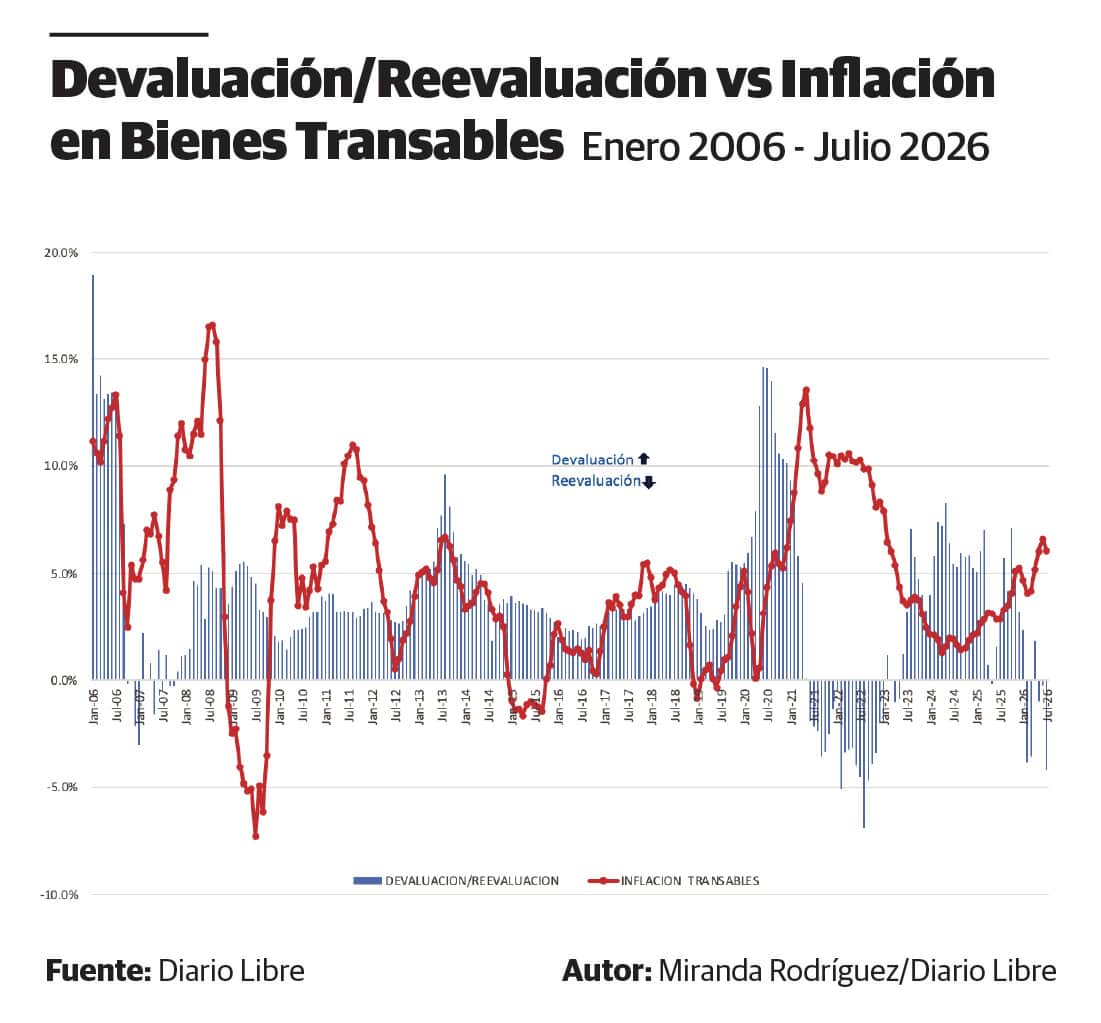
The Dominican peso appreciated 7.4 percent against the US dollar from December 31 to late July 2026, but failed to lower Dominican consumer inflation.
Data released in Santo Domingo showed the exchange rate dropped from 63.30 Dominican pesos per dollar at the end of 2025 to 58.62 pesos by late July 2026. However, annual inflation reached 5.47 percent, pushing price growth above the central bank target range of 4.0 percent plus or minus 1.0 percentage point.
According to economic analyst Ellen Pérez Ducy, senior economist at Intelligent Economics Dominicana and Consultores Actuariales SRL, the 7.4 percent gain represents the sharpest surge recorded for the January-to-July timeframe since 2006. The current rise surpassed previous period gains of 5.4 percent in 2022, which coincided with an earlier global oil shock, and 4.5 percent recorded in 2006.

Import Growth and Foreign Trade
The historical appreciation of the peso boosted national imports during the first half of the year, expanding trade volume as economic theory predicts. Total imports for the first semester grew by 7.8 percent, representing an increase of 1,146.5 million US dollars compared to the January-July 2025 period, when import growth remained flat.
Detailed trade data through March 2026 revealed that the import expansion was concentrated in raw materials and national capital goods. This pattern suggests a broader reactivation of domestic industrial activity across the Caribbean nation, where manufacturing plants rely heavily on imported machinery and production inputs.
Conversely, the stronger currency showed little sign of aiding export sales. Excluding the impact of elevated international gold prices, Dominican exports increased by 4.6 percent or 313.7 million US dollars during the period. This growth rate closely mirrored performance in 2025, when the Dominican peso appreciated by only 0.2 percent, demonstrating that currency strength did not significantly drive merchandise sales abroad.
Rising Prices Across Key Consumer Sectors
Consumer inflation reached 2.21 percent during the first seven months of 2026, while the interannual rate hit 5.47 percent. The figure places inflation above the upper threshold of the monetary policy target range established by the Central Bank of the Dominican Republic, which sets a benchmark of 4.0 percent with an allowable margin of 1.0 percentage point in either direction.
The highest price increases through July 2026 occurred in services and basic consumer necessities. Restaurants and hotels recorded the sharpest rise at 8.1 percent, followed closely by transport at 8.0 percent, food and non-alcoholic beverages at 6.8 percent, education at 6.5 percent, and alcoholic beverages and tobacco at 5.5 percent.
Pérez Ducy highlighted a persistent mystery in the national economy, noting that an exchange rate revaluation that lowers the cost of imported inputs has failed to reduce or stabilize domestic prices. Standard trade models do not fully explain why cheaper foreign currency has not relieved pressure on household budgets.
Evaluating Economic Theories and Market Behavior
Economic theories such as Gita Gopinath's Dominant Currency Paradigm do not account for the phenomenon in the Dominican Republic. Gopinath's framework models trade between two nations using non-dominant currencies, such as the Dominican Republic and Colombia, where dollar-denominated trade contracts remain unchanged during bilateral currency fluctuations against the US dollar.
Because the United States is the primary trading partner of the Dominican Republic, receiving over half of Dominican exports and supplying 41 percent of its imports, dollar exchange rate movements directly influence domestic costs, rendering non-dominant currency theories inapplicable.
Furthermore, price trends between international and domestic goods have defied standard expectations. In 2026, non-tradable goods and services produced and consumed locally registered a 2.3 percent inflation rate, compared to 2.1 percent for tradable items that enter foreign commerce. However, relative to July 2025, tradable inflation stood higher at 6.1 percent versus 4.9 percent for non-tradables.
Historical analysis over two decades reveals that 2026 is only the fourth episode, outside of the COVID-19 pandemic and post-pandemic recovery periods, where exchange rate movements and tradable inflation moved in opposite directions.
Oil Prices and Domestic Market Factors
Global petroleum prices continue to influence tradable inflation in the Dominican economy, which relies on crude oil imports to meet energy and transportation demands. However, data indicates that currency devaluation is not directly tied to tradable inflation despite heavy fuel imports, leaving price increases to be driven by other factors.
Across all consumer categories, only clothing and footwear, which consist almost entirely of imported products, and communications, a local service sector, registered negative inflation in 2026.
Pérez Ducy noted that price hikes in restaurants and hotels are largely driven by spending among affluent consumer segments who are less sensitive to price increases. Transport cost increases warrant further investigation given government subsidies provided to the sector, while sectors such as food, beverages, education, and health, all recording inflation above 5.0 percent with few imported inputs, must account for their own price trends.