

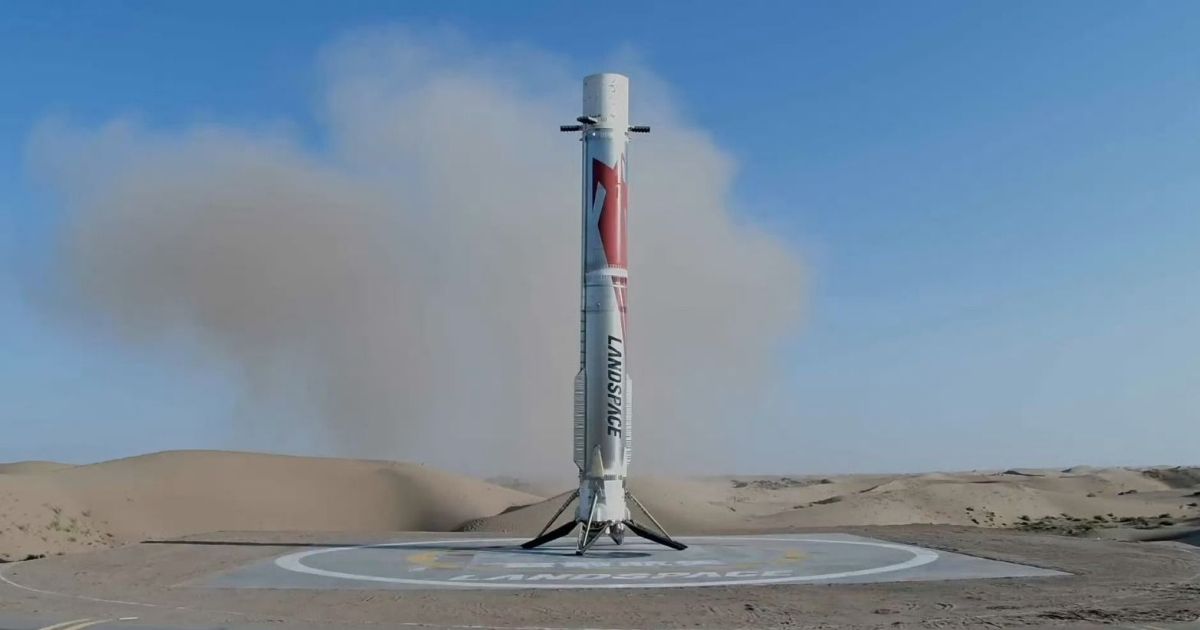
China achieved the first controlled landing of a rocket on land with the launch of the Zhuque-3, in a milestone in its rivalry with the United States over space technology. The launch took place at the Dongfeng Commercial Aerospace Innovation Test Zone on Wednesday, August 19, based on China's time zone.
Footage released the same day shows the rocket lifting off and later landing tail-first on solid ground. The mission marked the first successful controlled landing on land of a rocket's first stage.
The Zhuque-3 belongs to a new generation of launch vehicles designed for low cost, high payload capacity and frequent launches. It runs on liquid oxygen and liquid methane, and the project was approved by the China National Space Administration.
Rocket design and recovery system
The Zhuque-3 has a two-stage, single-core configuration built mainly from stainless steel, with a total length of 66.1 metres. Its first stage is fitted with a return control system, stabilising fins and landing legs, allowing it to be recovered vertically and reused after an orbital launch.
Following the launch, the Central Committee of the Communist Party of China and the State Council said the country would continue promoting reusable launch vehicles, with the aim of improving its space exploration capability at low cost and high frequency.
Space race: United States versus China
The competition over advances in space technology between the United States and China continues. SpaceX's Starship rocket recently completed a mission with a landing at sea after launching from Texas on the 24th, in a test considered crucial to the future plans of Elon Musk's company.
During that test, SpaceX launched its first 20 upgraded Starlink satellites into suborbital space, one of several objectives of the mission, as the company races to begin routine service with the rocket by the end of the year.
The test flight, called Flight 13, lasted about one hour and five minutes and was designed to end with a controlled landing of the upper part of the Starship spacecraft in the Indian Ocean.


