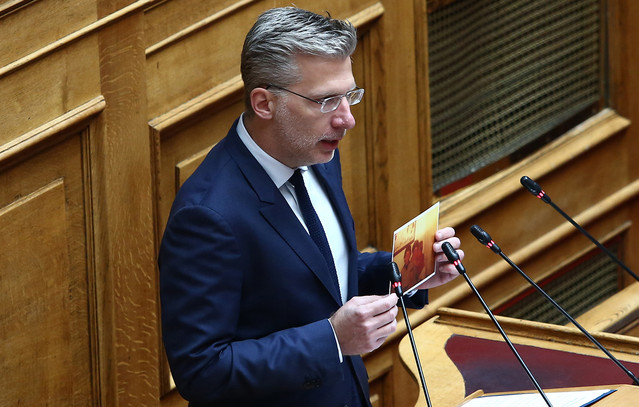
Greek Minister of State Akis Skertsos has rejected opposition claims that Greek purchasing power matches Bulgaria, arguing official statistics are being misinterpreted.
Responding on social media to political criticism, Skertsos said figures showing both countries at 68 percent of the European Union average for gross domestic product per capita in 2025 do not measure actual worker incomes.
He stated that gross domestic product per capita measured in Purchasing Power Standards reflects economic productivity per inhabitant rather than household income or salary purchasing power. According to Skertsos, Eurostat uses distinct metrics when assessing household material well-being and minimum wage purchasing power.
Skertsos serves as Minister of State in the Greek cabinet, a senior ministerial post responsible for coordinating government policy and public messaging. Eurostat, the official statistical office of the European Union based in Luxembourg, provides harmonised economic data across all member states to enable direct comparisons between national economies.
Household consumption and wage metrics
To measure household material well-being, Eurostat tracks Actual Individual Consumption. Skertsos noted that Greece reached 80 percent of the EU average under this indicator in 2025. That figure stands 12 percentage points above the country's GDP per capita ranking and places Greece ahead of six other EU member states.
Actual Individual Consumption measures goods and services consumed by households, including state-funded services like education and healthcare, regardless of who pays for them. Purchasing Power Standards are artificial currency units created by EU statisticians to adjust national economic numbers for regional price differences, allowing comparisons of living standards across countries with different price levels.
Turning to minimum wage purchasing power, Skertsos highlighted Eurostat figures from July 2026. Adjusted for purchasing power, the Greek minimum wage stood at 1,229 units, compared to 993 units in Bulgaria. He pointed out that this gives Greek minimum wage earners roughly 24 percent more purchasing power than their Bulgarian counterparts.
Under the July 2026 purchasing power ranking, Greece ranked 14th out of 22 EU member countries that maintain a national minimum wage, while Bulgaria ranked 20th. In nominal terms, the Greek minimum wage currently stands at approximately 1,073 euros per month on a 12-month basis, whereas the Bulgarian minimum wage is around 620 euros per month, representing a monthly gap of 453 euros.
Cost of living and regional rankings
Skertsos stressed that even after adjusting for local living costs, wages in Greece and Bulgaria are not equivalent. He noted that countries such as Cyprus, Malta, Slovakia, Hungary, and the Czech Republic lie between Greece and Bulgaria in the regional wage purchasing power rankings.
Within the 27-member European Union, 22 nations set a statutory national minimum wage by law, while five nations rely on collective bargaining agreements instead. Differences in nominal wages and local consumer price levels mean that raw wage comparisons often produce contrasting results depending on whether spatial price adjustments are applied.
Skertsos described the opposition argument equating Greece to Bulgaria based solely on matching GDP per capita figures as a statistical oversimplification born of either ignorance or political malice. He asserted that such claims fail under serious economic analysis.
Concluding his statements, Skertsos remarked that gross domestic product per capita is not salary, salary is not consumption, and no single statistical indicator can fully capture the living standards of a society. He added that statistical data should be used to analyze reality rather than to compress facts into a political slogan.