
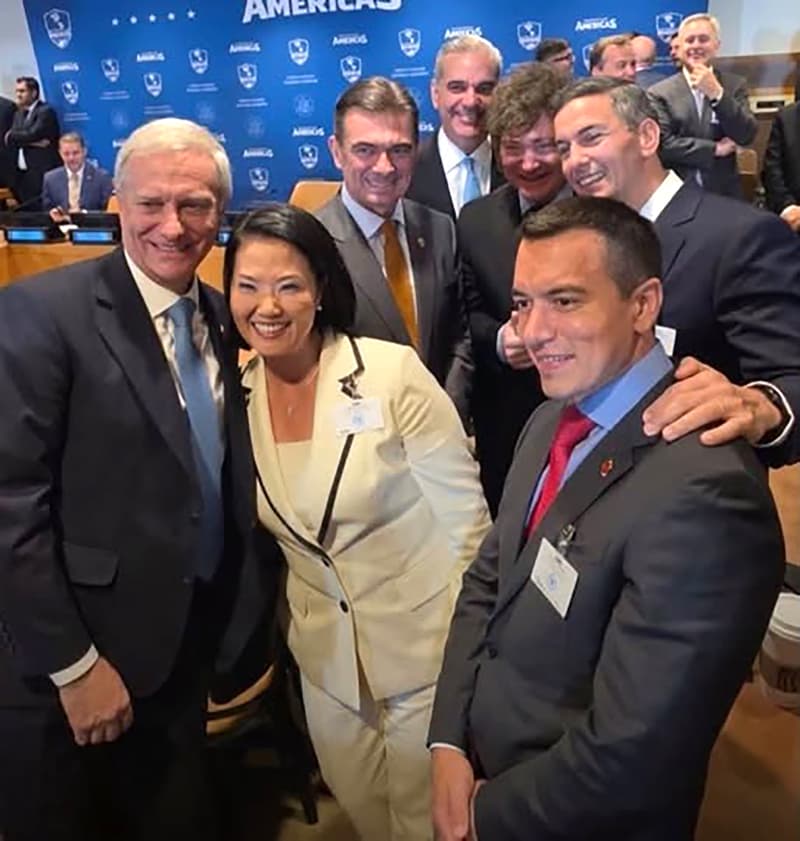
President Keiko Fujimori has declared a war on transnational organized crime during her debut address to the United Nations General Assembly in New York.
The Peruvian leader announced that the Armed Forces will be deployed in support of the National Police to combat drug trafficking, illegal mining, and human trafficking networks across the country.

Fujimori chose the high-level debate at the UN General Assembly to outline her foreign and security policy following her inauguration on July 28. Speaking before gathered heads of state and government, she designated transnational criminal organizations as terrorist groups and declared that her administration will confront them as enemies of the democratic state and of law-abiding citizens.
Keiko Fujimori took office as President of Peru after leading the right-wing Fuerza Popular political party and mounting several previous presidential campaigns. Peru, South America's third-largest country by land area, has faced escalating domestic security concerns linked to illicit mining in the Amazon basin and narcotics smuggling routes operating across the Andes.
During her address, Fujimori also ratified Peru's adherence to the Shield of the Americas initiative. She stated that her government's overarching agenda rests on three primary pillars: combating organized crime, reforming the educational system, and strengthening state institutions.
Strategy against transnational crime
Detailing the nature of the security crisis, Fujimori listed the illegal trade networks sustaining transnational gangs, including drug trafficking, illegal mining, contraband, human trafficking, extortion, and murder. She described transnational organized crime as a military threat that Latin American nations have previously fought in isolation with insufficient results.
She observed that in this conflict there are no traditional battle lines or defined borders, nor international rules, noting that the enemy wears no uniform and hides among ordinary citizens. She argued that treating criminal networks as separate national problems grants an advantage to transnational groups, allowing them to accumulate immense economic and military power.
To address the threat, Fujimori proposed a dual-track strategy combining legal reform with security enforcement. She explained that explicitly defining criminal cartels as terrorist organizations provides the legal basis for the Armed Forces to act decisively alongside the National Police when internal order is threatened.
In Peru, domestic law enforcement is managed by the National Police of Peru, while the Armed Forces operate under the Ministry of Defense. Under Peruvian constitutional law, military deployment for internal security requires executive authorization and explicit declarations regarding threats to national order.
Fujimori asserted that Peruvian authorities will pursue crime from the individual executing the offense to the broader network supporting the operation. She emphasized that her government will not back down against groups attempting to impose terror over the law.
Educational reform and classroom order
Turning to social policy, Fujimori maintained that law enforcement repression alone is insufficient unless accompanied by improvements to the educational system. She presented the framework of her educational reform program, which focuses on strengthening school infrastructure, expanding teacher training, and establishing a dedicated academy for school directors to restore order and discipline in classrooms.
The president expressed firm rejection of external ideological and cultural agendas that she stated have created deep divisions among the Peruvian population. She argued that a cultural agenda alien to Peru's reality has caused widespread confusion and disorder, leaving schoolteachers unable to enforce discipline for fear of facing legal complaints.
Peru's public education system, overseen by the Ministry of Education in Lima, serves millions of primary and secondary students across the country's 25 administrative regions. Educational policy has long been a focal point of debate between conservative leaders and educational reform groups in Peru.
Fujimori stated that the principle of respect for security must be restored in schools so that students can learn and teachers can teach without fear, identifying this objective as her government's explicit educational agenda.
Historical precedent and political context
In her speech, Fujimori incorporated historical references to the Inca Empire as a symbol of regional unity across South America. She declared that Peru knows the high price of peace, recalling that the nation previously defeated internal terrorism.
She added that 34 years after that victory, individuals who participated in counter-terrorism missions continue to face judicial trials despite evidence that due process was violated during legal proceedings.
The reference addresses Peru's internal conflict during the late 20th century against insurgent groups such as the Shining Path. The annual United Nations General Assembly high-level debate in New York offers world leaders a platform to present national priorities and diplomatic strategies to the international community.
Domestically, Fujimori's address comes amid a challenging political landscape following Peru's 2026 regional elections, in which Fuerza Popular did not win regional governorships. Fourteen of Peru's 25 regions are expected to proceed to a second-round vote in November to determine their regional leaders.