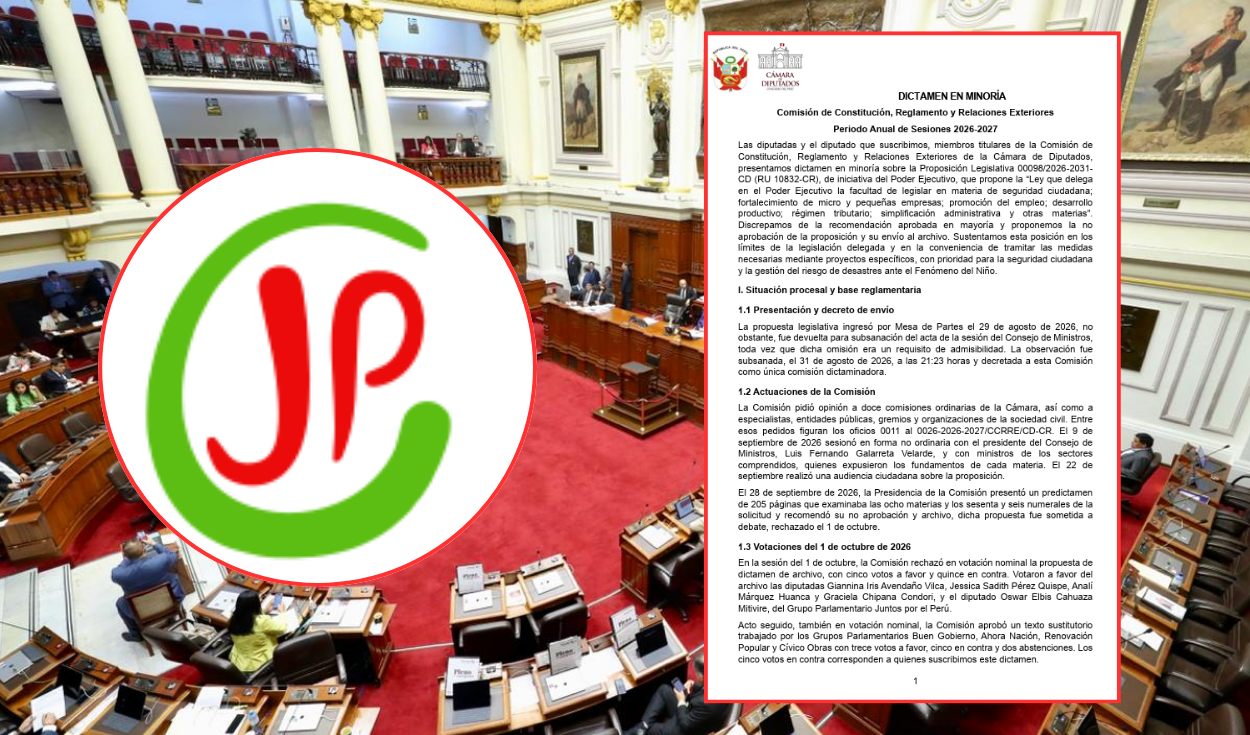
Peruvian legislative caucus Juntos por el Peru filed a minority report on Monday proposing to reject and archive executive requests for delegated legislative powers.
The parliamentary group warned that Legislative Proposal 00098/2026-2031-CD lacks precise boundaries and threatens environmental protection standards alongside the land and consultation rights of indigenous communities.
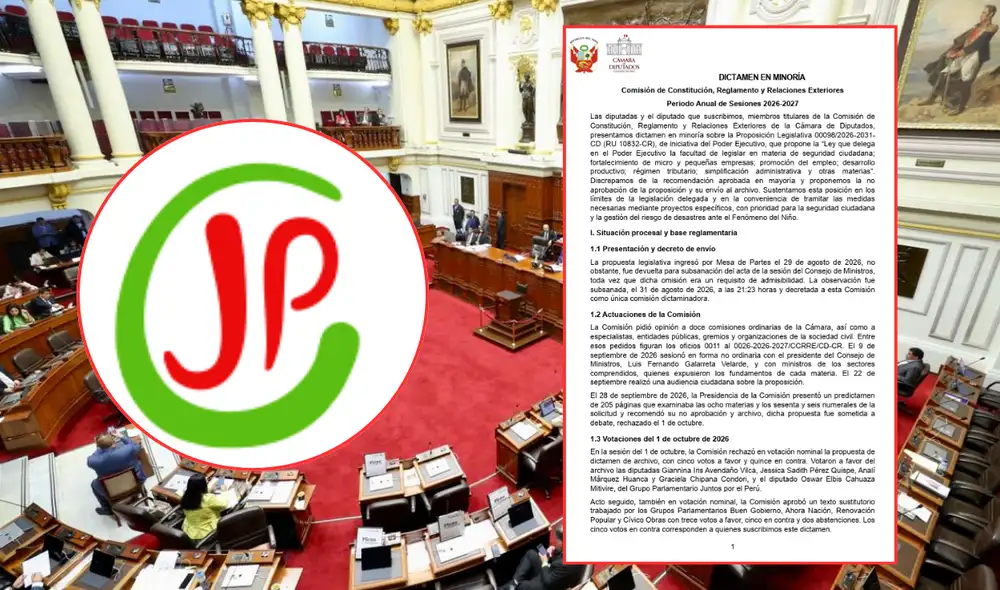
The minority report marks a direct challenge to the Executive Branch request for temporary lawmaking authority. Under the Peruvian Constitution, the national government can request delegated powers from Congress to pass legislative decrees on specific technical matters for a fixed period. However, Juntos por el Peru argued that the scope of the current request is overly broad and fails to state how proposed administrative changes align with existing statutory frameworks.
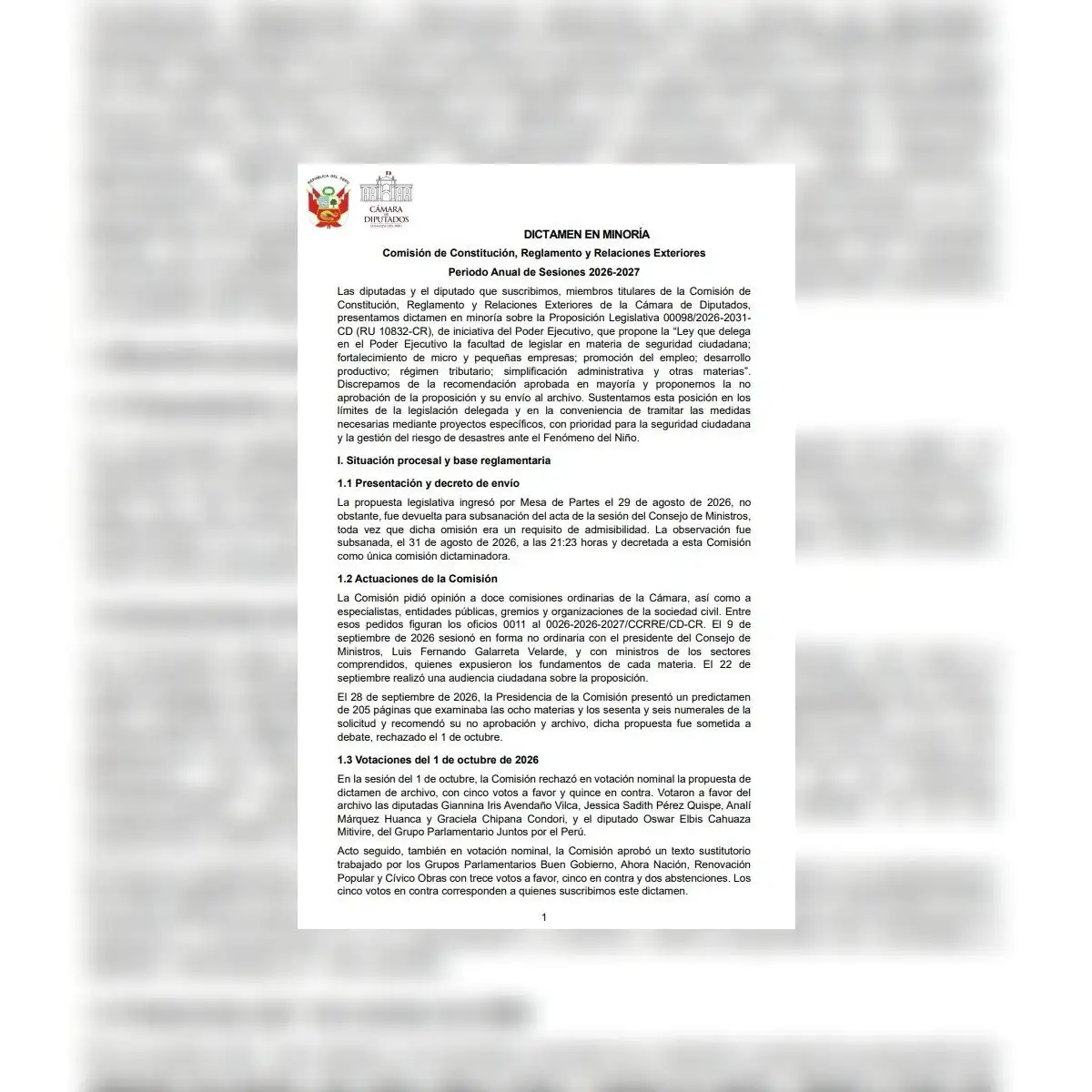
In the official document submitted on October 5, the signing lawmakers stated that they disagree with the majority recommendation approved in committee. They formally proposed that the full chamber reject the initiative entirely and send the file to the parliamentary archives.
Committee Vote Split and Alternative Dictamen
The presentation of the minority report follows a pivotal vote held on October 1 within the Constitution Commission of Congress. During that session, committee members voted thirteen to five, with two abstentions, to approve a substitute text endorsing the delegation of powers.
The approved substitute text was drafted jointly by four parliamentary blocs: Buen Gobierno, Ahora Nacion, Renovacion Popular, and Civico Obras. All five votes against the majority text were cast by the members of Juntos por el Peru who authored the dissenting report.
At the same time, the conservative Fuerza Popular caucus presented its own separate minority report regarding the delegation request. Rather than rejecting the executive request, Fuerza Popular proposed expanding the timeframe of delegated authority from 90 days to 120 days while adding new provisions covering economic and labor policy.
Juntos por el Peru is a left wing political coalition in Peru, while Fuerza Popular is a conservative party. The contrasting minority reports highlight ideological divisions within the Peruvian legislature over the extent of executive power and regulatory oversight.
Environmental Safeguards and Indigenous Prior Consultation
A central pillar of the objection raised by Juntos por el Peru centers on potential legal loopholes affecting environmental oversight and public participation. The caucus asserted that executive proposals regarding digitalization, public contracting, and the accelerated execution of infrastructure projects lack clear links to national environmental laws.
Specifically, the lawmakers emphasized that any administrative simplification must remain subordinate to the National Environmental Impact Assessment System established under Law 27446. The report stressed that where an infrastructure project or administrative procedure requires environmental certification, legal streamlining cannot be interpreted as an implicit exemption from environmental standards.
The report also highlighted mandatory protections for indigenous and native peoples under Peruvian Law 29785 and International Labour Organization Convention 169. Both legal instruments mandate prior consultation with indigenous groups regarding legislative or administrative measures that directly affect their collective rights.
Lawmakers argued in the document that neither an authorizing delegation law nor subsequent executive decrees can be legally employed to bypass prior consultation requirements whenever statutory conditions for consultation are met. ILO Convention 169 is a binding international treaty ratified by Peru, while Law 29785 establishes the domestic legal procedure for binding consults with native communities.
Arguments for Independent Legislation and Legislative Oversight
Beyond regulatory concerns, Juntos por el Peru contested the government claim that national emergencies require emergency decree powers. The caucus maintained that existing statutory mechanisms provide sufficient authority for state action, while Congress possesses procedures to process urgent government bills without granting sweeping legislative delegation.
The minority report stressed that Legislative Proposal 00098/2026-2031-CD requests generic authorizations across multiple government sectors without defining how those powers relate to or submit to current statutes. The legislators insisted that Congress must maintain its constitutional oversight role rather than transferring broad decision making to executive ministers.
Instead of blanket delegation, the caucus recommended debating priority national issues through separate, standalone bills. Lawmakers urged parliament to focus legislative debate on individual projects targeting citizen security and disaster risk management, ensuring transparent public scrutiny for each measure.
Deputy Zunini Warns Against Blank Check for Executive
Deputy Ernesto Zunini expanded on the caucus position, criticizing the Executive Branch for requesting 66 distinct delegated powers without demonstrating the exceptional circumstances required by law. Zunini stated that the government intends to push through major structural changes in taxation, labor relations, environmental regulation, and the hydrocarbons sector without standard parliamentary debate.
According to Zunini, bypassing legislative scrutiny undermines the balance of powers and deprives citizens of representation in the Chamber of Deputies. He stressed that lawmakers cannot sign what he described as a blank check for the executive branch, warning that unchecked administrative decrees carry a severe risk to democratic institutions and could trigger widespread social unrest.
Zunini also revealed an ongoing jurisdictional question between the two houses of parliament. More than ten days ago, lawmakers formally asked the Senate for an official ruling to define the constitutional boundaries between the Chamber of Deputies and the Senate regarding the modification of committee reports.
The Peruvian Congress operates as a bicameral legislature comprising the Chamber of Deputies and the Senate. Zunini confirmed that Juntos por el Peru is awaiting a clear procedural response from the Senate before taking final votes on the executive delegation request.