


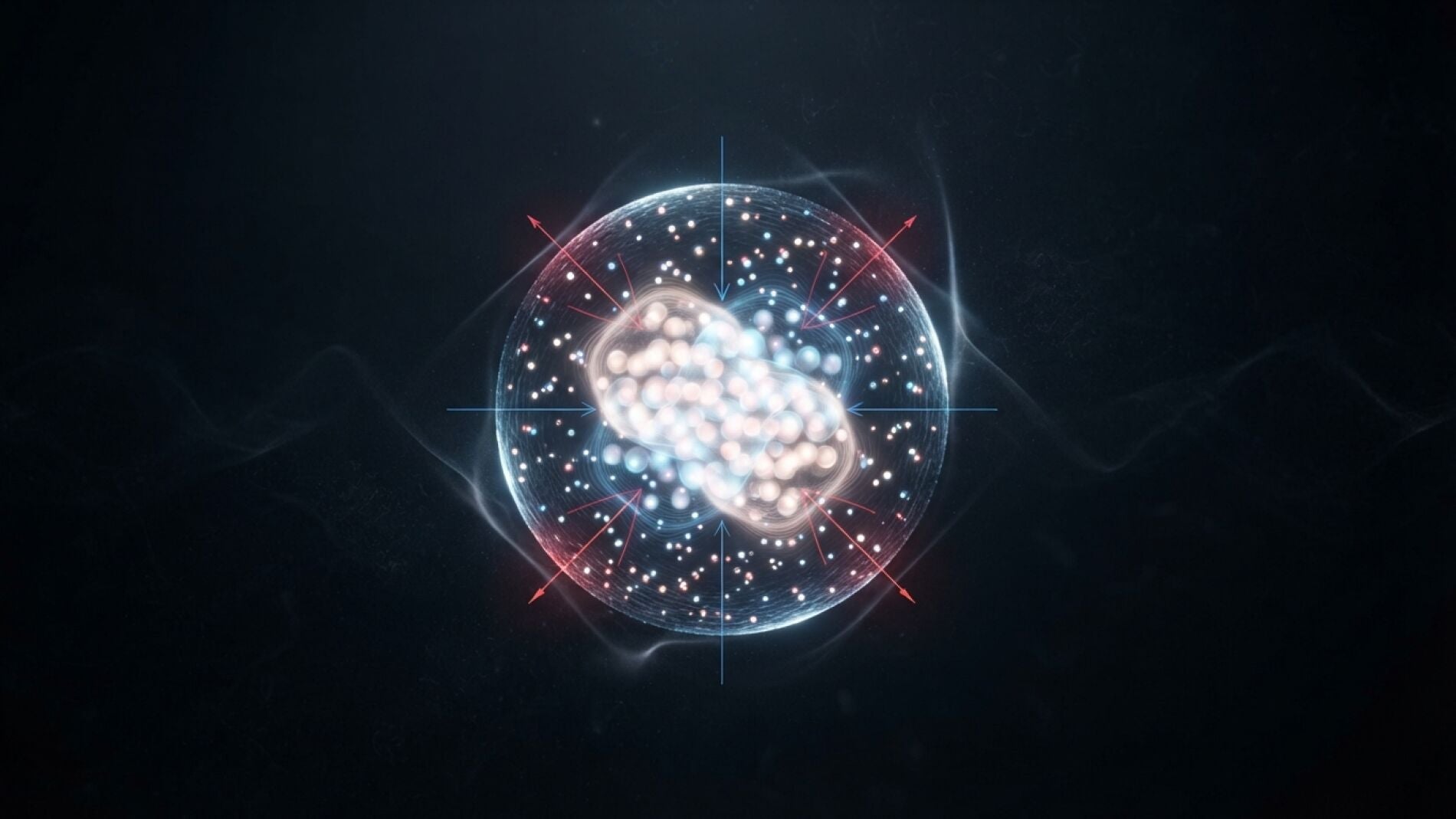
Physicists led by Sam Foster at Monash University have predicted a new state of matter in which ultra-cold bosons and fermions form tiny, self-bound quantum droplets.
The study, published in Physical Review Letters, shows that these quantum droplets emerge when strong attraction between the two particle families is balanced by Fermi pressure.
Researchers compared the phenomenon to mixing water and oil, but occurring at a subatomic scale governed by quantum mechanics.
Bosons and fermions are the two fundamental families of subatomic particles, each operating under radically different rules of physics. Bosons, named after Indian physicist Satyendra Nath Bose, can occupy the exact same quantum state simultaneously, allowing ultra-cold boson gases to merge into a single quantum entity known as a Bose-Einstein condensate.
In contrast, fermions, which include electrons, protons, and neutrons, obey the Pauli exclusion principle, named after Austrian physicist Wolfgang Pauli. This rule prevents identical fermions from occupying the same quantum state, creating an outward pressure known as Fermi pressure whenever the gas is compressed.
Balancing quantum forces
In the system analyzed by the research team, droplet formation relies on a delicate competition between particle attraction and repulsion. When the attraction between bosons and fermions reaches a resonant regime, the particles pull tightly together.
At the same time, Fermi pressure prevents the fermions from accumulating indefinitely in the same spatial area. When these opposing forces reach equilibrium, calculations demonstrate that a stable structure forms in the shape of a self-bound quantum droplet.
The mathematical framework developed by the team overcomes a longstanding limitation in quantum modeling. Foster explained that previous theoretical models could only describe systems where particles interacted weakly with one another.
He noted that the new approach allowed researchers to investigate what happens when interactions become far more intense, which is where the most interesting physical phenomena take place.
The calculations also revealed that the system does not have a single fixed configuration. Changing the ratio and density of the particles alters how the system behaves, and increasing the density of fermions can destabilize the droplet, triggering a phase separation where a mixture of bosons and fermions splits from an excess of fermions.
Testing in the laboratory
Researchers also observed behavior resembling a critical point between liquid and gas phases. The study noted that the conditions needed to produce the droplets could be achieved using ultra-cold gas mixtures already available in laboratories, provided the masses of the bosons and fermions are sufficiently close.
Because existing experimental setups can reach these conditions, scientists will be able to test the theoretical prediction without building completely new technology.
If experimentalists successfully create the droplets, researchers will be able to observe their properties directly and measure how they change under varying interaction strengths. Understanding how matter organizes under extreme quantum conditions could provide new methods for controlling quantum systems, offering insights for quantum sensors and quantum computing.
For now, the quantum droplets exist only on paper rather than in a physical laboratory. Foster emphasized that while water and oil separate in everyday life, quantum mechanics offers potential pathways to keep contrasting particle families together in a stable balance.


