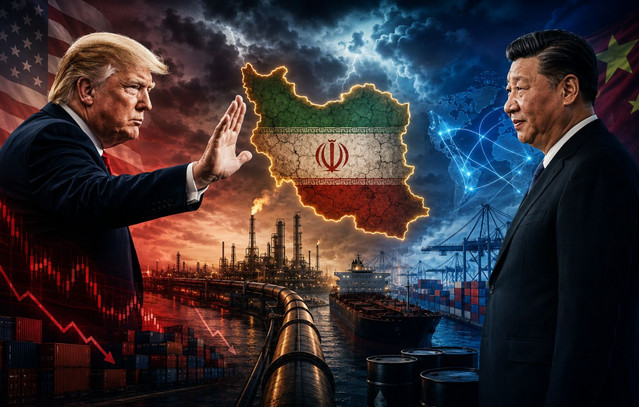
The United States has launched a sweeping new economic pressure campaign against Iran, targeting more than 60 companies, individuals and ships, but has so far stopped short of confronting the one country that could undercut the entire effort: China.
US Treasury Secretary Scott Bessent presented the campaign as "Operation Economic Outcast," describing it as an attempt to cut off every remaining economic lifeline keeping Iran's economy running. The sanctions named companies in China and Hong Kong, along with networks accused of helping Tehran sell oil, move money and evade existing restrictions.
What matters most, however, is who was left off the list. The Wall Street Journal noted that Washington unveiled a campaign meant to strike every economic route sustaining Iran, yet avoided directly targeting the country that has done more than any other to help Tehran withstand years of American sanctions, namely China, and in particular its largest banks and companies.
The Atlantic Council reached a similar conclusion, saying that a truly crushing blow to Iran's economy would likely require imposing significant costs on major Chinese companies and financial institutions, something that has not yet happened. Asked why the first round of measures was not more aggressive, Bessent said he did not want to trigger turmoil in the global financial system, a comment that appears to lay bare Washington's dilemma: it holds the weapon but has not decided whether to use it.
Why China matters to Iran
The relationship is not abstract. It runs on oil, money and payment networks. China is Iran's largest oil buyer and top trading partner. Before a sharp recent drop, Chinese imports of Iranian crude ran at roughly 1.4 to 1.5 million barrels a day, according to various estimates cited by international media.
Those flows have since narrowed considerably. Data from Kpler cited by the Guardian shows volumes bound for China falling from about 1.57 million barrels a day in February to around 534,000 barrels a day in August, a sign that American pressure is already causing pain, even if the artery itself remains open.
Teapot refineries and disguised oil
Iranian oil has for years found its way into the Chinese market through a complex system of independent refineries, tankers, intermediary firms and payments that do not necessarily rely on the dollar.
Smaller independent Chinese refineries, known as "teapots," play a critical role. Unlike China's large state-owned energy groups, which have far greater exposure to the international banking system and more to lose from US sanctions, many of these independent refiners have limited contact with the West and greater willingness to take on the risk of buying cheap Iranian crude.
Iranian oil has reached China labelled as originating from other countries, with transactions conducted in Chinese currency through chains of intermediaries that make it difficult to trace the true origin of the oil or the path of the money. The Atlantic Council describes the resulting pattern as a game of whack-a-mole: sanctions hit one mechanism, and the activity simply shifts to another.
The real weapon: Chinese banks
This is where US strategy could shift into a different gear. Washington can impose secondary sanctions on foreign companies and banks that do business with Iran, effectively forcing them to choose between Iran and access to the American financial system.
For a small Chinese firm with little US exposure, that choice may be manageable. For a major Chinese bank, the stakes are entirely different. The Washington Post noted that a genuine economic blockade of Iran from Chinese support would require extensive sanctions on Chinese banks and refineries, along with a far larger operation against the network of companies, ships and intermediaries operating between Asia and the Middle East. So far, the US Treasury has warned major Chinese banks about the risk of secondary sanctions without taking the decisive step of cutting them off, a limit that may be the most significant constraint on Trump's strategy.
How Beijing could respond
China's response has already begun at the rhetorical level. Beijing described the unilateral US sanctions as illegal and said it would do whatever necessary to protect its rights and interests.
More significant than what China says is what it could do. Analysts who spoke to the Washington Post pointed to export restrictions, sanctions against US companies, and restrictions or suspensions on purchases of American agricultural products as possible retaliatory tools. The Atlantic Council added another highly sensitive area: critical minerals, noting that China has already shown it can use its control over key raw materials as a bargaining weapon. A US strike on a major Chinese bank could therefore trigger retaliation in a sector critical to American technology, industry and defence, turning an operation aimed at punishing Tehran into a new US-China trade war.
Xi Jinping's political card
The timing adds another layer of sensitivity. Washington and Beijing are currently trying to preserve a fragile economic truce while preparations continue for a meeting between Donald Trump and Chinese President Xi Jinping.
Wendy Cutler, a former senior US trade negotiator, told the Washington Post that if Washington pushes too hard, it cannot be ruled out that China could threaten to postpone or cancel Xi's visit to the United States. That makes Iran part of a much larger chessboard: Trump is negotiating not only with Tehran but simultaneously with Beijing over trade, tariffs, critical minerals and a broader economic relationship on which two of the world's largest economies depend.
Can China save Iran?
Not without limits. Iran is already under enormous economic pressure, its oil exports to China have fallen sharply, and Beijing has no interest in sacrificing its entire economic relationship with the United States just to protect Tehran.
That does not mean China would easily accept an American demand to sever ties with Iran. Beijing has cheap oil to gain, geopolitical influence to preserve, and a further incentive to weaken the reach of US sanctions and the dollar in global trade. The Atlantic Council warns of exactly this risk: excessive pressure could push even more transactions into non-dollar channels that sit beyond Washington's direct reach.
The Financial Times describes this weakness as the "China problem" of America's economic war on Iran: US pressure can only become truly suffocating if Chinese support is sharply curtailed, but forcing Beijing's hand risks setting off far wider economic and diplomatic consequences. The Wall Street Journal frames the same dilemma from another angle, noting that the US has declared it is targeting every lifeline available to Tehran, but has so far avoided the largest one. Sanctioning a small intermediary, a ship or an independent refinery is one thing. Telling one of the largest banks in the world's second-largest economy that it must choose between the United States and Iran is another. If Trump reaches that point, Operation Economic Outcast would stop being simply a campaign to strangle Iran's economy and become a test of strength between the United States and China.