


A total solar eclipse will plunge Spain into darkness on August 12 at approximately 8:30 p.m., as the lunar shadow travels across the Iberian Peninsula from the Galician coast to Castellon.
Skywatchers positioning themselves along the path of totality must secure an unobstructed view of the western horizon, where the Sun will be setting during the phenomenon. Ignacio Crespo reported for Spanish news outlet La Razon that because the event occurs low in the sky, elevated terrain such as hills or mountains could block the view of the Sun.
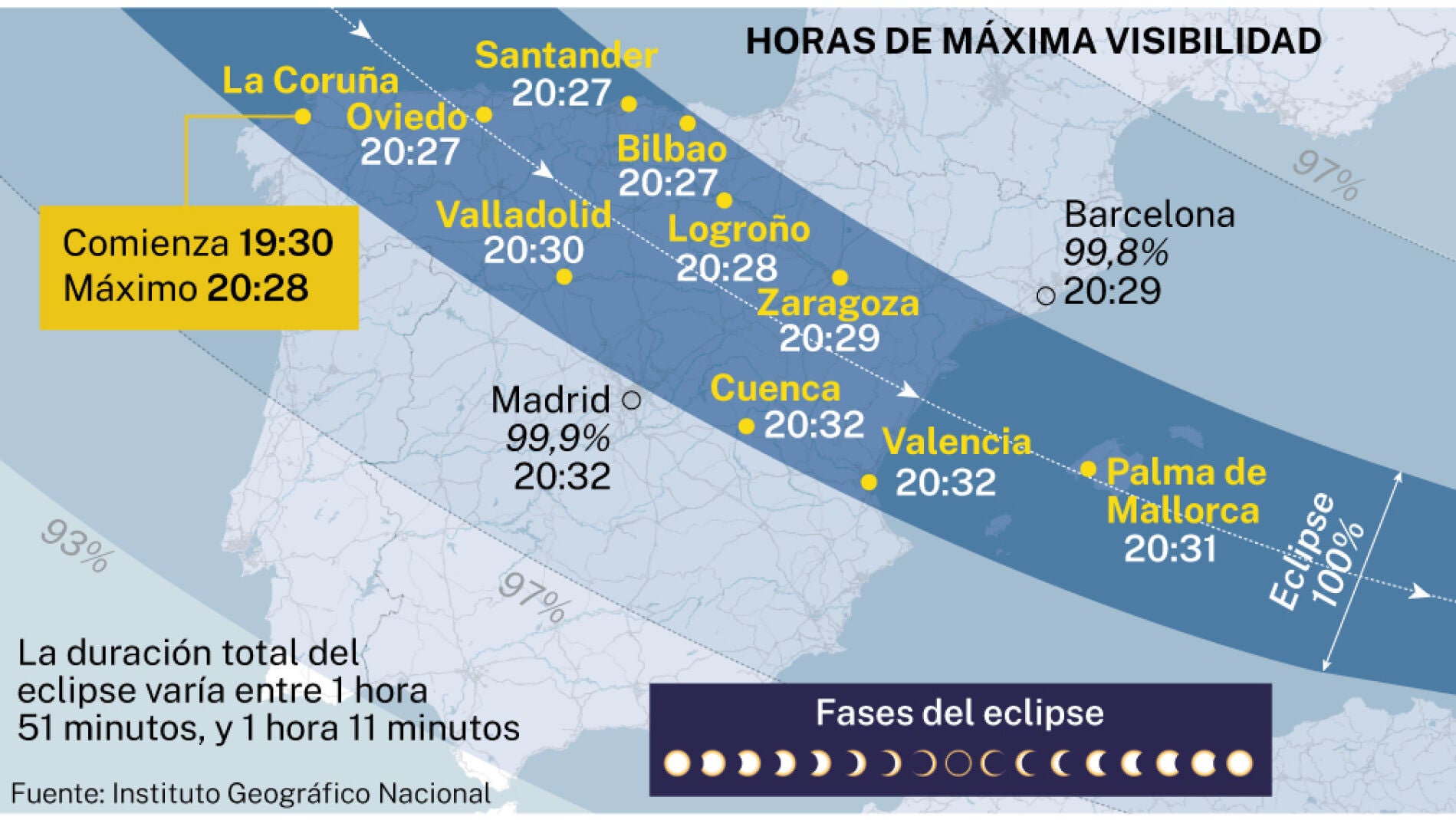
Crespo noted that while spectators often focus solely on the brief period of complete darkness, the astronomical event features a sequence of distinctive optical, environmental, and animal phenomena beginning a full hour before totality.
A total solar eclipse occurs when the Moon passes directly between Earth and the Sun, temporarily blocking solar radiation from reaching the surface. The path of totality across Spain stretches from Galicia, an autonomous community in northwestern Spain on the Atlantic Ocean, to Castellon, a province in the eastern Valencian Community along the Mediterranean coast.
Initial partial eclipse phase
The event begins between 7:30 p.m. and 7:40 p.m. local time, when the edge of the Moon first intersects the solar disc. During the initial minutes of partial eclipse, the gradual reduction in sunlight remains difficult to detect with the naked eye.
Observers wearing protective eclipse glasses will see a small notch form on the edge of the Sun, expanding gradually as the Moon advances across the solar disc.
If the Sun displays active surface conditions during the event, dark regions known as sunspots will be visible on the photosphere. Crespo noted that sunspots serve as precise visual reference points for tracking the progress of the Moon.
Under exceptional conditions, skywatchers using binoculars fitted with certified solar filters may also spot the International Space Station transiting across the face of the Sun. The passage of the crewed orbital laboratory lasts barely one second.
Changing light and environmental effects
Between 8:15 p.m. and 8:25 p.m., the reduction in sunlight becomes clearly noticeable. Daylight takes on a metallic, cold appearance as illumination drops across the landscape.
Because daylight originates from a progressively narrower solar disc, shadows cast on the ground develop sharp, highly defined edges. Ground radiation decreases simultaneously, causing ambient temperatures to drop by four to five degrees Celsius over the hour preceding totality.
The uneven cooling of the Earth's surface can also trigger subtle shifts in local wind patterns and air circulation during this period.
Crespo recommended looking beneath small-leafed trees during this phase. Gaps between leaves act as natural pinhole cameras, projecting dozens or hundreds of miniature eclipsed solar crescents onto the ground.
Animals also react to the premature darkness. Birds reduce their flight activity and return to tree branches as if night were approaching, while crickets and other nocturnal insects begin singing in response to the fading light.
Final minute before totality
Darkness intensifies rapidly between 8:29 p.m. and 8:30 p.m. as the eclipse approaches its climax. The surrounding horizon adopts the appearance of a 360-degree twilight ring, created by sunlight illuminating regions beyond the boundaries of the lunar shadow.
Shadows on the ground lose their sharp contrast and begin to blur. On flat, light-colored terrain under clear atmospheric conditions, skywatchers may observe shadow bands, which appear as thin, dark undulations sliding quickly across the surface.
Seconds before totality, the smooth arc of the solar edge breaks apart as sunlight filters through valleys on the lunar surface. This forms Baily's Beads, a series of bright points of light around the silhouette of the Moon.
As the remaining light narrows to a single point, the Diamond Ring effect appears briefly around the Moon's edge. This is immediately followed by a short glimpse of the solar chromosphere, a thin layer of the solar atmosphere displaying an intense pink coloration.
Total eclipse and solar features
Totality begins at approximately 8:30 p.m. once the pink chromosphere fades completely. Spectators can safely remove their protective eclipse glasses only during this complete phase to view the event with the naked eye.
With the photosphere covered, the solar corona becomes visible as a white halo extending delicate filaments several solar diameters into space along magnetic field lines. Enormous plasma arches, known as solar prominences, may also be seen projecting from the solar surface along the Moon's edge.
The sky darkens to near-nighttime conditions during totality. If atmospheric conditions are clear, bright planets and prominent stars become visible to the naked eye alongside the obscured Sun.
End of totality and local timing
Totality concludes between 8:31 p.m. and 8:32 p.m. as the Moon continues its orbital motion across the sky. The pink chromosphere reappears, followed by the Diamond Ring and Baily's Beads, signalling that protective eclipse glasses must be put back on immediately.
The sequence then proceeds in reverse as the Moon gradually uncovers the solar disc. Daylight returns, birds resume normal activity, nocturnal insects stop singing, and temperatures begin to recover.
By 9:30 p.m., the Moon leaves the solar disc entirely, returning the sky to a standard evening sunset.
Crespo noted that event timings vary slightly depending on geographic location, with totality occurring a few minutes later for observers located farther east. He advised skywatchers to verify exact local schedules and keep a detailed checklist of phenomena to ensure they do not miss any phase of the eclipse.


