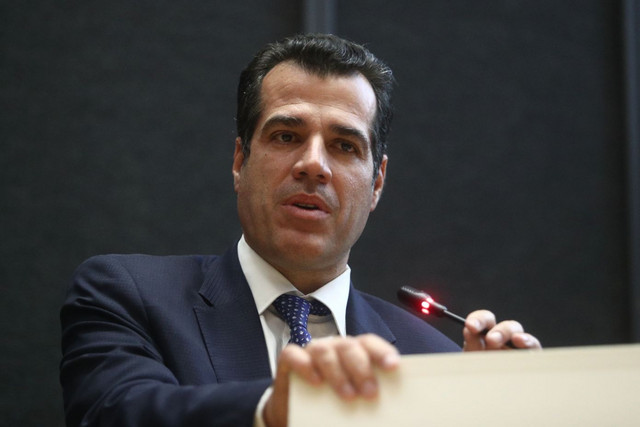
Greek Migration Minister Thanos Plevris stated on Friday, August 28, that migration flows into Greece are steadily falling, citing effective cooperation with neighboring Turkey while highlighting new pressure along the sea route from Libya to Crete.
Plevris explained that Spain, Italy, and Greece remain the three main first-reception countries in Europe facing constant migration pressure. He noted that island nations such as Cyprus and Malta experience less pressure because human trafficking networks avoid islands in favor of routes offering direct access to the mainland.
Greece remains the most geographically exposed nation in the region because it shares both land and sea borders with Turkey, while facing Egypt and Libya to the south across the Mediterranean.
Spain migration policy and Evros border
Plevris voiced disagreement with the migration policy pursued by Spain, claiming it operates on the assumption that individuals can easily obtain legal status. He said trafficking networks exploited and repeatedly misinterpreted Spain's law under Prime Minister Pedro Sanchez, broadcasting messages telling migrants to travel to Spain because authorities were granting papers.
Plevris noted that Spain issued one million legal residency documents under that policy. He added that Greece previously faced a similar influx at the Evros land border, but Greek authorities were fully prepared to manage the situation.
Turkey cooperation and Aegean sea routes
Turning to Turkey, Plevris stated that Ankara has altered its migration policy, partly because it receives substantial funding from the European Union. Turkish officials also recognized that securing their eastern borders reduced incoming flows, which in turn curtailed outgoing transit flows across their territory.
Plevris said Turkey has shown no sign of changing its cooperative stance, resulting in continuously falling arrival figures. He drew a sharp distinction between maritime enforcement in the Aegean Sea and the Libyan Sea.
In the Aegean, Greek forces can quickly detect incoming vessels, inform authorities, and carry out interceptions. In the Libyan Sea, however, boats must be stopped before they launch, as returning vessels once they reach open waters is not feasible despite claims by some commentators. Plevris noted that Libya presents a unique challenge, though Greece has developed contingency plans should the route escalate.
Crete arrivals and reduced asylum approval rates
Arrival figures in Crete reached 12,000 over the first eight months of the year. Plevris remarked that while these numbers are not satisfactory, they do not indicate a structural shift or an increase in migration intensity. Athens remains in active consultations to halt traffic along the Libyan route, with all arriving individuals immediately screened and distributed across reception facilities.
Plevris revealed that Greece has reduced its asylum approval rate to 37 per cent, down from a historic rate of 70 per cent, following reforms to asylum evaluation rules. For migrants who qualify for asylum, Greece provides immediate rural employment integration programs without offering cash benefits.
Offshore return centers in Africa and European alliance
Plevris stressed that individuals arriving illegally who do not qualify for asylum will not be legalized in Greece, regardless of procedural delays. He acknowledged that mandatory deportations are difficult, but stated that unapproved applicants will be held in closed facilities rather than living in local communities.
Greece is working alongside Germany, Austria, the Netherlands, and Denmark to establish offshore return centers for rejected asylum seekers. The five-nation group is close to finalizing an agreement with an African country to host the facilities.
Plevris expects the agreement to be concluded within 2026, with the offshore centers becoming operational in 2027. Under the proposed framework, rejected asylum seekers will be returned to their country of origin. If direct return is impossible due to non-cooperation, delays, or a lack of consular representation, applicants will be transferred to the African center, which will operate under European law outside Europe.
Domestic politics and opposition criticism
Addressing domestic politics ahead of the 2027 national elections, Plevris asserted that the government's true opponent is the daily problems of the Greek public rather than opposition parties.
He criticized the socialist opposition party PASOK, claiming it has adopted an anxious approach and effectively transformed into a left-wing party rather than a traditional centrist force. Plevris argued that PASOK is competing anxiously with former Prime Minister Alexis Tsipras to capture left-wing voters.
Regarding Tsipras, Plevris remarked that despite attempting a fresh political image and promoting new figures, Tsipras remains judged by his tenure as prime minister from 2015 to 2019. He called it provocative for Tsipras to announce plans to speak prior to the Prime Minister at the upcoming Thessaloniki International Fair.