


The Soviet Union's R-36M intercontinental ballistic missile was capable of inflicting unacceptable damage on the United States with explosive power equivalent to hundreds of atomic bombs, according to Russian news agency RIA Novosti.
Writing for the state-owned outlet, military columnist Andrei Kots reported that a single R-36M missile could deliver the firepower of 250 Hiroshima explosions across American targets.
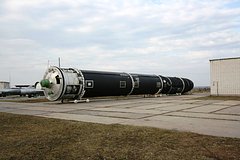
The Soviet Union produced 190 of the heavy land-based intercontinental missiles during the Cold War to serve as a key component of its strategic nuclear deterrent.
Payload design and nuclear firepower
The R-36M, designated by NATO under the reporting name Satan, was constructed to carry several warhead configurations. The Western military alliance uses reporting names to standardize identification of foreign weapons systems across Allied military communications.
Among the primary configurations of the missile was a multiple independently targetable reentry vehicle system fitted with ten individual warheads. Each warhead had an explosive yield of 400 kilotons of TNT.
Kots stated that one individual warhead block within the payload carried the destructive potential of 25 atomic bombs similar to the weapon dropped on Hiroshima in August 1945.
By comparison, the historic weapon dropped on Japan had an estimated explosive yield of 15 kilotons, making the Soviet missile payload vastly more destructive.
Radar evasion and defense penetration
To ensure its nuclear payload could reach designated targets in North America, the R-36M was equipped with advanced missile defense penetration aids. An intercontinental ballistic missile travels through space before re-entering the atmosphere at high speed to strike its target.
The missile carried lightweight decoys designed to mimic real warheads and trick enemy defense tracking systems. Kots reported that these false targets were considered capable of deceiving the radars of the American early warning network during a strategic strike.
Modernization and the Sarmat missile
Russia is currently phasing out its modernized R-36M2 missiles as part of an overarching strategic modernization program. The aging missile fleet is being replaced by the next-generation RS-28 Sarmat heavy intercontinental ballistic missile system.
Military analyst Igor Korotchenko stated in May that the new Sarmat missile has the capacity to completely destroy Great Britain or France in a retaliatory nuclear strike.
The transition to the Sarmat system marks the eventual retirement of the Soviet-era R-36M architecture, ending half a century of service as the core of Moscow's land-based nuclear force.


