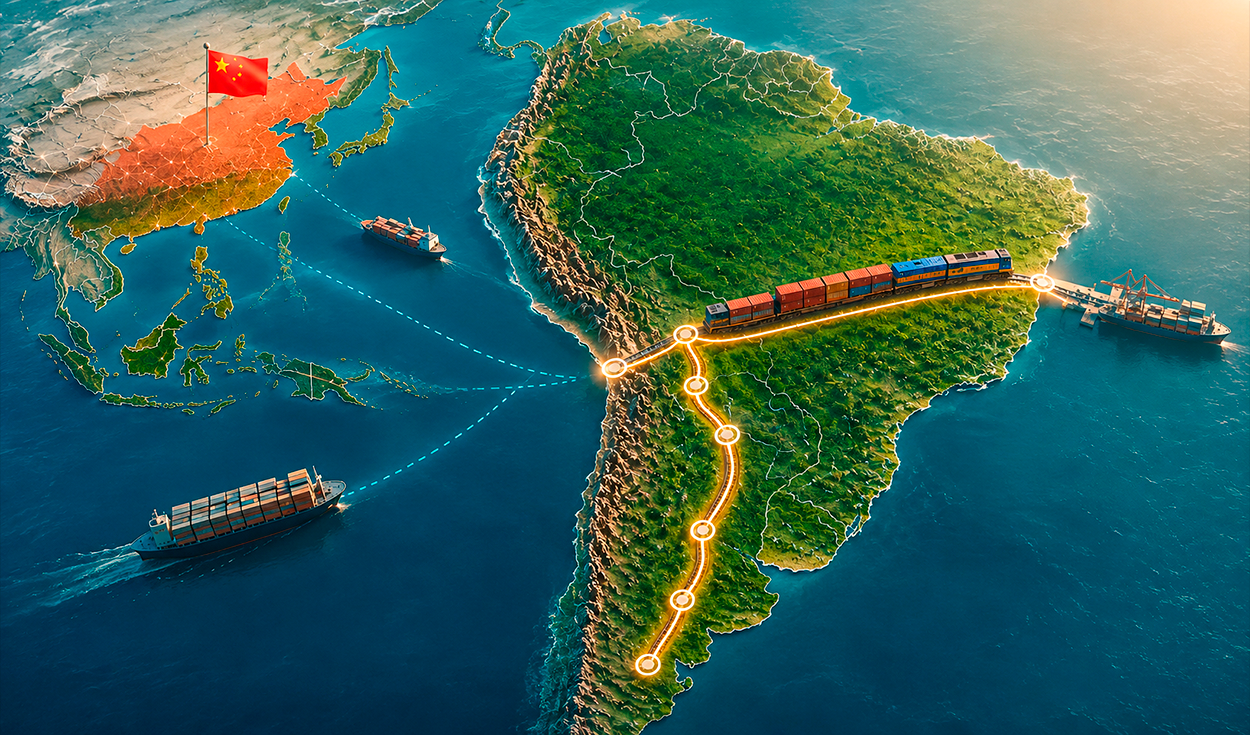
Brazil and China signed a memorandum in July 2025 to study a rail corridor linking Brazil's railway network to Peru's Chancay port, but Peru was not included as a formal party to the deal, according to Peruvian economist Santiago Roca, a member of the G12 group and a research professor at Lima's CENTRUM PUCP business school, writing in an opinion column.
Roca said the announcement was presented as a strategic advance for South America, with Brazil gaining a more direct outlet to the Pacific and China consolidating Chancay as a major platform toward Asia. Yet he called it an evident paradox that Peru, the country the train would have to cross and the site of the destination port, was left outside the formal agreement.
The stated explanation, Roca wrote, is that the memorandum was designed only as a preliminary study of Brazil's own rail network and its eventual international connection. Brazil is evaluating how to link its Integração Oeste-Leste (FIOL), Centro-Oeste (FICO) and Norte-Sul railways to a Pacific outlet, while China wants to measure the technical, economic, logistical and environmental viability of a corridor able to feed Chancay with Brazilian cargo. In Roca's reading, Brazil and China first wanted to map out their own side of the equation: production, investment, existing infrastructure and future cargo demand.
Chancay is a deep-water megaport north of Lima built with Chinese investment and inaugurated in November 2024, positioned as a gateway for South American exports to Asia.
Why Peru's absence matters
That technical explanation does not resolve the political problem, Roca argued. No corridor to Chancay can be built without Peru, he wrote, since routes cannot be drawn across the Amazon and the Andes, easements imposed, environmental impacts assessed, communities affected or cities connected to a Peruvian port without the Peruvian state involved from the design stage. If Peru arrives late to the table, he said, others will already have set the project's logic: which cargo gets priority, which route gets studied, which regions get connected and who captures the logistics revenue.
Roca described the stakes as more than a railway question. He called it a territorial decision. An isolated central route built solely to carry Brazilian cargo to Chancay, he warned, risks turning Peru into little more than a transit country, repeating what he called a familiar pattern of major investments that look outward without integrating the country internally. The train could cross Peruvian territory, he said, without creating a network of intermediate cities, industrial parks, regional economic zones, added value, technical jobs or production chains.
Roca's three demands
Roca argued Peru should respond neither with automatic rejection nor naive enthusiasm, but with a strategic position built on three demands. First, formal incorporation into any study touching routes, demand, costs, financing, environmental impact or the Chancay connection. Second, full access to the memorandum itself, its delivery schedule, its methodology and its cargo assumptions. Third, a clear statement that no study will be valid for the Peruvian stretch unless it incorporates alternatives for national development.
A network, not a single route
Peru's condition, Roca wrote, should be simple: do not accept a route, demand a network. If Brazil and China want to use Peruvian territory to reach the Pacific, he argued, they should help finance what he called a Peruvian Bioceanic Network. That would mean the eventual central route to Chancay should also connect to a northern and eastern branch running through Pucallpa, Tarapoto, Bagua, Olmos, Piura and Bayóvar, or alternatively to a hypothetical southern rail route through Madre de Dios, Cuzco, Puno and Arequipa, or the southern interoceanic highway.
Such a network, Roca said, should include dry ports, industrial parks, new population centers, logistics hubs, energy supply, fiber optic lines, inland customs facilities, technical training and processing zones. The objective, he wrote, should not be for Brazilian soy, corn or minerals to simply pass through Peru, but for Peru to produce, process, export and integrate more fully with both Brazil and Asia.
Peru's negotiating leverage
Roca said Peru holds real negotiating power because the critical stretch of any corridor lies within its own territory, and that this leverage should be used intelligently, not to block the project but to raise its quality. Brazil is seeking competitiveness and China is seeking volume for Chancay, he wrote, while Peru should be seeking territorial development. In practice, he said, that means negotiating joint Chinese-Brazilian financing for the Peruvian branch lines, open-access rules, participation by domestic suppliers, environmental protections, shared logistics data and firm commitments to add value on Peruvian soil.
Roca described the Brazil-China memorandum as both a warning and an opportunity. It warns, he wrote, that other countries are already planning around Peruvian territory according to their own interests. But it also opens the possibility for Peru to recover the initiative and propose its own vision. The bioceanic train, he concluded, should not be designed simply to cross Peru. It should be designed to build Peru.
Roca also noted that the Peruvian president's speech on July 28 spoke of strengthening ties with fellow Andean Community countries but made no mention of Brazil, which he described as the neighboring country with potentially the greatest capacity to contribute to Peru's development.