Peruvian economist Santiago Roca has proposed creating a high level macroeconomic coordination body to resolve long standing inconsistencies between short term price stability and long term economic growth in Peru.
Writing in Peruvian newspaper La Republica, Roca said Peru has maintained price stability for several years but continues to suffer from very high informal employment, sluggish economic growth, poor quality economic activity, low productivity, extreme poverty, and weak formal investment.
Roca, a member of the G12 advisory group and professor researcher at the CENTRUM business school of the Pontifical Catholic University of Peru, previously argued in an article on August 7 that the South American nation deserves better macroeconomic management. He stated that Peru currently experiences desynchronization in short term macroeconomic balances alongside contradictions between immediate policy decisions and broader development goals.
Current institutional gaps in Peru
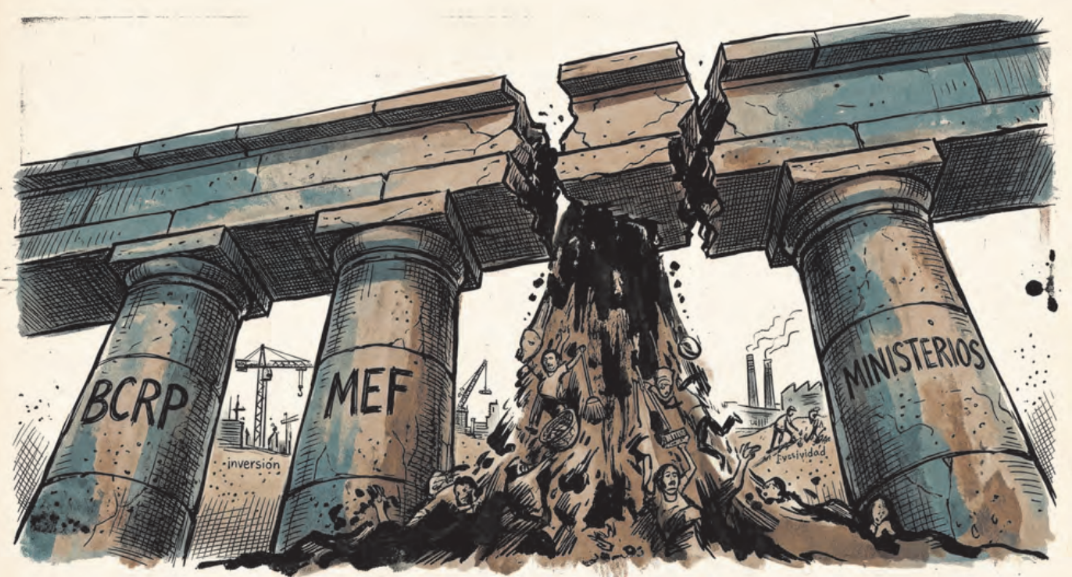
Under Peru's existing framework, the Ministry of Economy and Finance manages fiscal policy, state budgets, and public debt, while also overseeing economic programming and public investment despite what Roca described as significant weaknesses. Meanwhile, the Central Reserve Bank of Peru focuses on preserving monetary stability, and individual sectoral ministries manage their respective areas in isolation.
Roca said Peru lacks an institution whose primary responsibility is to view the economy as a whole and verify that short term decisions remain consistent with medium and long term objectives for savings, investment, employment, and productivity.
Roca cited several contradictions created by the absence of overarching coordination:
- Peru can register a high external trade surplus and abundant foreign currency reserves while a portion of national savings finds no domestic investment destination.
- The central bank can lower inflation by raising interest rates, which simultaneously increases the cost of productive credit for businesses.
- The finance ministry can meet fiscal deficit targets by compressing public investment or accumulating future structural rigidities.
While each authority operates within its legal mandate, Roca said the aggregated result for the national economy falls short of what is possible. He argued that Peru needs an institutional function to ensure coordination and consistency across all government bodies.
Structure of the proposed national council
Roca proposed establishing high level coordination bodies that would act in an advisory role without executive powers. The president of the new body would hold a seat on the Council of Ministers and report directly to the President of the Republic.
Operational decisions would remain with existing competent institutions. Roca noted that the coordination body would not approve interest rates or public budgets directly, but would highlight cross effects and financial costs before making policy recommendations.
The proposed body would build shared economic scenarios, project interactions between economic variables, identify incompatibilities, prepare responses to economic shocks, and evaluate policy alternatives. It would also evaluate whether relative prices and financing sources align with a sustainable growth trajectory.
Eight sets of macroeconomic indicators
To support the high level coordination body, Roca recommended establishing a Technical Commission tasked with monitoring eight comprehensive categories of macroeconomic indicators.
According to Roca, the commission would track:
- The real sector, covering Gross Domestic Product, consumption, employment, household income, and productivity.
- The public sector, covering government revenue, public spending, the fiscal deficit, national debt, and financing.
- The monetary and credit sector, covering money supply, credit availability, interest rates, and market liquidity.
- The external sector, covering exports, imports, the current account balance, capital flows, foreign exchange rates, and international reserves.
- Social sectors.
- Sources and uses of funds, identifying who saves, who invests, who receives financing, and through which financial instruments.
- The aggregate investment program, tracking public, private, public-private partnership, and foreign investment alongside funding sources and destinations.
- An input-output matrix to estimate how shifts in demand, investment, and exports move across economic sectors, imports, employment, and income.
Roca stressed that these economic interrelations must close simultaneously across accounting models. For example, if higher investment is projected, funding tables must show who will finance it, and if exports or capital inflows increase, authorities must evaluate the impact on the exchange rate and domestic production. Similarly, policies that lower inflation or reduce the fiscal deficit must be evaluated for their impact on credit, investment, employment, and productivity.
International models in Brazil and Germany
Roca pointed to Brazil as an example of successful policy coordination that preserves institutional autonomy. Brazil operates a National Council bringing together the Minister of Finance, the Minister of Planning, and the President of the Central Bank, supported by a Technical Commission of senior officials from the Central Bank, Treasury, economic policy, planning, and securities market authorities.
Germany offers a complementary approach where the Bundesbank maintains operational independence, but its president attends cabinet meetings when the Annual Economic Report and draft budget are approved. Central bank technicians participate in government forecasting groups on tax revenue, economic cycles, and fiscal stability, while the independent German Council of Economic Experts identifies conflicts between growth, employment, price stability, and external balance.
Government commissions and missing links
Roca noted that the Peruvian government recently announced four presidential commissions focused on informality and productive jobs, banking and financial markets, public investment, and tax evasion and taxes.
He said these commissions could help improve the efficiency and effectiveness of key executing agencies, including the Ministry of Economy and Finance, the Central Reserve Bank of Peru, individual ministries, tax authority SUNAT, strategic planning agency CEPLAN, banking supervisor SBS, and securities supervisor SMV.
However, Roca concluded that Peru still needs to create high level mechanisms to coordinate economic, monetary, social, and productive authorities, ensuring that short term actions align with medium and long term macroeconomic goals.