
Up to 6,000 bodegas could close across Peru during 2026 as rising crime and severe weather pressure small businesses, according to industry projections.
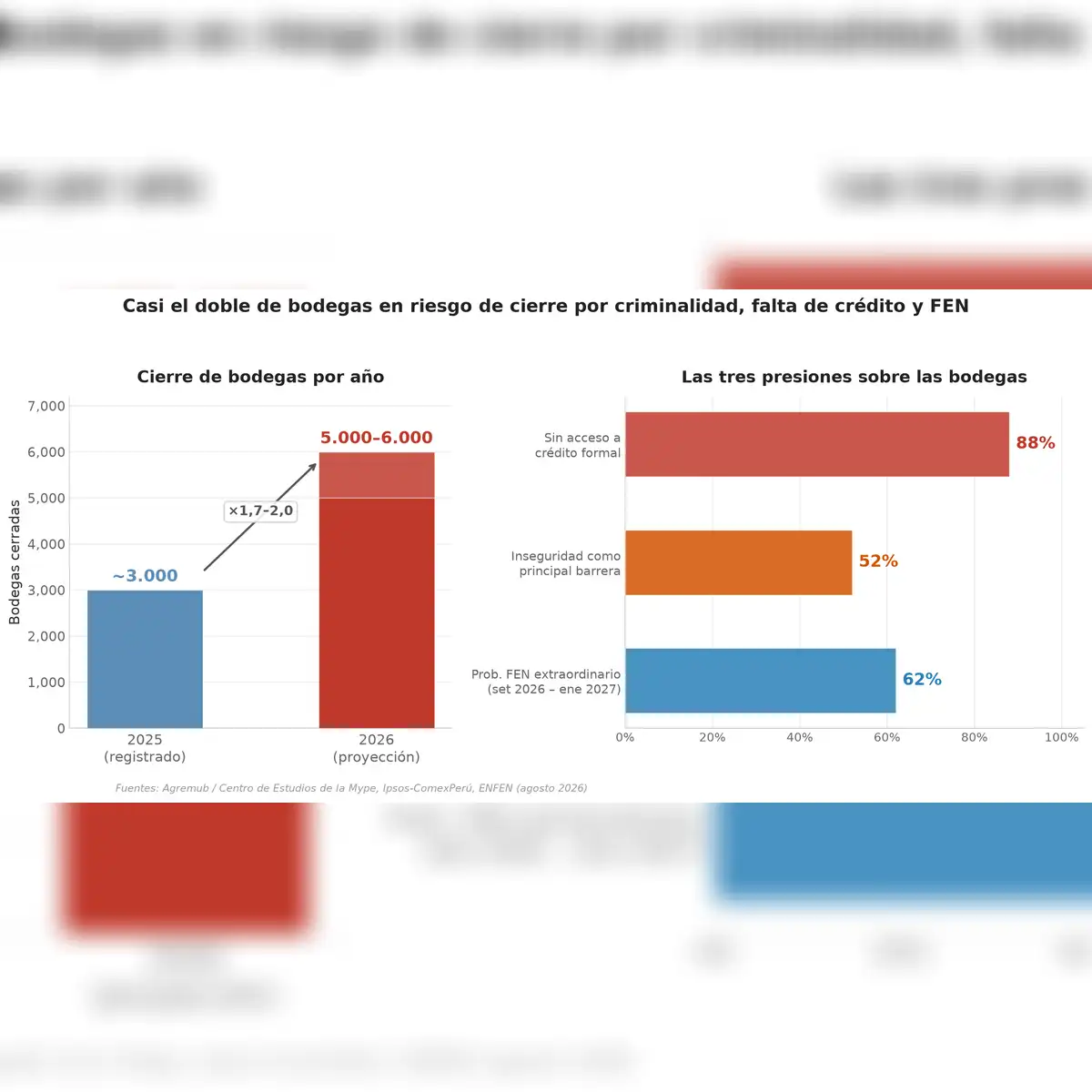
Data from the Microenterprise Study Centre, cited by the Association of Women Bodega Owners, shows that between 5,000 and 6,000 neighbourhood grocery stores are at risk of shutting down. If realized, the projection would nearly double the figure of slightly more than 3,000 store closures recorded in 2025.

Rising insecurity as a barrier to microenterprise growth
Insecurity has become a primary obstacle across Peru's small business sector. A study by market research firm Ipsos for foreign trade association ComexPerú, titled Businesses and State: Diagnosis of barriers and opportunities for formalisation and growth, revealed that 52 percent of microenterprises identify insecurity as their main barrier to growth.
For bodegas, public exposure magnifies security risks because most commercial activity takes place directly facing customers on the street. Extortion represents an additional cost for businesses that depend on daily sales and maintain minimal financial margins to absorb losses.
Carla Campos, president of the Association of Women Bodega Owners, noted that female-managed businesses are among the hardest hit. She explained that commercial trading serves as the main source of income for these business owners and their families.
Campos stated that while policy measures represent a necessary step, concrete and rapid actions are required to curb the wave of insecurity. Her statement followed the approval of Peru's General Government Policy 2026-2031, an official state document establishing guidelines to reduce the impact of violent crime, extortion and organised crime on citizens and economic units.
The policy explicitly includes economic units alongside individuals as affected entities. However, public policy guidelines do not automatically guarantee an immediate reduction in extortion without concrete enforcement actions.
Financial restrictions and credit barriers
Security challenges coincide with severe constraints in obtaining capital. Figures from the Association of Women Bodega Owners indicate that at least 88 percent of corner grocery stores cannot access formal bank credit.
For small shops, the lack of formal financing complicates inventory purchases, product restocks and emergency expense management. Financial limitations become critical when stores face declining sales or rising security costs simultaneously.
To break this constraint, Campos advocated for government or institutional guarantee mechanisms to expand bodega access to the formal financial system. She stated that creating a guarantee mechanism to break that vicious cycle and boost access to formal financing was urgent.
The proposed guarantee mechanism represents a trade association request and has not been officially approved. Furthermore, the 88 percent unbanked figure originates from internal association data rather than official financial system statistics.
The combination of security threats and credit restrictions limits business resilience. When customer visits decline or extra security costs arise, store survival depends entirely on available cash liquidity.
El Niño climate risks and supply chain disruptions
Climate conditions present an additional challenge for retail merchants. The Multisectoral Committee for the National Study of the El Niño Phenomenon maintains an active Coastal El Niño Alert status for Peru.
In a communique issued on August 28, the monitoring body reported a high probability that Coastal El Niño conditions will persist through the summer of 2027. For the oceanographic region designated as Niño 1+2, the committee estimated an extraordinary warming magnitude between September 2026 and January 2027, assigning a probability of at least 62 percent.
The official forecast predicts atmospheric temperatures significantly above normal levels across the entire Peruvian coast from September through November 2026, alongside higher probabilities of heavy rain on the northern coast. Monitoring authorities recommended incorporating these scenarios into disaster risk reduction and seasonal preparedness plans.
For corner stores, weather impacts extend beyond physical premises. Road damage, transport interruptions and movement difficulties can disrupt supply chains and increase wholesale freight costs.
Sales could also fall in areas hit by flooding or related weather events. However, total commercial losses will depend on the intensity and location of climate impacts, meaning closures cannot be attributed entirely to weather conditions.
Campos urged authorities to include retail commerce in disaster prevention measures due to its role in daily household supply. She emphasised that bodegas are a key link in the supply chain and warned that if not enough is done to mitigate the impact of El Niño on the sector, the consequences would be reflected directly in the national economy.
Evaluating the projected closures for 2026
The projected closure of 5,000 to 6,000 bodegas in 2026 represents an industry estimate rather than an official registry of closed businesses. Available data does not specify what proportion of shutdowns would result solely from crime, climate events or financial distress.
Nevertheless, comparison with 2025 figures highlights the scale of potential disruption. If projections materialize, closures in 2026 will nearly double the slightly more than 3,000 store shutdowns recorded in 2025.
Official warnings confirm that El Niño events cause severe rainfall and affect multiple socioeconomic sectors while authorities monitor hydrological impact.
Small grocery stores currently face three distinct pressures: crime identified as a growth barrier for microenterprises, structural exclusion from bank credit, and potential logistical obstacles from weather events. Final closure numbers will depend on how these factors evolve and how well small businesses absorb their impacts through the end of the year.