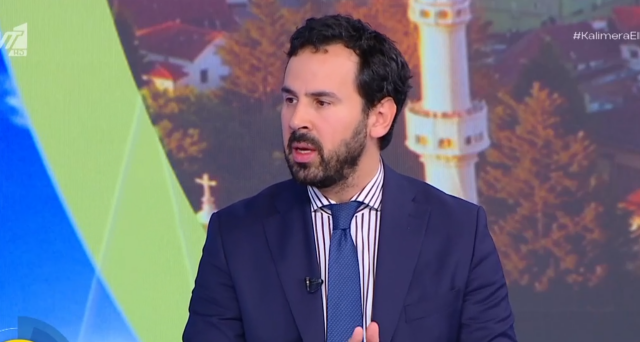
Nikos Romanos, Director of Digital Communication to Prime Minister Kyriakos Mitsotakis, declared Thursday that Thessaloniki is undergoing a transformation from a city of empty promises into a hub of active major infrastructure projects.
Speaking on television station ANT1 on August 27, 2026, Romanos said the northern port city serves as a microcosm for development across Greece under the ruling New Democracy party.
Romanos drew on popular culture during the broadcast, responding to the track Tha Tha Tha by singer Lena Zevgara by contrasting past unfulfilled pledges with completed works. He added that he would humorously dedicate another hit song, titled Can I Have the Bill Please, to the political opposition and specifically to former prime minister Alexis Tsipras.
Romanos stated that Tsipras owes the public an exact accounting for the economic proposals he has made or plans to announce, as well as for the finances of his own political party. He noted that the opposition has failed to provide transparent figures regarding its policy platform.
Thessaloniki International Fair Presentation
Romanos emphasized that political leaders will be evaluated primarily on measurable outcomes as the government prepares to attend the annual Thessaloniki International Fair. He said the administration will present tangible evidence of completed work alongside a distinct package of policy measures for the upcoming period.
Thessaloniki, the second largest city in Greece and the administrative capital of Central Macedonia, has long served as the focal point for major national policy announcements. The Thessaloniki International Fair, held every September, is the premier economic forum where Greek prime ministers outline annual fiscal plans and government initiatives.
Economic Growth and Cost of Living
Addressing the rising cost of living, Romanos acknowledged that high prices remain a serious issue affecting the daily lives of citizens. He insisted that the government does not underestimate consumer pressures, describing inflation as a broader pan-European challenge.
Romanos maintained that the Greek economy is in a significantly stronger position to withstand inflationary pressures than in previous years. He pointed out that 600,000 more citizens have secured employment, supported by higher investments, increased industrial output, rising exports, broader income gains, and the implementation of 86 tax cuts.