


NASA has identified a layer of Venus's atmosphere as one of the most Earth-like environments in the solar system, reviving a debate over whether the planet, not Mars, could be the better candidate for humanity's first colony beyond Earth.
The idea does not involve landing on Venus. Instead, it proposes building floating settlements roughly 50 kilometers above the surface, inside the planet's atmosphere, under a NASA concept called HAVOC, the High Altitude Venus Operational Concept. The architecture is based on aircraft designed to hover permanently in the Venusian sky.
Why Mars looked like the obvious choice
For decades Mars has been the default answer for the first off-world colony. It has frozen water, a day that lasts just 39 minutes longer than Earth's, annual seasons and a solid surface to build on.
Venus, by contrast, looks like a nightmare on paper: surface temperatures of 467 degrees Celsius, atmospheric pressure 93 times that of Earth, and clouds made of sulfuric acid. If the choice came down to where to land, Mars would win without argument. But the study suggests the problem may be the word "land" itself.
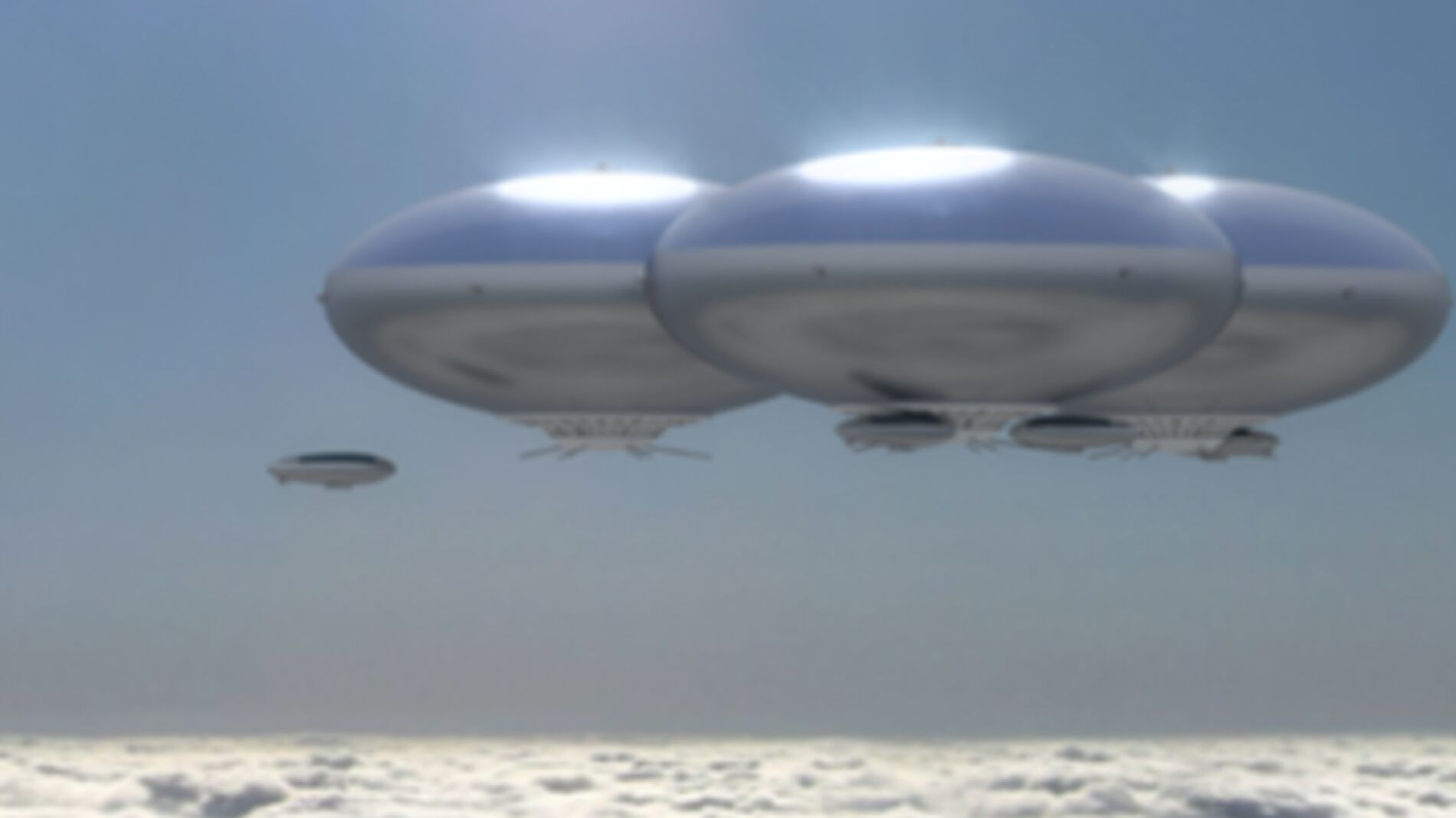
The case for floating cities on Venus
At around 50 kilometers of altitude, conditions change dramatically. Temperatures there sit roughly between 30 and 70 degrees Celsius, and atmospheric pressure is similar to what is found at sea level on Earth, according to the HAVOC research. Those are remarkably mild conditions compared with the planet's surface.
Gravity and pressure favor Venus
The first advantage over Mars is gravity. Venus has surface gravity equivalent to about 90 percent of Earth's, while Mars reaches only about 38 percent. Scientists do not yet know the long-term effects of living for decades under gravity as low as Mars's, but microgravity is known to cause muscle and bone mass loss along with other physiological changes. A Venusian colony suspended in the clouds would, at least on paper, offer conditions much closer to those on Earth.
The second advantage is atmospheric pressure. On Mars, pressure is less than 1 percent of Earth's, an atmosphere so thin that liquid water cannot remain stable on the surface for long and offers limited protection from radiation. Any Martian colony would essentially need to be a pressurized bubble sitting inside another bubble that is almost a vacuum.
On Venus, something unusual happens at 50 kilometers: outside pressure comes close to matching Earth's. That does not mean astronauts could step outside unprotected, since the sulfuric acid clouds and unbreathable atmosphere remain. But not having to contain an atmosphere against a near-total vacuum could greatly simplify habitat design, according to the HAVOC study, which described the region between 45 and 60 kilometers above the Venusian surface as "one of the most Earth-like environments in the solar system."
A possible habitable zone in the clouds
Venus's atmosphere is not only of interest for human habitats. A 2015 study published in the journal Icarus proposed the existence of a possible "aerial habitable zone" between about 51 and 62 kilometers of altitude, a range the authors calculated by combining two of the main limits for life on Earth: temperature and acidity. That band overlaps with Venus's thick cloud layers, which contain sulfuric acid particles and small amounts of water.
The study does not claim life exists there, but it raises the possibility that extremophile microorganisms could, in principle, survive in that environment. The research team, led by Lewis R. Dartnell, an astronomer at the University of Leicester, calculated that even an extreme solar radiation event, such as one that may have occurred in the year 775, would probably not deliver a dose sufficient to fully sterilize this hypothetical biosphere.
Radiation and solar power
Radiation offers another potential edge for Venus. Mars has a very thin atmosphere and lacks a global magnetic field to shield its surface, meaning future colonists would need additional shielding. An aircraft floating 50 kilometers above Venus, by contrast, would be surrounded by a much denser atmosphere, and HAVOC studies suggest radiation protection there would be broadly comparable to that at Earth's surface.
Solar energy also favors Venus. The planet sits about 108 million kilometers from the Sun, compared with roughly 228 million kilometers for Mars, meaning Venus receives nearly four times more solar flux than Mars and about 1.9 times what Earth receives. Venus's clouds reduce the radiation reaching certain altitudes, so that difference does not translate directly into available electricity, but Venus still starts from a significant energy advantage, and a floating platform could carry solar panels on its upper surface.
Where Mars still wins
Mars offers something Venus cannot easily match: accessible water. Water ice exists on Mars, and there is abundant evidence the planet once had rivers, lakes and other bodies of water. That water is not always simple to extract, but it exists in quantities that make Mars a far more attractive candidate for sourcing the resource locally. Venus, in contrast, is extremely dry and lost most of the water it once had.
Mars also wins on soil and mineral resources. Colonists there could dig, build shelters, use regolith as a construction material and access minerals in the crust directly. A floating Venusian colony would have to remain permanently suspended and depend on far more sophisticated infrastructure.
Venus also carries a problem with no simple fix: its clouds contain sulfuric acid. NASA considers the corrosion of materials, structures and solar panels one of the biggest challenges for any aircraft intended to operate in that atmosphere for a long time.
Even day length favors Mars. Venus takes about 243 Earth days to complete one rotation, and its solar day lasts roughly 117 Earth days. Mars, on the other hand, has a day of 24 hours and 39 minutes, extraordinarily close to our own.
No easy winner
The comparison does not produce a clear winner. Mars remains probably the more logical candidate for building a settlement on another world, given its water, solid ground and directly accessible resources. Venus, however, could prove surprisingly attractive if the idea shifts from living on the planet to living inside it.
That does not make Venus an easy destination. Reaching a floating colony, maintaining it for decades and protecting it from the corrosive chemistry of the clouds would likely be harder than establishing a first settlement on Mars. But the research points to a possibility long hidden behind appearances: Mars may be the best place to set foot, but Venus could be the best place not to.


