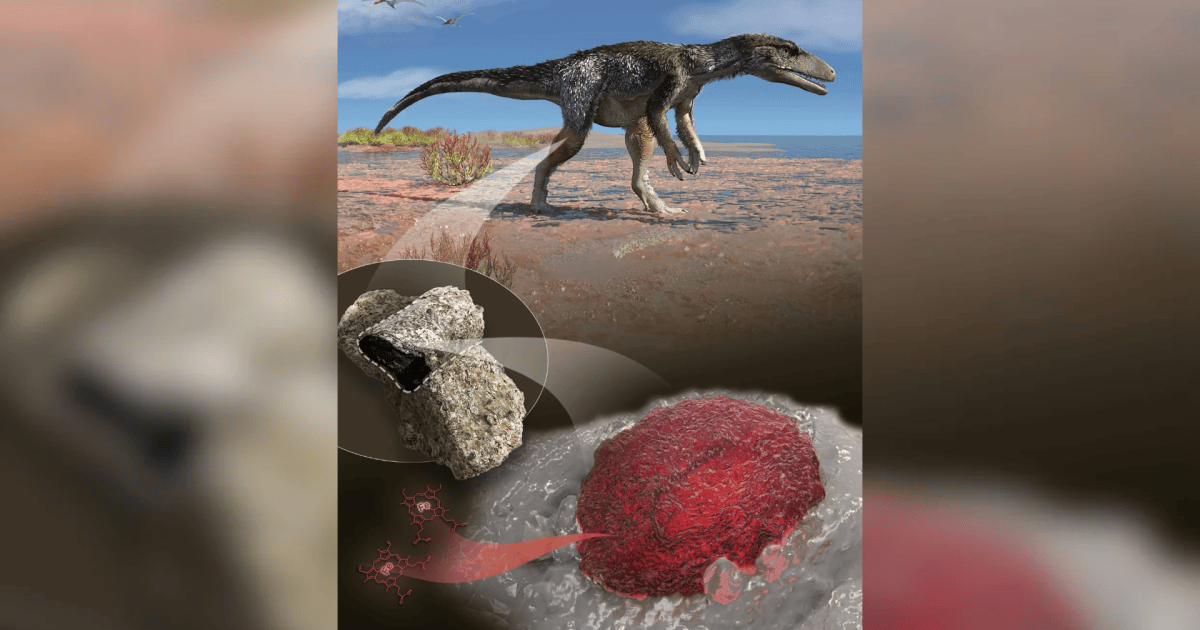
Scientists have discovered preserved red blood cells inside a 115-million-year-old Brazilian dinosaur fossil named Aratasaurus museunacionali in the Chapada do Araripe region.
The chemical analysis identified heme B, a vital blood molecule responsible for binding iron, alongside its reduction products embedded directly within the vascular canals of the theropod skeleton.
Researchers described the survival of the cells as an extraordinary occurrence because organic tissues and delicate biological molecules typically degrade or suffer severe environmental contamination shortly after an organism dies.
The study was published on Monday in the journal Proceedings of the National Academy of Sciences, reporting findings led by Australian paleontologist Kliti Grice, a professor at Curtin University, alongside four Brazilian researchers.
Professor Grice said that detecting intact heme-derived molecules in 115-million-year-old red blood cells was surprising and represented a historic milestone for paleontology. She explained that the discovery not only expanded the known fossil record of prehistoric blood, but also provided a direct molecular window into the physiology of extinct creatures, allowing scientists to understand the animals and their ancient environments more clearly.
Preservation in the Romualdo Formation
The fossilised remains were recovered from the Romualdo Formation, a geological site situated across a border area shared by the northeastern states of Pernambuco, Ceará, and Piauí.
The site forms part of the wider Araripe Basin, a region renowned among paleontologists worldwide for producing exceptionally well preserved fossils dating to the Early Cretaceous epoch. Sedimentary rocks in the formation frequently enclose animal remains within hard limestone concretions, which can shield delicate structures such as muscles, skin membranes, and fine blood vessels from biological decay and physical crushing over millions of years.
According to the research, Aratasaurus museunacionali was a theropod dinosaur, a classification that describes bipedal reptiles that walked on their hind legs and possessed hollow, pneumatic bones filled with internal air cavities.
Theropods represent one of the most prominent groups of prehistoric animals, encompassing diverse predators ranging from small, agile hunters to apex carnivores such as Tyrannosaurus rex. The group is also central to the study of vertebrate evolution, as small feathered theropods gave rise to the evolutionary branch that produced all living birds.
Molecular Isolation and Testing Methods
To detect the microscopic organic remains within the petrified bone, the scientific team extracted organic material from the fossilised tissue using specialised chemical isolation techniques.
The team analysed these organic extracts to detect specific biological markers. Researchers compared the retention times, ultraviolet-visible absorption spectra, and mass spectra of the fossil extracts against genuine modern chemical standards to confirm the presence of heme B.
Heme B serves as the primary iron-bearing core within hemoglobin molecules across vertebrate species, functioning as the biochemical carrier that binds and transports oxygen through the circulatory system. Identifying this specific chemical signature provided physical confirmation of blood residues trapped inside the skeletal channels.
Following the isolation and chemical identification of the molecules, the researchers used non-destructive techniques to examine structural compositions on a micrometre scale within thin fossil slices.
Contamination Controls and Chemical Signatures
The scientists conducted microanatomical mapping across the fossil specimens to locate the spatial distribution of the cellular structures within the internal vascular architecture of the bone.
A central challenge in molecular paleontology is determining whether organic material recovered from ancient stone originated from the prehistoric animal or entered the rock through modern bacterial infiltration or mineral deposits. The research team conducted rigorous contamination verifications to confirm that the detected biomolecules were original and endogenous to the dinosaur specimen, ruling out modern biological contamination or geological artifacts.
Professor Grice noted that these findings directly challenged long-held scientific assumptions that complex organic molecules, including hemoglobin derivatives, cannot endure over extensive geological periods.
Traditional views in taphonomy, the branch of paleontology dealing with fossilisation processes, long maintained that proteins and cellular components deteriorate completely within hundreds of thousands of years. The verified recovery of heme products surviving for 115 million years provides rare evidence that biochemical traces can withstand deep geological time under exceptional preservation conditions.
Comparison With Modern Avian Blood
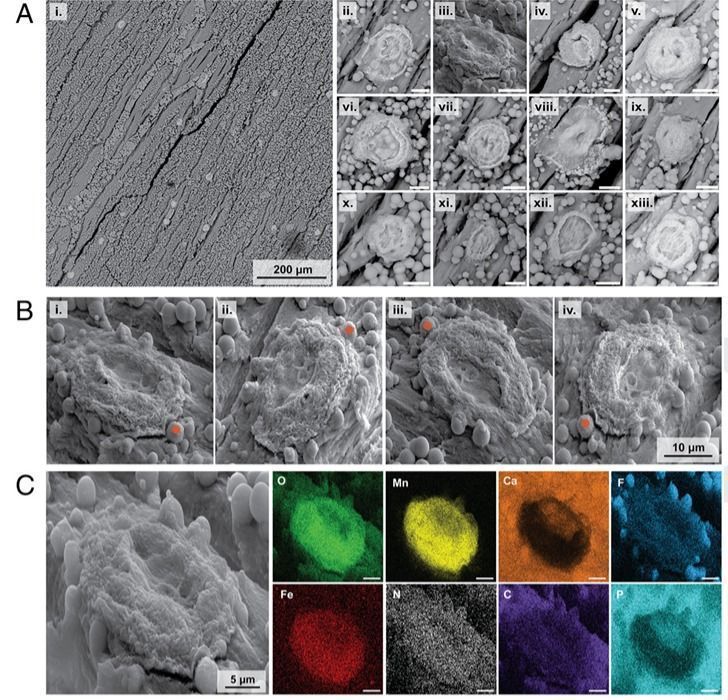
The researchers reported that the preserved blood cells in Aratasaurus museunacionali differed markedly from the red blood cells found in modern birds in their overall shape, physical dimensions, surface area, and evolutionary adaptations.
Microscopic analysis demonstrated that while the red blood cells of living birds are visibly elongated, the red blood cells of Aratasaurus museunacionali are nearly spherical in shape.
Significant differences were also documented in the physical size of the cells. The red blood cells of the Brazilian dinosaur measured an average of 22.97 micrometres in length and 19.54 micrometres in width.
By comparison, the red blood cells of modern birds generally measure between 7.5 and 13 micrometres in width and are substantially shorter than those measured in the Cretaceous fossil.
Evolutionary Changes in Red Blood Cells
The researchers explained that these physical variations reflect distinct evolutionary trajectories between non-flying Cretaceous theropods and modern avian lineages.
Aratasaurus museunacionali did not descend from ancestors capable of flight, an evolutionary status that permitted the species to retain larger red blood cell dimensions throughout its vascular system.
In contrast, modern birds are the living descendants of small theropods that underwent an extensive evolutionary process of body miniaturisation and physiological adaptation to achieve powered flight.
Powered flight requires exceptionally high rates of oxygen delivery to fuel flight muscles. Evolutionary miniaturisation of red blood cells increases their total surface-area-to-volume ratio, facilitating faster gas exchange through cellular membranes and enhancing overall circulatory efficiency in flying birds.
Joint Australian and Brazilian Research
The international research effort was conducted through an academic collaboration connecting Curtin University in Western Australia with major Brazilian scientific institutions.
Four Brazilian researchers took part in the investigation: Renan Bantim and Antônio Saraiva from the Universidade Regional do Cariri, along with Juliana Sayão and Alexander Kellner from the Universidade Federal do Rio de Janeiro and the National Museum of Brazil.
The Universidade Regional do Cariri operates directly within the Cariri region of Ceará, where researchers frequently lead field investigations across the Araripe fossil deposits. The National Museum of Brazil, managed by the Universidade Federal do Rio de Janeiro, is the nation's oldest scientific organisation and houses extensive paleontological archives documenting South America's prehistoric wildlife.
The authors concluded that analysing blood-derived biomolecules in vertebrate fossils provides crucial insight into the physiology and evolutionary biology of ancient organisms. The team noted that the breakthrough will enable future research comparing the biological makeup of extinct dinosaurs with the physiology of contemporary bird species.