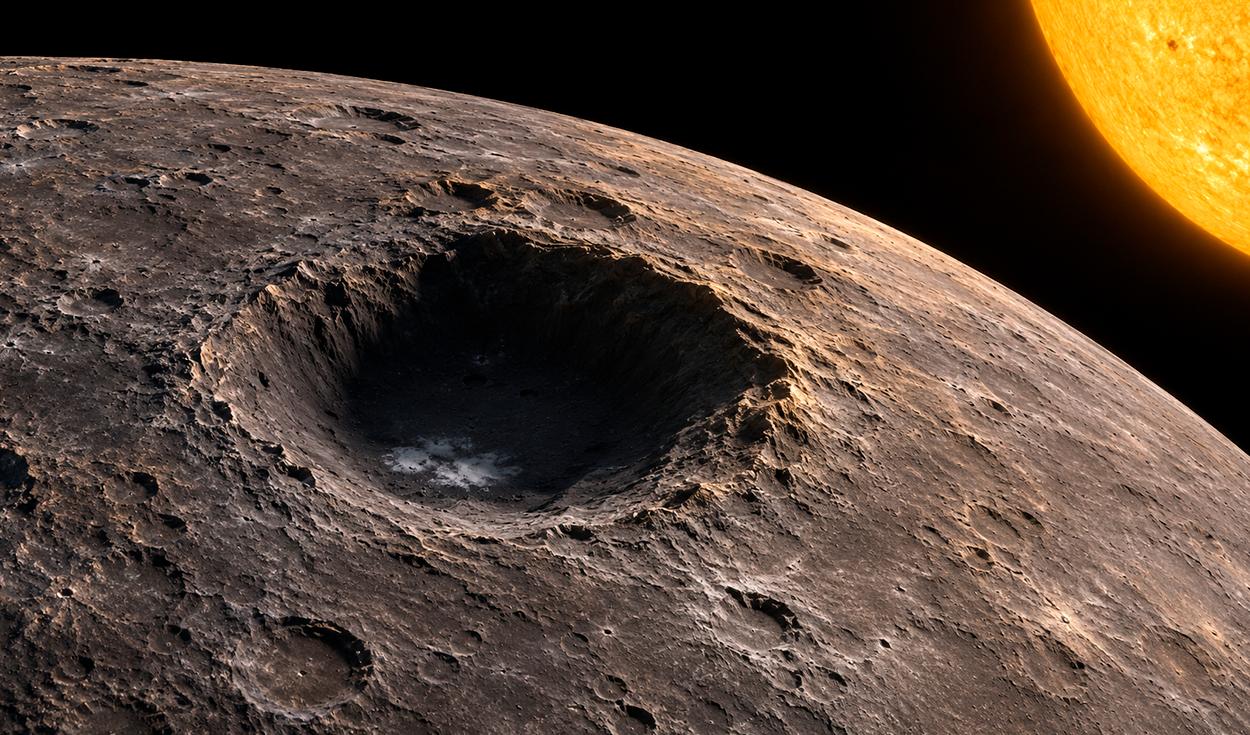
Mercury, the planet closest to the Sun, reaches daytime temperatures above 400 degrees Celsius in its sunlit regions, yet NASA's MESSENGER spacecraft found solid evidence of ice deposits near its north pole, according to the journal Science. The findings, released in 2012, confirmed observations that ground-based radar on Earth had already picked up decades earlier.
MESSENGER orbited Mercury between 2011 and 2015 as part of a NASA mission to study the planet's surface, geochemistry and magnetic environment. Mercury itself is the smallest planet in the solar system and has no moons, which makes the discovery of ice hidden inside its craters especially striking to planetary scientists.
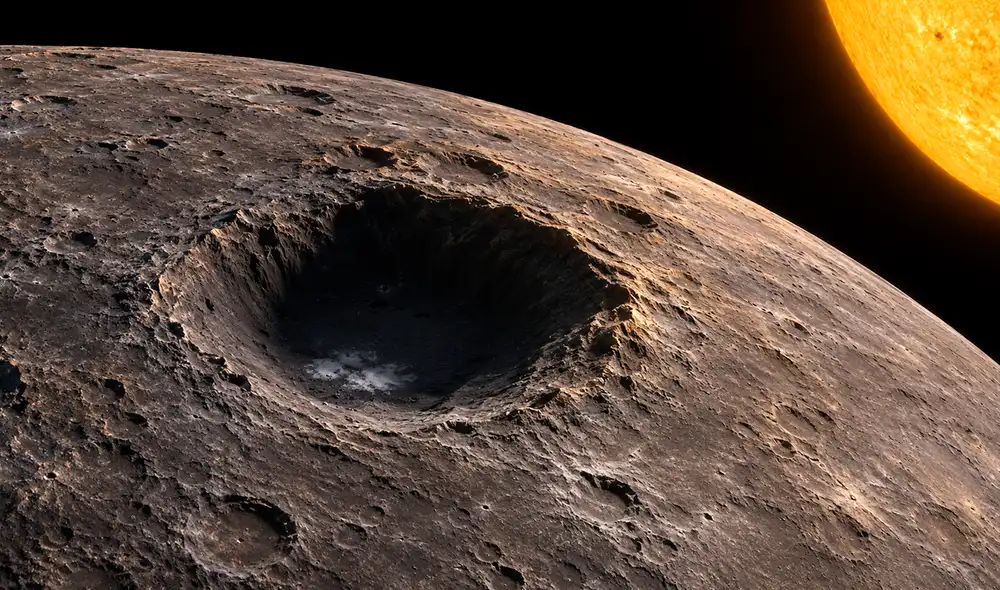
The leading theory for how that ice got there holds that comets and asteroids rich in volatile compounds delivered the water when they struck the planet. But a study published in 2020 in The Astrophysical Journal Letters, reported by the science outlet Physics, proposes a complementary explanation: Mercury itself may generate part of its own water supply through chemical reactions driven by its extreme heat.
How heat and solar wind create water on Mercury
The process begins when protons carried by the solar wind strike Mercury's exposed surface crust. There, the arriving hydrogen bonds with oxygen already present in surface minerals to form hydroxyl groups, structures made of one atom of hydrogen and one atom of oxygen.

In areas lit by daylight, the high temperatures drive the interaction between these particles and release water molecules into the exosphere, the thin gaseous layer that surrounds the planet closest to the Sun. Brant Jones, the study's lead author at the Georgia Institute of Technology, where the team analyzed well-defined surface regions, said the basic chemical mechanism behind this reaction has been observed dozens of times in studies dating back to the late 1960s.

After the water forms, part of it breaks down under radiation from the Sun or escapes into the vacuum of space, while a fraction migrates toward the poles. Jones's calculations suggest this process could account for up to 10 percent of the ice that has built up on Mercury over time.

Why ice survives near Mercury's poles
Mercury's rotational axis tilts by only about 2 degrees, one of the smallest tilts of any planet in the solar system. That near-vertical alignment keeps the Sun very low on the horizon at the poles, so the rims of numerous craters block sunlight all year round, creating permanent shadows where temperatures fall as low as minus 200 degrees Celsius.
These extreme cavities act as cold traps, capable of freezing water vapor almost instantly and keeping it intact for geological eras. Thomas Orlando, a co-author of the research, said water molecules can enter the shadows but can never leave them.
What MESSENGER's data showed
Data gathered by the MESSENGER probe confirm that ice is exposed directly at the surface in the coldest parts of the north pole. In areas with slightly higher temperatures, by contrast, the frozen water stays hidden beneath a dark crust of complex organic compounds that acts as a thermal insulator, shielding the ice from the surrounding heat.
Test yourself
Which NASA spacecraft found ice deposits near Mercury's north pole?
According to the 2020 study, what share of Mercury's ice could come from the planet's own chemical reactions?
What creates the permanent shadows that preserve ice in Mercury's polar craters?
Have your say
Which explanation do you find more convincing for the ice found on Mercury?