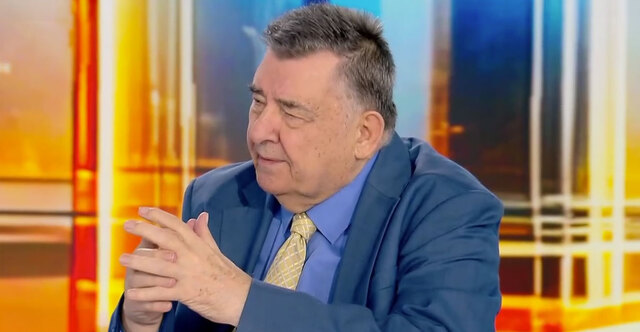

Pavlos Marinakis, Greece's deputy minister to the prime minister and government spokesperson, said the government has not yet restored a 13th pension payment or cut value added tax on fuel because "the math doesn't work out." He was speaking at the government's 16th citizen briefing, the first held since the 90th Thessaloniki International Fair.

The Thessaloniki International Fair is an annual trade exhibition in northern Greece where the prime minister traditionally sets out the government's economic policy for the year ahead. Prime Minister Kyriakos Mitsotakis used this year's fair to announce a package of measures, and Marinakis used the briefing to field questions from citizens about them.
Asked who benefits from the new measures, Marinakis said the government's core policy is raising disposable income across all social groups, and that the announcements cover the self-employed, salaried workers, pensioners, public sector employees, farmers, people with disabilities and families.
No 13th pension or fuel VAT cut
Pressed on why the government had not restored a 13th pension or lowered VAT on fuel, Marinakis said the government wanted to avoid loading future generations with new burdens or putting the country's fiscal stability at risk. He said Greece has cut 83 indirect and direct taxes to date, and that with the latest announcements the total will reach 91 tax cuts by spring, raising household income along the way.
On fuel VAT specifically, he said the issue required caution. The diesel subsidy introduced during a period of emergency conditions is continuing for one more month, he said, but the government needs to be certain that any further measure would actually reach citizens before acting.
Housing crisis for teachers
Asked about reports of a newly appointed teacher living in a tent, Marinakis said he would not sugarcoat the situation, calling the image genuinely shocking. He said the housing shortage cannot be solved overnight, particularly in tourist areas, but remains a core government priority.
He said that within 2026, teachers will receive a second rent payment on 25 September, covering the 2024 tax year retroactively, followed by a rent and double-rent refund for the 2025 tax year on 30 November. Marinakis said he would like to see island municipalities do more to support teachers and doctors, noting that some islands are already doing so.
Tax cuts for large families
Responding to criticism that a tax-free threshold of 20,000 euros only helps those earning around that amount, Marinakis said the government had not simply reduced the tax for farmers and families with three children but eliminated it entirely, as it already did last year for young people and families with many children.
He said the tax-free threshold of 20,000 euros does not only apply to people earning up to that amount. As an example, he said a parent of three children earning up to 20,000 euros a year will pay no tax at all, while a salaried parent of three children with an annual income of 30,000 euros, who previously paid 2,820 euros in tax a year, will now pay 1,020 euros.
Germany's far-right surge and Greece
Asked whether Greece could see a similar rise in far-right support after gains by the Alternative for Germany party, known as AfD, Marinakis said the party's result in the German state of Saxony was not driven only by migration or unemployment. He said populists had simply convinced voters they cared more than moderate politicians did.
Alternative for Germany is a far-right party that has made significant gains in recent German state and federal elections, particularly in the country's eastern states. Saxony is one of those eastern states.
Marinakis said that in Greece, populists of the left and the far right had governed together in the past and nobody's life improved as a result. He said the best response to extremists and populists is concrete policy results, citing border security and migration management as the clearest example.
He said the government inherited a situation of despair in 2019, when some argued that the sea has no borders. He said more than 50,000 undocumented migrants were once held in what he called shameful facilities in the North Aegean alone, a figure he said has since fallen to no more than 3,000.