Greece's Ministry of Education is preparing for the 2026-2027 school year with 5,259 new permanent teacher appointments, lockers in primary schools, thousands of defibrillators and interactive whiteboards, an expanded Digital Tutoring programme, and a new artificial intelligence system to forecast teacher shortages.
Education Minister Sofia Zacharaki presented the plan to the Cabinet, also announcing changes to Special Education, the National School Leaving Certificate, and student housing.
The plan covers 13,842 school units, more than 1.27 million students and over 145,000 permanent teachers, according to the briefing Zacharaki gave to the Cabinet on Monday, 24 August.
5,259 new permanent teachers, target of 30,000 substitutes from day one
Filling vacancies before schools open remains one of the biggest challenges. On 11 August, the ministry announced 5,259 new permanent appointments, bringing the total number of permanent appointments since 2019 to 53,912.
The ministry is also aiming to have around 30,000 substitute teachers in place from the very first day schools open, through the first phase of hiring.
At the same time, the number of teachers seconded away from classroom duties is being reduced. This year that figure stands at 1,590, down from 1,833 last year and 2,047 in the 2024-2025 school year.
EduPlan.AI: artificial intelligence for school staffing gaps
One of the biggest innovations Zacharaki presented is EduPlan.AI, a new digital system intended to make staffing planning more accurate.
The system will combine data on staffing positions and actual operational needs with demographic data and the specific characteristics of each school unit. In simple terms, the ministry wants to be able to predict earlier where shortages will occur, in which specialties, and how many teachers will be needed in each area, rather than planning mainly after problems have already appeared.
Housing measures for teachers working far from home
Zacharaki gave particular attention to the housing problems faced by permanent and substitute teachers on islands and in tourist areas, where high rents have created serious difficulties in recent years.
The plan includes doubling rent reimbursement, using public properties to create teacher housing in cooperation with local government, drawing on the Ministry of National Defence's housing programme, tax incentives for landlords who rent homes to teachers, and travel discounts for those taking up new postings.
Lockers in primary schools to lighten school bags
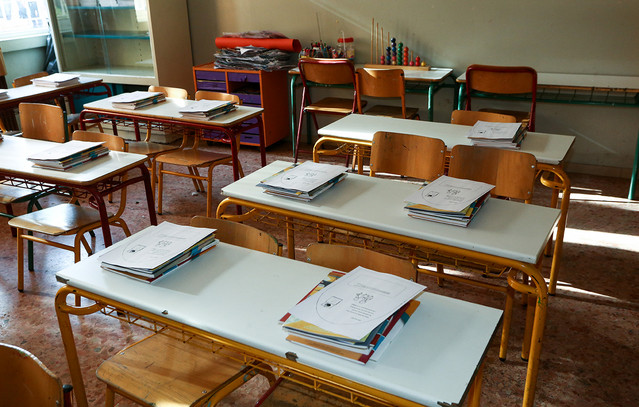
One change students will notice immediately is the installation of individual lockers in primary schools. Students will be able to leave books and school supplies there, so they no longer need to carry all their school items between home and school every day. The goal is to noticeably reduce the weight of school bags, an issue that has concerned parents and children for years.
6,479 defibrillators for schools
A major investment is also planned in safety equipment. Schools will receive 6,479 defibrillators, alongside a first-aid training programme. In addition, 4,550 school units will get new sports equipment.
More than 44,000 interactive systems
The digital upgrade of classrooms is also continuing. By the end of the school year, schools will have a total of 44,164 interactive systems. Over the summer, 2,900 new interactive whiteboards were delivered, with 5,000 more systems to follow.
The ministry has also distributed 117,121 robotics kits, while 1,600 science laboratories in middle schools will receive new equipment. Music schools will receive new musical instruments for the first time in 17 years, and equipment at art schools is also being renewed.
718 school buses for students with disabilities
A significant intervention is also planned for transporting students with disabilities. During the year, a tender will be launched for the procurement of 718 school buses, funded through the Social Climate Fund.
Eight new Onassis Schools and public IB programmes
The network of Public Onassis Schools is expanding with eight new school units. At the same time, 11 public schools are launching their first International Baccalaureate (IB) programmes, making it possible for the first time to obtain the IB qualification through public schools.
State language certification from school
Among the new initiatives is the pilot launch of a free electronic State Certificate of Language Proficiency for third-year middle school students. The programme will cover English, French, German and Italian, with the aim of allowing students to certify their language skills through the public education system.
Digital Tutoring expands to first and second year high school
The Digital Tutoring programme, which has surpassed 410,000 users, is expanding. Live lessons will no longer be limited to students preparing for national university entrance exams, as the programme will also extend to first and second year high school students. Through the EduAi programme, the ministry is also planning a digital assistant that will attempt to adapt Digital Tutoring materials and use to each student's needs.
FinStart: 40,000 students to learn how money works
A new addition is the FinStart financial literacy programme. About 40,000 students will be trained in basic practical skills: how to draw up a budget, how to evaluate different financial choices, and how to spot risks in digital transactions.
Innovation Centres are also increasing from 13 to 18, giving more students access to robotics, programming and modern digital tools.
Special education: 7,230 inclusion classes
In Special Education, 7,230 Inclusion Classes are now operating, supporting 71,184 students. Two new Centres for Educational and Counselling Support (KEDASY) are being created in Heraklion, Crete, and Santorini, while a digital platform is being developed to manage and track applications. The KEDASY centres have already received nine new assessment tools for diagnosing and supporting children and families.
National Leaving Certificate: proposal expected by November
A National Dialogue on secondary education and the National School Leaving Certificate is under way. So far 55 sessions have been held, and the committee is expected to submit its proposal in November 2026. A public digital consultation with students, parents, teachers and stakeholders will follow before final decisions are made.
The Multiple Textbook initiative, by contrast, is scheduled to be implemented from September 2027, alongside updated curricula.
Hundreds of schools being renovated
On the construction front, 669 schools have been included in the first two phases of the "Marietta Giannakou" programme. Studies for another 500 school units begin in September, and new schools built through Public-Private Partnerships will also open during the new school year.
Student housing: 90 million euros in benefits and 8,600 new beds
The interventions also extend to universities. Around 90 million euros is earmarked for the student housing allowance in 2026, while 8,600 new beds are being planned through Public-Private Partnerships. The overall goal is to add or renovate around 10,000 student beds over the next three years.
The university transfer process will also start earlier this year, with the aim of completing its main phase by mid-October.
Changes visible from September
The ministry's plan spans many areas, but for students and families the most immediate changes this year will be specific: more teachers from the first day, lockers in primary schools, new digital and laboratory equipment, defibrillators, an expanded Digital Tutoring programme, and more options within the public school system.
The real test, however, will be implementation. With 13,842 school units and more than 1.27 million students, the plan's success will ultimately be judged not by the number of announcements but by how many reach classrooms on time and are felt in everyday school life.