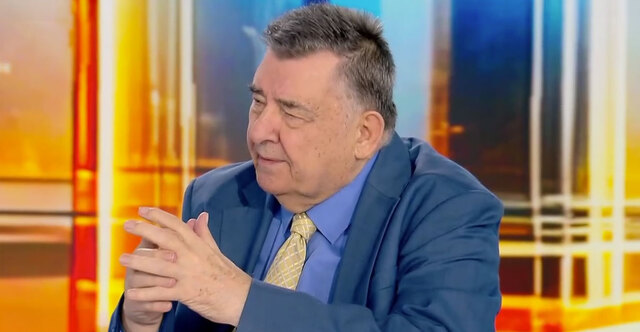
Greek Foreign Minister Georgios Gerapetritis said Greece would respond with any means necessary to any attempt to infringe on its sovereign rights, addressing recent moves by the Turkish government in an interview with the newspaper To Vima tis Kyriakis.
Gerapetritis said Greece would keep building its foreign policy in the region, and that anyone bothered by this, at home or abroad, should get over it. He said the era of passive diplomatic inaction in Greece was over for good, a remark he also aimed at domestic critics of the government.
Asked whether the Athens Declaration should now be considered dead, Gerapetritis said dialogue with Turkey was not an invention of the current government. He said every Greek government since the restoration of democracy had held talks with Turkey, often disorganized and unproductive, pointing to 64 rounds of exploratory contacts that he said contributed nothing substantial to strengthening Greece's national positions.


The Athens Declaration and structured dialogue
Gerapetritis said the Athens Declaration had, for the first time, established a structured dialogue built on three pillars, functioning as a channel to ease pressure in relations between the two countries. He said no one expected long-standing disagreements to vanish, noting the declaration itself allowed both sides to keep their legal positions intact.
He said that in an international environment marked by volatility and unpredictability, with wars spreading through the wider neighborhood, it mattered to have a clear framework for communication and peaceful resolution of disputes, especially one in which Turkey, for the first time, explicitly accepted the globally recognized principles of international law.

Turkey's regional ambitions
On Turkey's effort to build a leading role in the region and create facts on the ground against Greece, Gerapetritis said Turkish actions in the Aegean and the eastern Mediterranean were a reaction to Greek initiatives aimed at securing Greece's sovereign rights on the basis of international law.
He described these actions as part of a broader Turkish attempt to build a regional power profile backed by a strong defense industry and a presence in other countries, saying Turkey's presence in Libya and Syria was not always beneficial. He said recent Turkish interventions in Syria appeared to be pushing Ankara toward further assertiveness with consequences for security across the wider region. He added that no fait accompli can be produced unilaterally, something he said international law requires and that Greece, alone or through its alliances, always makes clear to all sides.
Why Greece pursued 'calm waters'
Asked whether Greece is now seeing the end of the "calm waters" policy, Gerapetritis said the approach was never an end in itself but a tool to serve Greece's national goals. He said it followed a prolonged period of escalating tension with Turkey that actively threatened peace in the region and could have led to conflict, making a functional relationship with Turkey a clear and nationally beneficial choice, one that reduced crises while strengthening Greece on multiple fronts.
He listed five results he said the policy delivered for Greece. First, violations of Greek national airspace fell, migration flows from the east were minimized, the eastern Aegean islands saw relief and economic development, and no major crisis emerged despite ongoing tensions.
Second, the time gained was used to grow the economy and the armed forces, which he said had suffered heavily during the financial crisis but have since been reinforced and now hold a position of superiority in the air and at sea, citing Rafale jets, upgraded F-16s, Belharra frigates, a new multidimensional force structure and F-35 jets Greece expects to receive.
Third, Greece advanced diplomatically and is now at the height of its influence, embedded in the core of major international organizations with strategic alliances including the United States, France, Israel, Egypt, India and Gulf states, while also mending ties with Libya and expanding its diplomatic footprint worldwide.
Fourth, improved relations with Turkey helped restart informal talks on the Cyprus problem after a long standstill, under the auspices of the United Nations Secretary-General.
Fifth, Greece set out, for the first time and unambiguously, legal and political arguments backing its national positions, including its Maritime Spatial Planning and its program to develop undersea resources, which he said cement Greece's sovereign rights in practice.
Cyprus energy links and territorial waters
Gerapetritis described the Greece-Cyprus electricity interconnection as a project of major importance that ends Cyprus's energy isolation. On the recent entry of the French company Meridiam as majority shareholder in the Great Sea Interconnector project, he said it confirmed the project's economic and technical viability, adding that Greece, in coordination with the Republic of Cyprus, would do what is required for its full and unobstructed completion.
On extending Greek territorial waters in the Aegean, he said extending them to 12 nautical miles is an inalienable right that Greece retains the right to exercise unilaterally, at a time and in a manner chosen by the Greek state.
International law and domestic criticism
Gerapetritis said international law cannot be applied selectively, and that Greece acts exclusively within the framework of international law, particularly the Law of the Sea. He said this is not self-restraint but a self-evident obligation and a conscious choice reflecting responsibility and institutional seriousness from a country governed by rule of law that respects the international order.
Responding to criticism the government has faced on the domestic front, he said this is what a responsible government does so it can later invoke international law on every front. He pointed to the extension of territorial waters in the Ionian Sea to Cape Tainaro, delimitation agreements on the Exclusive Economic Zone with Italy and Egypt, contracts awarded to energy majors to explore and develop deposits south of Crete, the Maritime Spatial Planning framework, and ongoing work on marine parks in the Aegean and Ionian seas. He challenged critics who fault the government over Turkey's expected reactions to these moves to explain why they never dared bring forward even one such action themselves.
Communication with Turkish counterpart
Asked about his relationship with his Turkish counterpart, Hakan Fidan, and whether personal channels of communication remain open, Gerapetritis said he and the Turkish foreign minister had achieved a satisfactory level of communication regarding each side's positions and red lines. He said this communication helped avoid major crises over the past three years and built a functional relationship benefiting both peoples.