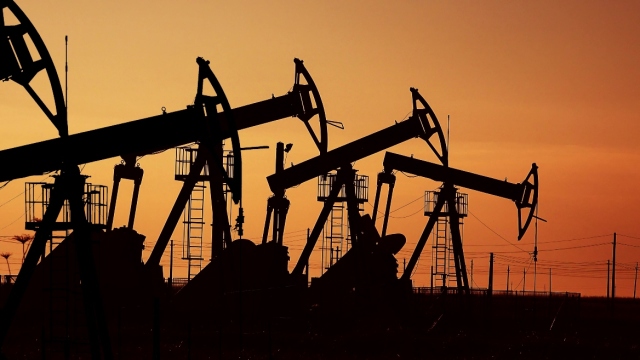
Crude oil prices rose for a fifth consecutive day on Friday as US President Donald Trump threatened economic sanctions against trade partners of Iran.
Brent crude futures settled at $94.39 a barrel, up 0.65 percent or 61 cents. West Texas Intermediate crude in the United States closed at $87.06 a barrel, gaining 0.26 percent or 23 cents.
For the week, Brent rose by 6.39 percent while West Texas Intermediate gained 5.66 percent. Both benchmarks touched their highest levels since July 24 during the previous session.
Brent crude is an international benchmark extracted from the North Sea that sets the price for two thirds of global traded oil. West Texas Intermediate serves as the main pricing benchmark for crude produced in the United States.
John Kilduff, a partner at the energy investment firm Again Capital, said sanctions were the only measure that had successfully forced Iran to back down.
Tehran warned on Friday that its response to any new US threats would be devastating. The statement followed a pledge from Washington to enforce the harshest economic sanctions in history to overthrow the Iranian leadership.

Crispous Nyaga, an analyst at brokerage firm Empire FX, said the immediate impact of the new sanctions on market supply could be limited because US naval blockades had already significantly curtailed Iranian exports.
Nyaga warned that an increase in maritime incidents and potential Iranian retaliation against economic sanctions could worsen market conditions at a time when traffic through the Strait of Hormuz remained far below normal levels.
Alternative Supply Routes and Market Sources
Energy markets have begun identifying alternative supply routes and sources while movement through the Strait of Hormuz faces ongoing restrictions. Phil Flynn, a senior analyst at Price Futures Group, said the Strait of Hormuz remained a concern but was no longer the only factor driving market prices.

Flynn explained that pipelines, ship shipments, American shale oil, recovering Venezuelan output despite infrastructure issues, and production from the United Arab Emirates were supplying additional barrels to global markets.
The United Arab Emirates is a major Middle Eastern crude exporter and a key member of the Organization of the Petroleum Exporting Countries, maintaining significant spare production capacity.
Despite these alternative sources, crude prices advanced because of persistent concerns over tight supplies from key Middle Eastern producers, including Saudi Arabia, Iraq, the United Arab Emirates, and Kuwait.

A previous peace agreement between the United States and Iran expired this week without either side taking steps to restart negotiations. Offers of Iranian crude to Chinese buyers fell while prices rose sharply, driven by the US blockade restricting shipments from Tehran and the threat of fresh sanctions from Washington.
Strait of Hormuz Disruptions and Refinery Attacks
Maritime movement through the Strait of Hormuz remains severely disrupted. Data from energy tracking firm Kpler showed that only seven cargo vessels crossed the strait on Thursday, representing a 50 percent drop compared to the previous day.
The Strait of Hormuz is a critical maritime transit corridor connecting the Persian Gulf to global ocean trade routes. Kpler is a global data intelligence company that monitors vessel movements and commodity freight flows.
Before joint US and Israeli military strikes against Iran began in late February, approximately one fifth of global oil and liquefied natural gas supplies passed through the strait. Energy flow disruptions remain active as the conflict approaches the six-month mark.
Global energy markets faced further uncertainty on Friday after Ukrainian President Volodymyr Zelenskyy announced that Ukrainian forces had carried out an overnight strike on a Russian oil refinery in Perm, located more than 1,600 kilometres from the Ukrainian border.
Perm is an industrial city in western Russia situated near the Ural Mountains, housing major refining infrastructure that processes crude oil for domestic and international markets.