

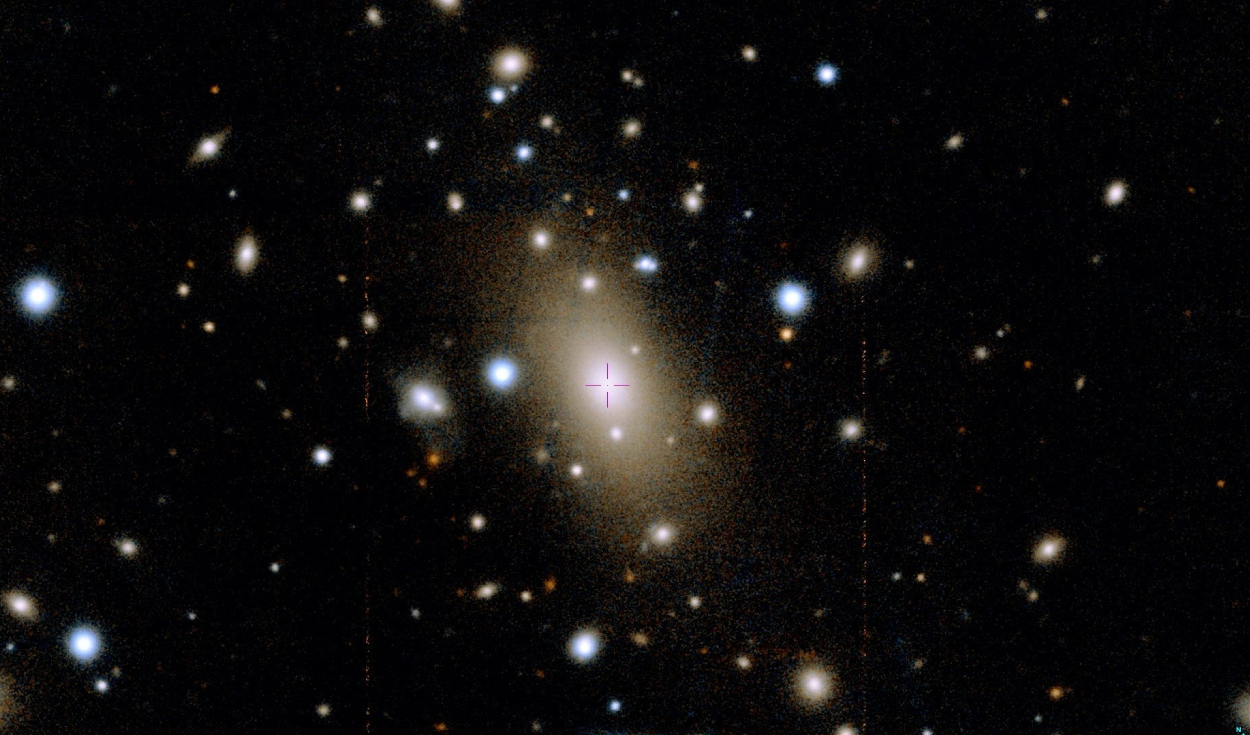
Astronomers have measured the true boundary of IC 1101, the largest known galaxy, confirming it spans roughly 520 kiloparsecs, or 1.7 million light-years, with a stellar mass nearly 3.4 trillion times that of the Sun. The findings appeared on July 16 in a preprint posted to the arXiv server.
The work addressed one of the central difficulties in studying giant galaxies: separating where a galaxy ends and where the faint diffuse light filling the space between members of a galaxy cluster begins. Researchers from the Instituto de Astrofísica de Canarias eliminated light contamination from more than 250 foreground stars, uncovering the true outer edge of IC 1101, which sits at the center of the galaxy cluster Abell 2029.
The team used ultra-deep images taken with the Wide Field Camera of the Isaac Newton Telescope. They built a detailed model of the telescope's optical behavior using dozens of reference stars, then removed foreground signals one by one to expose extremely faint regions that had previously been hidden.
By tracing how brightness changed from the center of IC 1101 outward, the team located a radius of 260 kiloparsecs, giving a projected diameter of 520 kiloparsecs. Previous estimates had put the galaxy's extent at up to 607 kiloparsecs, but that figure did not correspond to a clearly defined edge. The researchers noted that IC 1101's edge radius remains among the largest recorded for any individual galaxy.
IC 1101 belongs to a class called brightest cluster galaxies, structures that reach extraordinary sizes by absorbing smaller galaxies over billions of years, leaving visible traces in the form of stellar streams and large stellar halos. The Milky Way has a diameter of around 30 kiloparsecs, making IC 1101 roughly 17 times wider.
The observations also uncovered eight faint, extended, asymmetric stellar structures beyond the galaxy's main edge. Two of them align with disturbances previously detected in the cluster's hot gas through X-ray observations, pointing to ongoing mass intake. The authors said the outer regions of IC 1101 show clear signs of a continuing process of mass buildup, meaning the galaxy is still growing. That finding is consistent with a prior X-ray study that linked those disturbances to a collision between Abell 2029 and another galaxy group that occurred approximately 2 to 3 billion years ago.


