

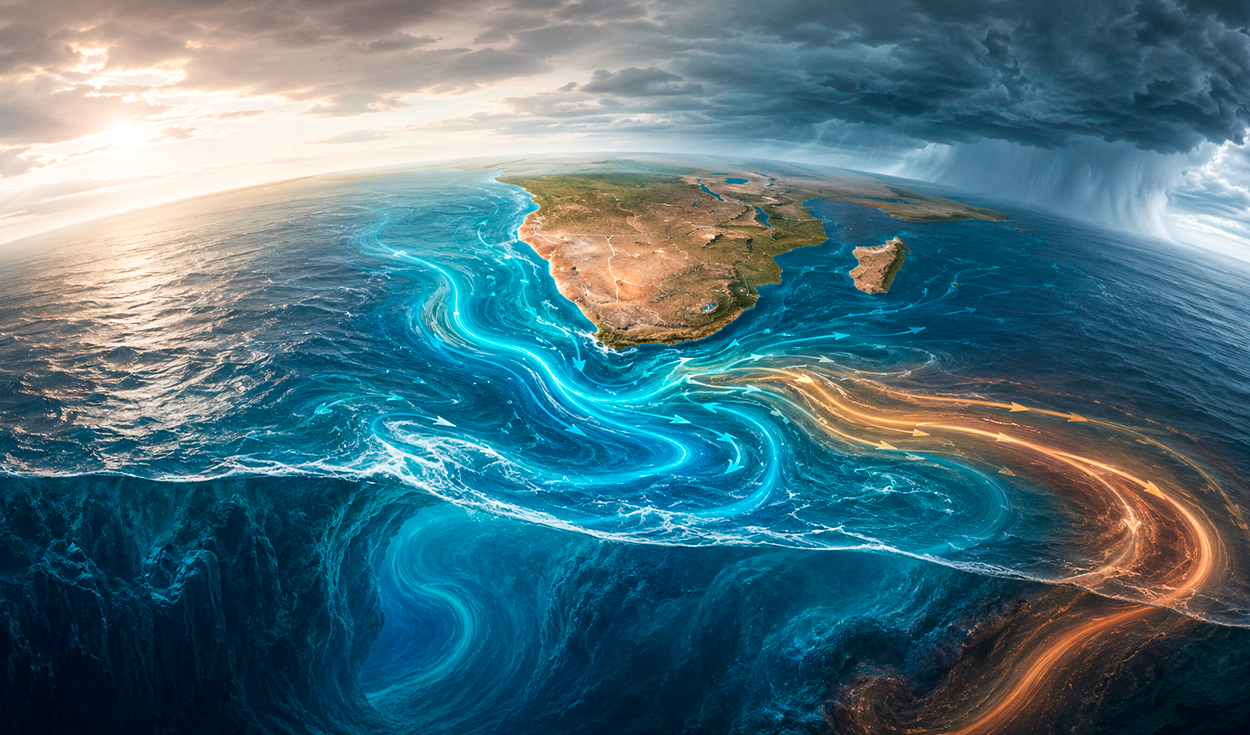
Scientists studying the Agulhas Leakage, an ocean current that carries salty water from the Indian Ocean into the Atlantic around the southern tip of Africa, have found that its connection to the Atlantic Meridional Overturning Circulation, known as AMOC, is far more complicated than researchers believed for decades. The findings appear in a study published in the journal Nature Geoscience.
AMOC plays a major role in distributing heat, carbon, nutrients and water resources around the planet, moving warm water north while sending cold currents back along the ocean floor. The study's authors said the new data do not suggest the system is stalling or point to an imminent collapse. Instead, they said the findings specifically call into question how much AMOC depends on water entering from the Agulhas Leakage under different climate conditions.
Testing a decades-old theory
Oceanographers had long held that the Agulhas Leakage strengthens AMOC by carrying warm, salty water from the Indian Ocean into the Atlantic. A higher salt concentration raises the density of seawater, a factor believed to drive the sinking of deep currents in the North Atlantic.
To test that theory, researchers examined sediments roughly 3.4 million years old, extracted from the Agulhas Plateau near southern Africa. Analysis of dinoflagellate fossils and organic biomarkers allowed them to reconstruct temperatures from the late Pliocene, a period when global temperatures ran about 3 degrees Celsius above preindustrial levels, and which the team used as a natural laboratory for measuring ocean variations.
The results revealed a paradox. During a cold phase, the transfer of water into the Atlantic dropped sharply, yet the formation of deep currents in the north actually intensified. That evidence breaks the assumed direct cause-and-effect relationship, since a smaller supply of salty water does not automatically weaken AMOC in every setting.
A basin-wide reorganization
The researchers compared signals from South Africa with records from the Gulf of Mexico, the Caribbean and other parts of the Atlantic. Francien Peterse, a researcher at Utrecht University, said the matching patterns allowed the team to interpret the phenomenon as a reorganization of the thermocline across the whole basin, rather than simply a regional anomaly.
The finding does not rule out the importance of the Agulhas Leakage, since water exchange between the Indian and Atlantic Oceans still affects global circulation. Evidence from the late Pleistocene shows salt fluctuations tied to AMOC, but the researchers said that link is more nuanced than assumed. How strong the connection is depends on the climate, ocean fronts and the position of continents in a given era, which reduces the role of certain physical mechanisms under different circumstances.
What it means for AMOC's future
The authors cautioned that these ancient episodes do not prove AMOC is immune to today's global warming. The modern system faces different pressures, including freshwater input from high latitudes, and multiple simulations project severe changes to the overturning circulation as global temperatures keep rising. Forecasting future scenarios, the authors said, requires evaluating salinity, freshwater, thermal boundaries and their combined interactions at the same time, rather than pinning the outcome on a single trigger.


