

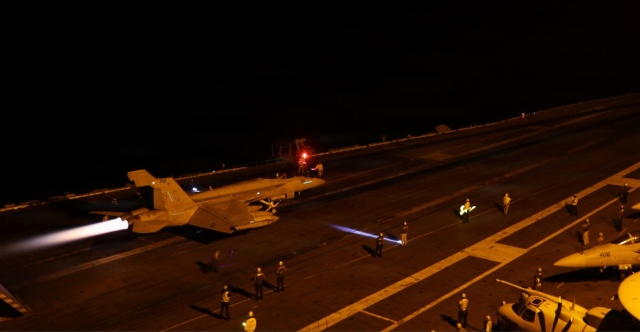
United States military forces bombed Iranian targets on Larak Island near the Strait of Hormuz on Sunday, prompting Tehran to launch retaliatory strikes against American bases in Jordan.
Iran's Islamic Revolutionary Guard Corps announced that it fired ballistic missiles and unmanned aerial vehicles at American military installations in Jordan after US air strikes destroyed two Iranian missile launchers, causing deaths and injuries among personnel.
US Central Command, the unified combatant command responsible for American military operations across the Middle East, confirmed that US forces targeted two launchers on Larak Island. Captain Tim Hawkins, a CENTCOM spokesman, stated that American forces struck the two launchers after discovering members of the Revolutionary Guards preparing to fire missiles loaded with naval mines into international shipping lanes in the Strait of Hormuz. The operation marked the first American bombardment inside Iranian territory in approximately one month.
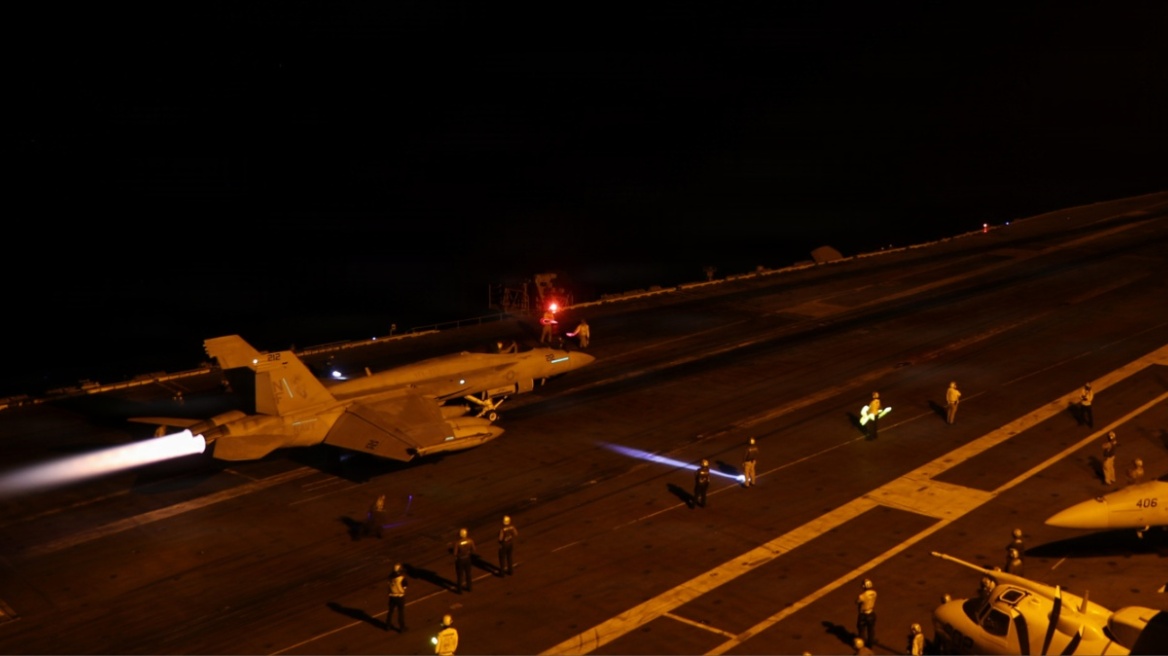
Following the bombardment on Larak Island, the Revolutionary Guards launched direct retaliatory attacks against two bases in Jordan where American military units are stationed. The Iranian military organization targeted technical facilities, maintenance infrastructure, and parked aircraft, while warning that any further hostile actions would trigger even stronger retaliation.
The Jordanian armed forces reported that their air defense units intercepted and destroyed eight missiles after the projectiles entered the airspace of the Hashemite kingdom. Jordanian military officials stated that they successfully neutralized the incoming threat shortly after Tehran announced its strikes on the American facilities, though they did not specify where the missiles had been launched from.
Conflict in the Strait of Hormuz
The exchange of strikes represents a major escalation following a brief reduction in regional hostilities, though sporadic clashes have persisted near the Strait of Hormuz. The narrow passage between the Persian Gulf and the Gulf of Oman, which carried roughly one-fifth of global hydrocarbon consumption prior to the war, remains effectively closed under Tehran's authority.

Iran has repeatedly targeted commercial vessels attempting to traverse the Strait without Iranian authorization, while the United States has responded by enforcing a naval blockade on Iranian ports in the Persian Gulf.
Captain Tim Hawkins noted that CENTCOM completed a specialized mine-clearing operation last week to remove naval mines from international shipping routes in the Strait of Hormuz. Hawkins added that American forces are maintaining close surveillance of the region and remain prepared to protect the free transit of commercial shipping through the vital waterway.

The regional conflict began on February 28, 2026, when joint air strikes by the United States and Israel targeted Iranian installations, leading Tehran to retaliate against Washington's allies across the Persian Gulf. A temporary ceasefire agreed in April halted 40 days of intensive exchanges involving aerial bombardment, ballistic missiles, and drone strikes.

In mid-June, opposing parties signed the Islamabad Memorandum of Understanding, establishing a diplomatic framework intended to end armed hostilities. However, the agreement collapsed in July, causing fighting to resume while diplomatic negotiations reached an impasse.

Economic Sanctions and International Relations
In addition to military action, Washington has moved to intensify economic pressure against Iran, an Islamic republic that has faced multilateral international sanctions for decades. US Treasury Secretary Scott Bessent introduced a series of secondary sanctions designed to target third-party commercial partners of Tehran rather than Iranian entities directly.
The new secondary sanctions cover international maritime shipping, commercial aviation, digital assets, technology transfers, and gold trade. Washington also issued specific sanctions against 60 individuals, commercial companies, and maritime vessels accused of assisting Iran with oil revenue generation, weapons procurement, and cyber warfare operations.

The secondary measures place significant financial pressure on China, the world's second-largest economy and a primary trading partner of Iran. The Chinese government in Beijing responded to the measures by declaring that it will vigorously defend its national interests and its ongoing economic cooperation with Tehran.
Iranian President Masoud Pezeshkian acknowledged that his nation faces severe economic difficulties, but asserted that American economic pressure will yield no concessions from Tehran. Iranian officials have ruled out returning to the pre-war status quo in the Strait of Hormuz, a stance that the United States and its regional allies reject as unacceptable while demanding the waterway's complete reopening. US President Donald Trump recently stated that the Strait of Hormuz will become American territory.


