

Scientists at the Wuhan Institute of Physics and Mathematics have published what they describe as the most precise measurement ever made of a key prediction of Einstein's general theory of relativity, achieving a margin of error of just 0.2 percent.
The results, published in the journal Nature, confirm the Lense-Thirring effect, the phenomenon by which a massive rotating body drags space-time around it. Previous measurements carried uncertainty of up to 10 percent.
The Lense-Thirring effect was first modeled mathematically in 1918 and is a direct prediction of general relativity. Around supermassive black holes it is pronounced, but around a body as small as Earth it is extraordinarily weak, making direct measurement highly challenging.
A satellite stripped to its essentials
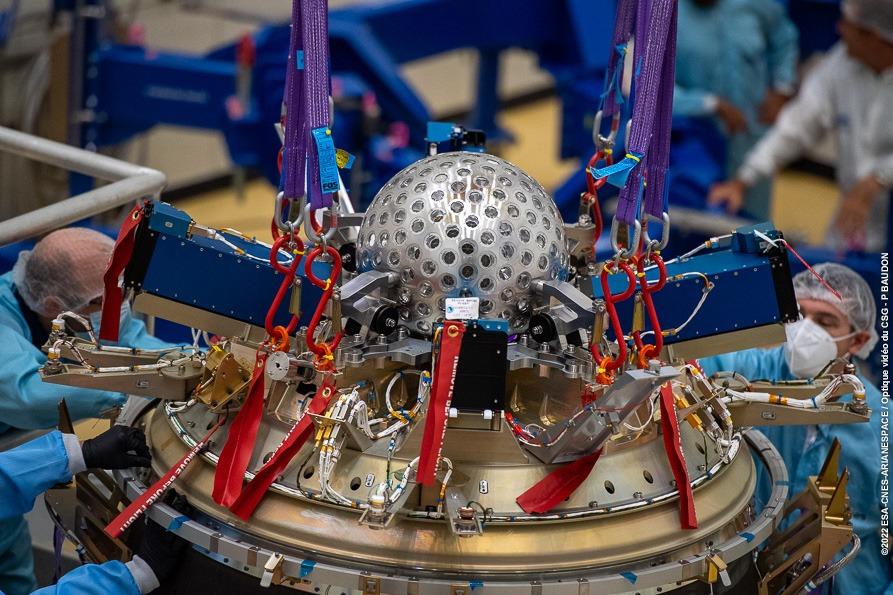
The key instrument was LARES-2, the Laser Relativity Satellite 2, developed by the Italian Space Agency. The satellite is a solid ball of nickel-chromium alloy roughly 40 centimeters in diameter and weighing approximately 295 kilograms. It carries no engines, solar panels, or onboard electronics. Its entire surface is covered with 303 corner reflectors that bounce laser pulses back to ground stations.
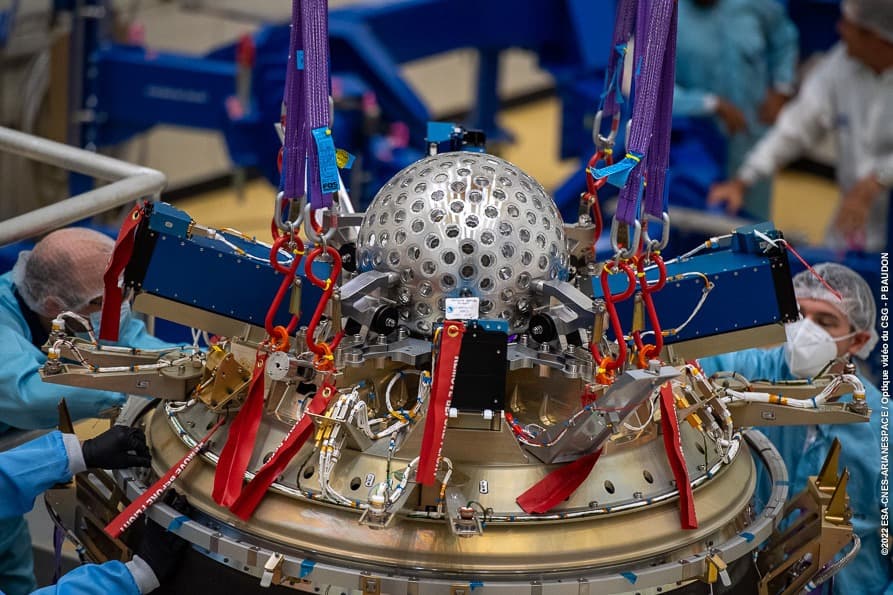
That dense, heavy design gives LARES-2 the lowest surface-area-to-mass ratio of any satellite in medium orbit, minimizing the influence of non-gravitational forces on its trajectory.
From July 2022 to June 2025, ground stations fired lasers at the satellite and recorded the returning signals, building a dataset of 200,000 observations accurate to one millimeter.
Filtering out the noise
Isolating the frame-dragging signal required filtering out the much stronger classical gravitational forces caused by Earth's uneven mass distribution. Researchers combined LARES-2 data with measurements from LAGEOS, a NASA satellite launched in 1976. The orbital planes of the two satellites are separated by 180.01 degrees, nearly the ideal 180 degrees needed for their classical gravitational perturbations to cancel each other mathematically.
A further source of interference was the K1 lunisolar tide, a fluctuation in Earth's gravitational field caused by the combined pull of the Moon and the Sun. The team resolved this by exploiting the 1050-day precession cycle over which the tidal influence naturally averages out, processing the data with GEODYN software developed at NASA's Goddard Space Flight Center.
Matching Einstein exactly
After removing all interference, the scientists measured an orbital shift of 61.3 milliseconds of arc per year attributable solely to Earth's rotation, a value in precise agreement with Einstein's predictions.
The authors say the result also tightly constrains alternative theories including Chern-Simons gravity, which attempts to reconcile general relativity with quantum mechanics. The experiment additionally produced the most accurate measurements to date of the K1 lunisolar tide, which the researchers say will benefit future geophysical studies of Earth.


