
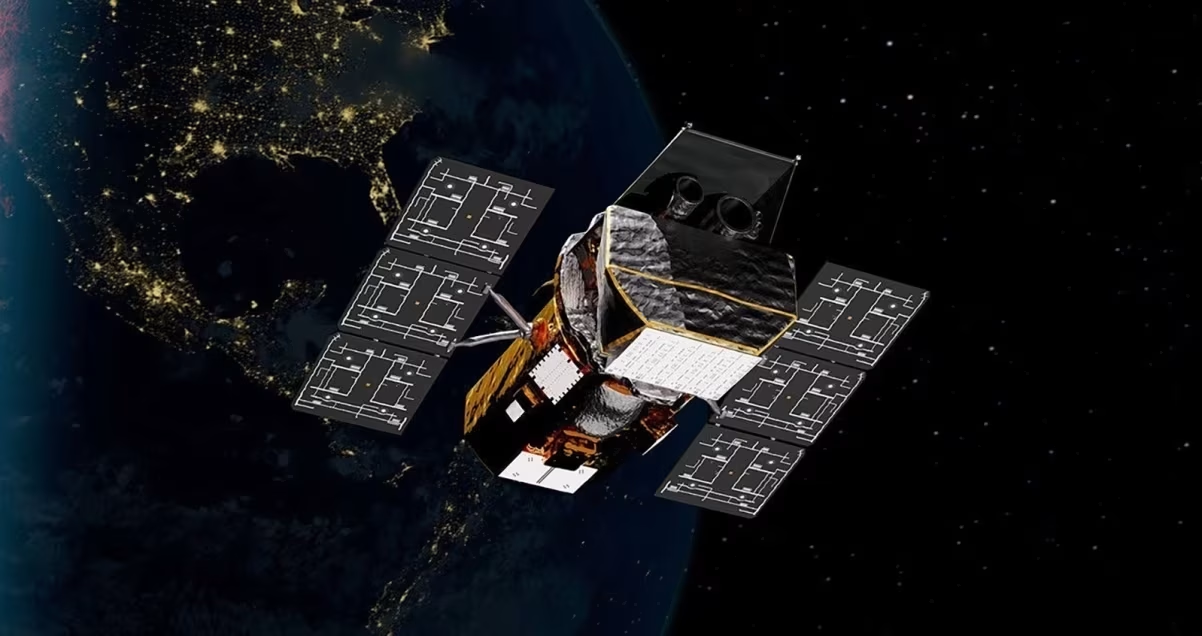
Chinese researchers aboard the Tiangong space station have set a new record for artificial cooling by chilling a gas of atoms to 9.7 picokelvins.
The landmark result, published on 5 November in the scientific journal Science, represents a temperature less than ten trillionths of a degree above absolute zero, the theoretical boundary where all thermal energy reaches its lowest possible point.
A picokelvin is one trillionth of a kelvin, the temperature scale used by physicists where zero represents absolute zero. That baseline corresponds to minus 273.15 degrees Celsius. While laws of thermodynamics prevent matter from ever reaching absolute zero exactly, cooling substances to within fractions of a degree of the limit allows scientists to witness physical behaviours that never appear under normal conditions.
In the Tiangong experiment, the research team subjected an atomic gas to extreme chilling to investigate the mechanics of the quantum realm, the branch of physics that governs nature at the atomic scale. Under these extreme conditions, the scientists produced a Bose-Einstein condensate, an unusual state of matter where a group of atoms stops behaving as independent particles and instead acts as a single collective quantum system.
Physicists Satyendra Nath Bose and Albert Einstein first predicted this exotic state of matter in theoretical papers during the 1920s. When particles are cooled to near absolute zero and occupy the same quantum state, their individual distinctions blur. This collective behaviour gives researchers a rare opportunity to observe and test quantum phenomena on a macroscopic scale.
Microgravity in orbit
The measurement of 9.7 picokelvins marks a major advance over earlier records established in atomic cooling experiments. The achievement was made possible by conducting the research aboard Tiangong, China's crewed space station operating in low Earth orbit, where microgravity creates experimental conditions that terrestrial laboratories cannot reproduce.
In conventional ground laboratories, Earth's gravitational pull constantly drags cooled atoms downward, disrupting the delicate clouds and limiting the time available to study them. In the near-weightless environment of orbit, researchers can observe ultracold atoms with far less gravitational interference. That stability enables exceptionally precise measurements and provides unprecedented control over fragile quantum systems.
Testing Einstein's theory of gravity
The researchers reported that the orbital cooling technique could open new pathways for studying fundamental physical phenomena, including the fundamental behaviour of gravity. According to the study, the method developed on the space station could also facilitate future experiments testing Albert Einstein's theory of gravity.
Einstein formulated his general theory of relativity in 1915, describing gravity not as an ordinary force, but as the bending of space and time caused by matter and energy. Finding ways to unify general relativity with quantum mechanics remains one of the greatest unresolved challenges in modern physics, and ultra-cold atomic experiments in space offer a promising way to test the boundaries between the two frameworks.
The team concluded that the findings highlight the growing potential of space-based laboratories to expand quantum physics research, paving the way for future orbital experiments that depend on reaching the lowest temperatures in the universe.