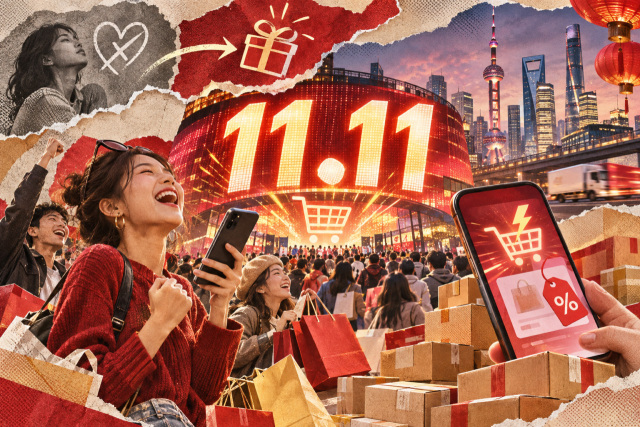
China's Singles' Day, the November 11 shopping festival that began as a university joke, has grown into a commercial event where billions of yuan change hands and millions of shoppers hunt for discounts. Every year on 11.11, Chinese businesses treat the date as their most important sales day.
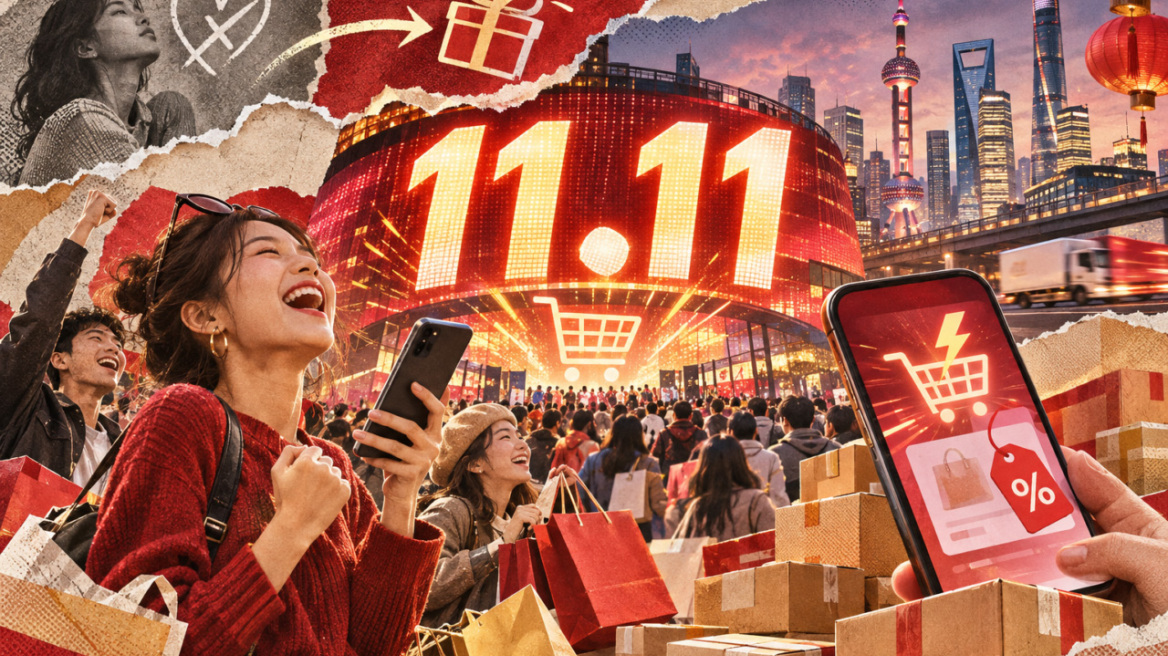
It is not Christmas and it is not Black Friday. It is Singles' Day, a celebration that started as a joke among students, became a symbol of personal independence, and ended up as the largest annual commercial event in Chinese e-commerce.
A Student Joke Becomes a National Holiday
The idea dates back to 1993 at Nanjing University. According to the most widely told version of the story, a group of students decided that bachelors deserved their own holiday, since couples already had Valentine's Day.
The date chosen was 11 November, written as 11/11, because the four ones stood alone, symbolizing a person without a partner. It was originally called Bachelor's Day and had the feel of an informal student celebration, with participants holding gatherings, going out for meals and exchanging small gifts to mark being single.
The idea gradually spread beyond universities and was eventually celebrated by both men and women, becoming a kind of Chinese anti-Valentine's Day. No one at the time could have imagined that this small act of independence would evolve into one of the biggest commercial experiments in history.
Alibaba Turns the Joke into a Sales Event
The real turning point came in 2009, when Alibaba, the Chinese e-commerce company, decided to turn the informal holiday into a major online discount event. An Alibaba executive named Daniel Zhang, who went on to become the company's chief executive, was central to organizing the first large November 11 sales campaign through Taobao Mall, later renamed Tmall.
Only 27 brands took part. Discounts reached at least 50 percent, and shipping was free across the country. The result was striking for the time: 52 million yuan in sales in a single day.
Billions of Yuan in Minutes
Growth in the years that followed outpaced almost every expectation. Sales climbed to nearly one billion yuan in 2010 and reached 268.4 billion yuan by 2019.
At its peak, the event resembled a sporting final more than an ordinary sales period. Shortly before midnight on 10 November, millions of shoppers waited with digital shopping carts full and discount codes ready to activate the moment the clock struck midnight.
In 2019, Alibaba recorded 10 billion yuan in sales in just one minute and 36 seconds. At the busiest point, the platform processed up to 544,000 orders per second. Behind the record-breaking numbers, warehouses, delivery firms and workers faced the challenge of turning millions of clicks into real deliveries.
A Global Retail Phenomenon
Singles' Day quickly crossed China's borders and became one of the most powerful events in global retail. By 2025, the total value of sales across online platforms during the extended promotional period reached about 1.695 trillion yuan, or roughly $240 billion, according to market estimates.
That figure needs an important caveat: it covers the whole extended discount period rather than 11 November alone, and it reflects transaction value rather than companies' net revenue. Even so, the scale places 11.11 at the top of global retail events, often well above the Western Black Friday and Cyber Monday.
Phones, cosmetics, clothing, appliances, luxury goods, household items and food all feature in the sales. Alibaba is no longer alone in the race: JD.com, Pinduoduo and Douyin now compete for a share of the spending.

For businesses, Singles' Day has become far more than a day of higher sales. It is a massive operation involving marketing, inventory management, logistics and customer acquisition, with preparations starting weeks in advance, advertising budgets rising, and brands negotiating premium platform exposure, exclusive launches and live product demonstrations. Coupons, bundled offers, loyalty programs, free shipping and time-limited discounts are all deployed. Heavy discounting squeezes profit margins, advertising costs eat into revenue, and companies must handle enormous volumes of orders and returns, making the festival both the biggest opportunity and one of the toughest tests for Chinese retail.
Livestreams and the Lipstick King
Along the way, the festival gained another dimension: livestream shopping. Popular hosts began selling products live to huge online audiences, showing clothes, testing cosmetics, answering questions and announcing deals with theatrical countdowns, turning shopping into spectacle.
Some hosts became commercial powerhouses in their own right. Austin Li, known as the "lipstick king," became one of the most famous figures in Chinese online sales. During Singles' Day 2026, Li advertised access packages for artificial intelligence tools, selling 100,000 monthly subscriptions in just 30 minutes, a sign that a festival once built around clothes, cosmetics and electronics now sells computing power for AI applications too.
2026: Caution Replaces Frenzy
This year's 11.11 reveals a significant shift. Singles' Day remains a huge commercial event, but Chinese consumers are no longer shopping with the same enthusiasm as before. Economic uncertainty, pressure on incomes and a prolonged crisis in the property market have made households more cautious.
More shoppers are calculating spending carefully, comparing prices and avoiding purchases they consider unnecessary. Stockpiling large quantities of products simply because they are discounted has lost some of its old appeal.
Platforms have adapted. Complicated coupon rules are gradually being replaced by simpler discounts, and the traditional midnight rush is giving way to calmer shopping. In 2026, JD.com launched its campaign on 12 October, while Alibaba and Douyin started on 15 October. A festival that once lasted 24 hours has turned into a sales period of almost a month.
Despite the longer window, growth is not guaranteed. Available data through the end of October 2026 shows modest growth compared with last year, far from the explosive rates seen over the past decade.
AI Becomes the Personal Shopper
The most interesting new chapter of Singles' Day is being written by artificial intelligence. China's major platforms are deploying digital assistants that can compare products, search for discounts, recommend purchases and, in some cases, complete orders.
Alibaba has linked its Qwen system to its vast product catalog, while JD.com promotes a shopping assistant called Dongdong, which the company says now has close to 80 million users, more than three times last year's figure. AI is also moving into the sales process itself, with virtual hosts appearing in livestreams, apps letting shoppers try on clothes digitally, and personalized recommendations becoming increasingly sophisticated. 11.11 is no longer just a price war; it has become a testing ground for the future of global e-commerce.
Perhaps the greatest irony of Singles' Day lies in the distance between its original idea and its current form. The Nanjing University students wanted to celebrate independence from the pressure of romantic relationships. The modern consumer industry turned that message into an invitation to shop, transforming "I don't need a partner to be happy" into "I can buy myself a gift." Thirty-three years after the 1993 student joke, 11 November continues to show how a clever idea can turn into an economic phenomenon of global scale.