The Spanish government has accelerated annual funding for a multi-billion euro rail tunnel beneath the Strait of Gibraltar to connect Spain and Morocco.
The administration led by Prime Minister Pedro Sanchez has directed several million euros each year to the state-owned study company SECEGSA, which is attached to the Ministry of Transport. The capital injections aim to advance technical preparations for the long-planned fixed link between the Iberian Peninsula and North Africa.
The total investment required for the fixed link is estimated to exceed 8 billion euros, with official projections placing the eventual inauguration between 2035 and 2040 at the latest. However, the Spanish government has examined whether the railway crossing could be completed in time for the 2030 FIFA World Cup, which Spain and Morocco are scheduled to host jointly alongside Portugal.

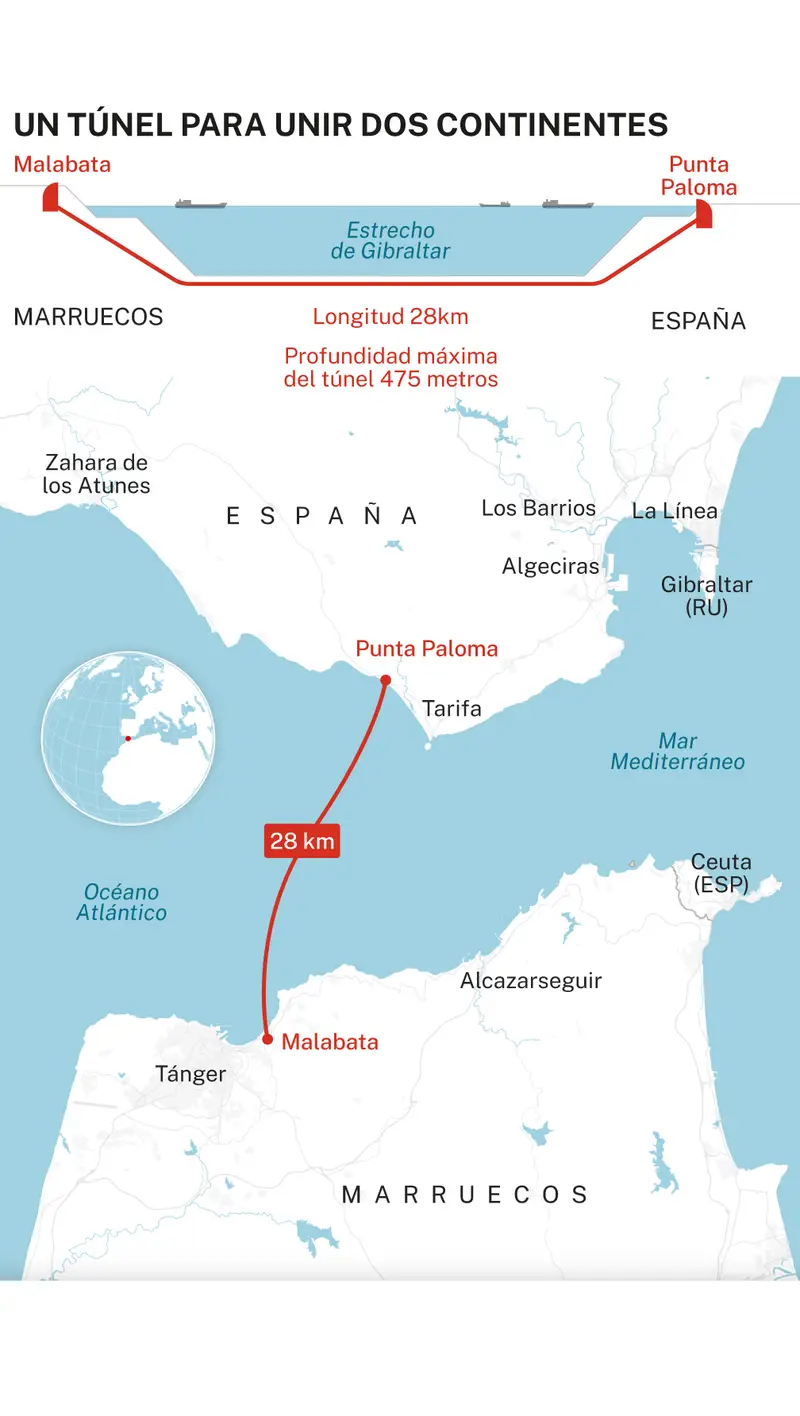
Current engineering plans specify an overall route length of approximately 40 kilometres, with slightly more than half of the alignment running beneath the seabed. The rail corridor will connect Punta Paloma, located in the southern Spanish province of Cadiz, directly with Cape Malabata, situated near Tangier on the northern coast of Morocco.
The Strait of Gibraltar forms the maritime gateway between the Atlantic Ocean and the Mediterranean Sea, separating the European continent from Africa by only 14 kilometres at its narrowest point. Formal bilateral interest in establishing a permanent crossing dates back to 1979, when the two kingdoms agreed to examine technical feasibility, before reviving and intensifying joint research in 2003.
Budget acceleration and funding timeline
Spain maintained only minimal financial support for the undersea crossing for decades before initiating a sharp spending increase. Between 2018 and 2022, SECEGSA, known in full as the Spanish Society for Fixed Communication Studies across the Strait of Gibraltar, received roughly 50,000 euros each year from the central government.
State backing doubled to 100,000 euros in 2022, according to company records. That adjustment marked the beginning of a deliberate budget acceleration under the Sanchez government, designed to shorten preparatory schedules and move the initiative beyond preliminary paperwork.
Funding expanded into multi-million euro territory in 2023. The Ministry of Transport provided 750,000 euros from its ordinary budget and matched that sum with an additional 750,000 euros drawn from Spain's Recovery, Transformation and Resilience Plan, delivering an annual total of 1.5 million euros.
The economic injection reached its highest annual level in 2024, when Madrid allocated 3,264,000 euros to the project. That contribution combined 2,739,000 euros from the Ministry of Transport's annual budget with 525,000 euros from European Union funds. In 2025, investment remained at a similar scale of 3,014,000 euros, incorporating another 2,739,000 euros from the ministry and 275,000 euros from European financing.
The most recent transfer, executed during the 2026 financial year, delivered 1,739,000 euros directly from the Ministry of Transport. Total state subsidies and transfers to SECEGSA since Sanchez assumed office in 2018 now stand at 9,797,000 euros, confirming an upward funding trend that has persisted over the past four years.
Moroccan media organisations have welcomed Madrid's sustained budget increases. Commentators in the country have praised the Spanish government's renewed commitment to advancing the transcontinental infrastructure scheme.
Moroccan contributions and bilateral financing
Spanish financial commitments correspond to equivalent spending targets established on the other side of the strait. Morocco plans to allocate approximately 11 million euros next year for the Gibraltar tunnel undertaking, according to figures released by the Moroccan Ministry of Equipment and Water.
Rabat coordinates its participation through its own dedicated state entity, the National Society for Strait of Gibraltar Studies, or SNED. Since bilateral work began in 1979 and regained momentum in 2003, more than 100 million euros has been poured into technical research, with cumulative costs divided almost equally between Spain and Morocco at roughly 50 percent each.
The tunnel programme sits within a broader expansion of commercial and transport partnerships between Madrid and Rabat. In another major bilateral transaction, Spain approved a financing credit of more than 750 million euros to upgrade Morocco's railway network and renew its passenger train fleet.
Engineering design and geological challenges
Current technical specifications for the Strait of Gibraltar crossing follow the multi-tube design used in major international subsea tunnels. The scheme envisions three parallel galleries: two outer tubes reserved exclusively for railway traffic and a central service tunnel dedicated to maintenance, ventilation, and emergency evacuations.
Transport planners have ruled out private motor vehicle traffic within the link. Personal cars and freight lorries would instead board dedicated shuttle trains to cross between continents, avoiding exhaust fumes and ventilation hazards inside deep undersea tunnels.
The alignment will descend to an unprecedented maximum depth of 475 metres below sea level. Engineers must overcome the Camarinal Sill, a shallow underwater ridge that presents severe geotechnical obstacles. Fractured rock strata, complex fault systems, and powerful marine currents along the ridge combine to slow excavation speeds and complicate exploratory drilling.
Future construction and international financing
The money spent so far covers only exploratory investigations, mapping, and feasibility studies supported by domestic tax revenues and European recovery mechanisms. Full-scale physical construction will demand vastly greater financial resources. Spanish officials anticipate that major international private investment funds and the European Union will participate directly in funding the civil engineering work.
Authorities intend the Gibraltar fixed link to function in the same manner as the Channel Tunnel between the United Kingdom and France. That 50-kilometre undersea railway, opened in 1994 beneath the English Channel, demonstrated the economic viability of carrying high-speed passenger trains and vehicle shuttles between separate nations.
Both governments continue to advance exploratory work through SECEGSA and SNED to determine whether construction schedules can be accelerated. While the official target window remains set between 2035 and 2040, transport authorities on both sides of the strait remain focused on whether key sections could be operational for the 2030 World Cup.