

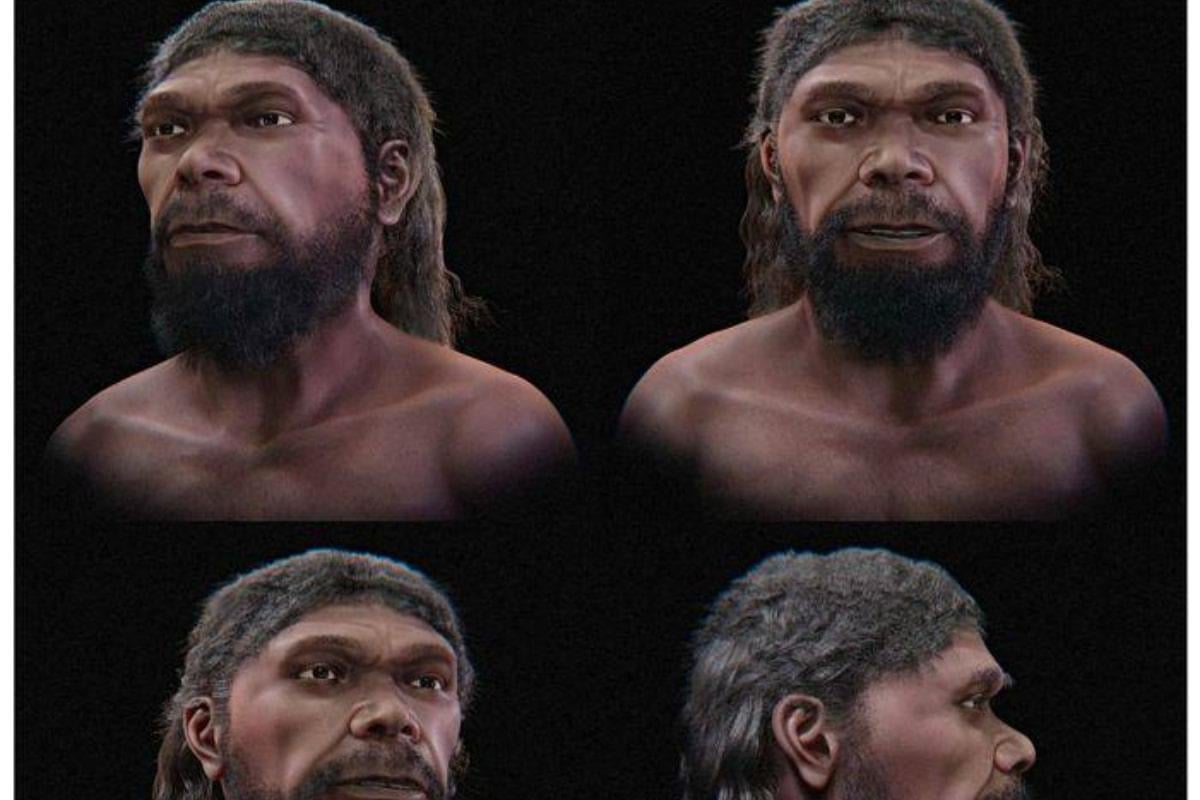
Scientists have reconstructed the appearance of a human who lived roughly 315,000 years ago in modern Morocco using fossils from the oldest known Homo sapiens.
The digital facial approximation, reported by the Romanian science publication Descopera.ro, was created by 3D designer Cicero Moraes and published in the academic journal Heritage.
Moraes explained that an individual from Jebel Irhoud could walk unnoticed through a modern city crowd, although a closer inspection would reveal several distinctive characteristics, particularly massive facial bones and a prominent lower jaw.
Reconstruction from composite fossils
To recreate the ancient face, researchers assembled a digital skull using multiple fossil fragments found at the Moroccan site. Specialists at the Max Planck Institute for Evolutionary Anthropology in Germany originally merged these prehistoric remains into a single unified 3D model.
The primary structure of the braincase and the upper face came from the original fossil cranium discovered at the location, catalogued as Irhoud 1. Because that skull lacked a mandible, researchers incorporated a lower jaw and teeth recovered from different skeletal remains found within the same archaeological deposit.
The resulting image does not depict a single historical individual, but rather a composite representation of the population. Moraes noted that the jaw and teeth from the second individual fitted the upper skull remarkably well, suggesting that the cranium would look virtually identical even if the original jawbone had been preserved.
Digital modelling and anatomy
The team generated a 3D digital model of the skull using photographic and video records published alongside earlier research papers in 2017. Moraes then used a computed tomography scan from an anonymous living adult, digitally altering the modern donor skull to match the precise shape and proportions of the Moroccan fossil.
Facial soft tissues were mapped onto the digital bone structure, with tissue thickness estimated using anatomical measurements taken from modern humans. Forensic specialists and digital artists have developed and tested this digital anatomical deformation approach since at least 2013 to estimate living appearances from bare bone.
The researchers stressed that soft tissues cannot survive for hundreds of thousands of years. Because of that natural decay, modern anatomical data provides an unavoidable approximation rather than absolute proof that prehistoric populations shared the exact same soft tissue distribution.
The team also measured the internal capacity of the reconstructed cranium, recording an endocranial volume of 1,364 millilitres. This figure aligned closely with an earlier estimate of 1,375 millilitres, confirming the overall proportions of the model while acknowledging that no facial reconstruction can claim complete precision.
Monochrome and realistic versions
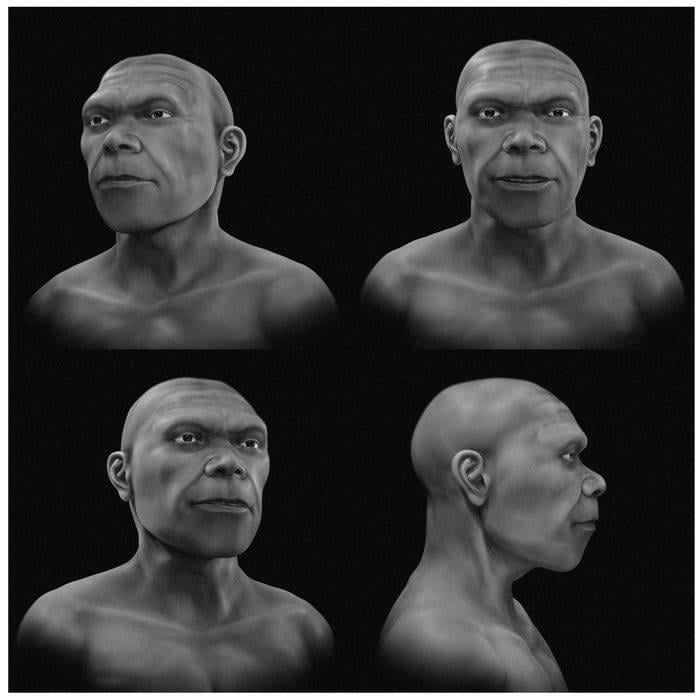
The project produced two distinct visual representations of the Jebel Irhoud individual. The primary scientific version is a neutral monochrome image without hair, focusing strictly on anatomical structure and facial proportions.
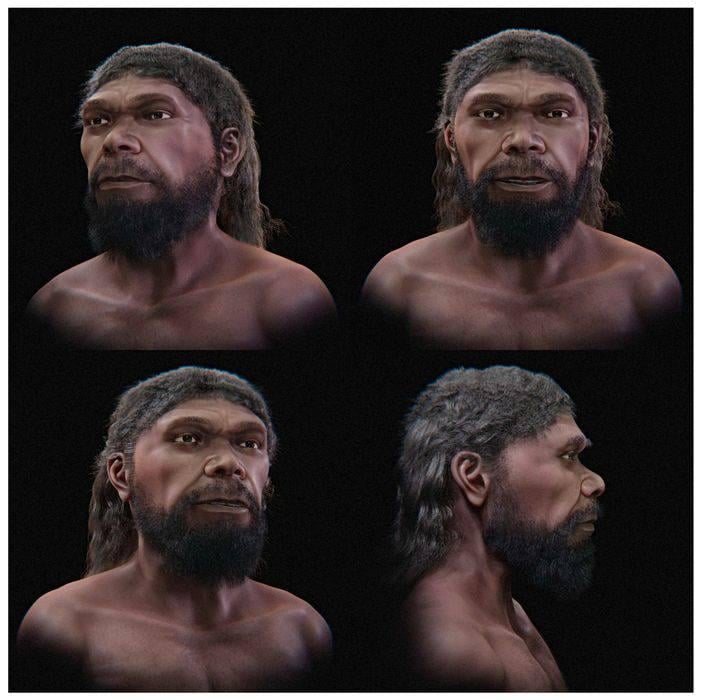
A second rendering presents a full-colour portrait showing realistic skin pigmentation, dark eyes, shoulder-length hair, and a beard. Moraes acknowledged that this colour version relied most heavily on artistic interpretation.
Moraes explained that regarding subjectivity, it was fair to say that the colour image, together with facial hair, was the most artistic version and contained fewer elements strictly supported by scientific evidence.
Discovery at Jebel Irhoud
The discovery of the fossils dates back to the early 1960s at Jebel Irhoud, an archaeological site located roughly 100 kilometres west of Marrakesh in Morocco. A worker extracting minerals in a local mine unexpectedly uncovered a fossilised skull embedded in cave deposits.
Scientists initially believed the cranium belonged to an African Neanderthal who lived approximately 40,000 years ago. Early researchers struggled to place the specimen because its heavy brow ridge and elongated braincase differed sharply from the rounded skulls of contemporary humans.
Subsequent archaeological excavations across the site yielded additional human skeletal remains alongside Middle Stone Age flint tools and animal bones. In 2017, two landmark studies established that the fossils represented early members of our own species, Homo sapiens, rather than Neanderthals.
Dating analyses determined that the fossils were approximately 315,000 years old, with an uncertainty margin of about 34,000 years. The finding pushed back the documented history of modern humanity by roughly 100,000 years, revising scientific understanding of where and when Homo sapiens first emerged.
Significance for human evolution
The Max Planck Institute for Evolutionary Anthropology, based in Leipzig, Germany, played a central role in re-evaluating the Moroccan fossils. The institute is internationally recognized for its research into palaeoanthropology, ancient genetics, and the evolutionary lineage of early humans.
Before the redating of the Jebel Irhoud remains in 2017, the oldest known Homo sapiens fossils were dated to around 195,000 years ago, discovered at the Omo Kibish site in Ethiopia. That earlier evidence supported a long-standing theory that modern humans arose exclusively in an East African cradle.
The discovery of 315,000-year-old Homo sapiens in North Africa demonstrated that our species developed across a much broader geographic range across the continent. By translating those fossilised bones into a lifelike human face, the reconstruction offers a direct visual encounter with the earliest known chapter of modern human history.


