

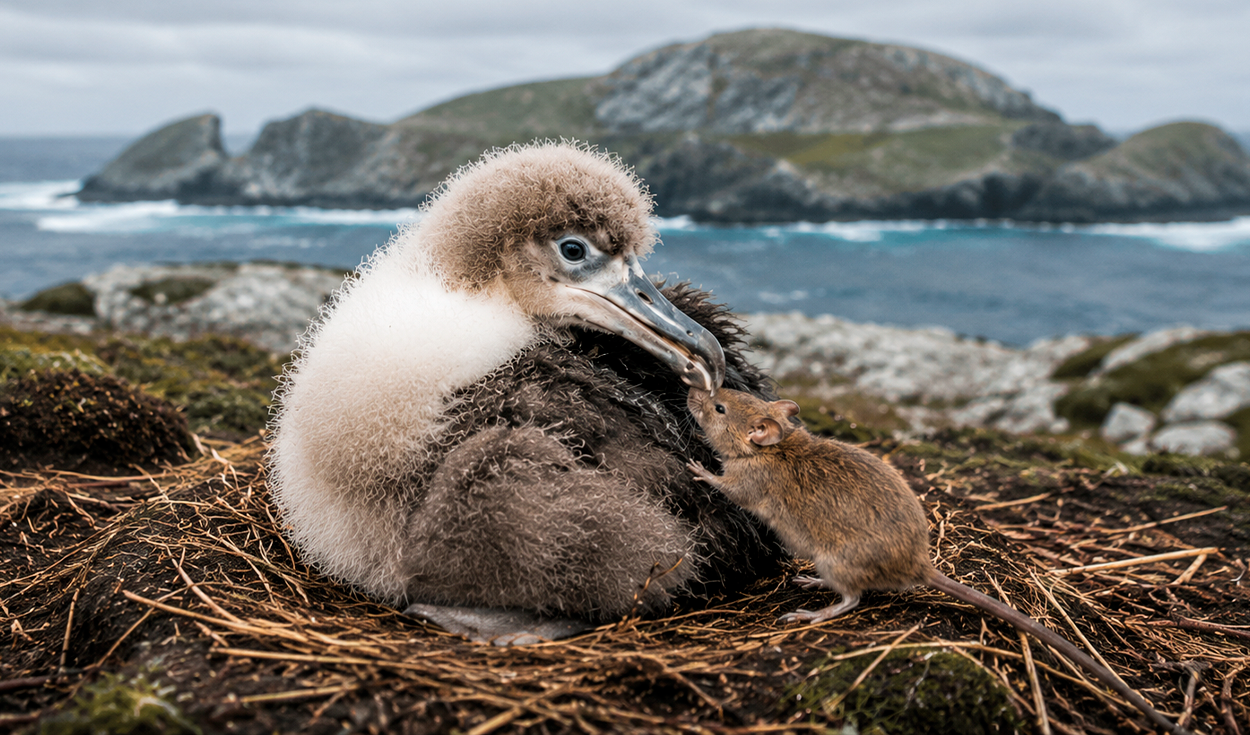
Scientists and environmental authorities are preparing what they describe as the largest rodent eradication ever attempted, targeting an invasive mouse population that has turned carnivorous and is killing albatrosses on Marion Island, a remote subantarctic territory administered by South Africa.
The initiative, called Mouse-Free Marion, is being run in partnership with the South African government and BirdLife South Africa. Anton Wolfaardt, the project's director, said that conservation rarely offers miracle solutions, but that eradicating introduced species on islands is the closest thing available.
How mice became predators
House mice were brought to Marion Island by sailors in the 19th century and over time shifted their behavior to become aggressive nocturnal carnivores. The rodents attack seabird chicks, biting their heads, necks, and backs until the animals die.
Scientists say climate change has driven a rapid surge in the mouse population while also reducing the invertebrates the animals previously fed on during winter. Pushed by food scarcity, the mice began hunting native birds that evolved without land-based predators and have no defensive instinct. The birds remain completely still while incubating eggs or protecting chicks, making them easy targets.
A helicopter-led rodenticide campaign
The eradication plan calls for an initial phase of bait distribution followed by a large-scale aerial rodenticide drop scheduled for the austral winter of 2028. A fleet of helicopters will use GPS precision to cover every part of the island's terrain. Wolfaardt said the operation is a necessary step to correct damage caused by humans in the past.
Marion Island holds around 50 percent of the global population of wandering albatross and serves as a refuge for grey-headed, sooty, and light-mantled albatrosses. Scientists warn that without intervention, invasive rodents could locally eliminate 19 of the island's 29 bird communities within decades, a threat compounded by an outbreak of highly pathogenic avian influenza H5N1.
A previous attempt to control pests with cats introduced in 1949 killed an estimated 450,000 birds per year before the cats were themselves eradicated in 1991. Specialists now describe removing the mice as the last piece of the puzzle for restoring environmental stability to the territory.
The team pointed to comparable efforts in New Zealand, where rodents have been cleared from more than 300 island territories using GPS technology and helicopters, and a similar achievement in South Georgia. Wolfaardt's team said completing the Marion Island project would represent one of the greatest conservation victories ever achieved on an island.


