

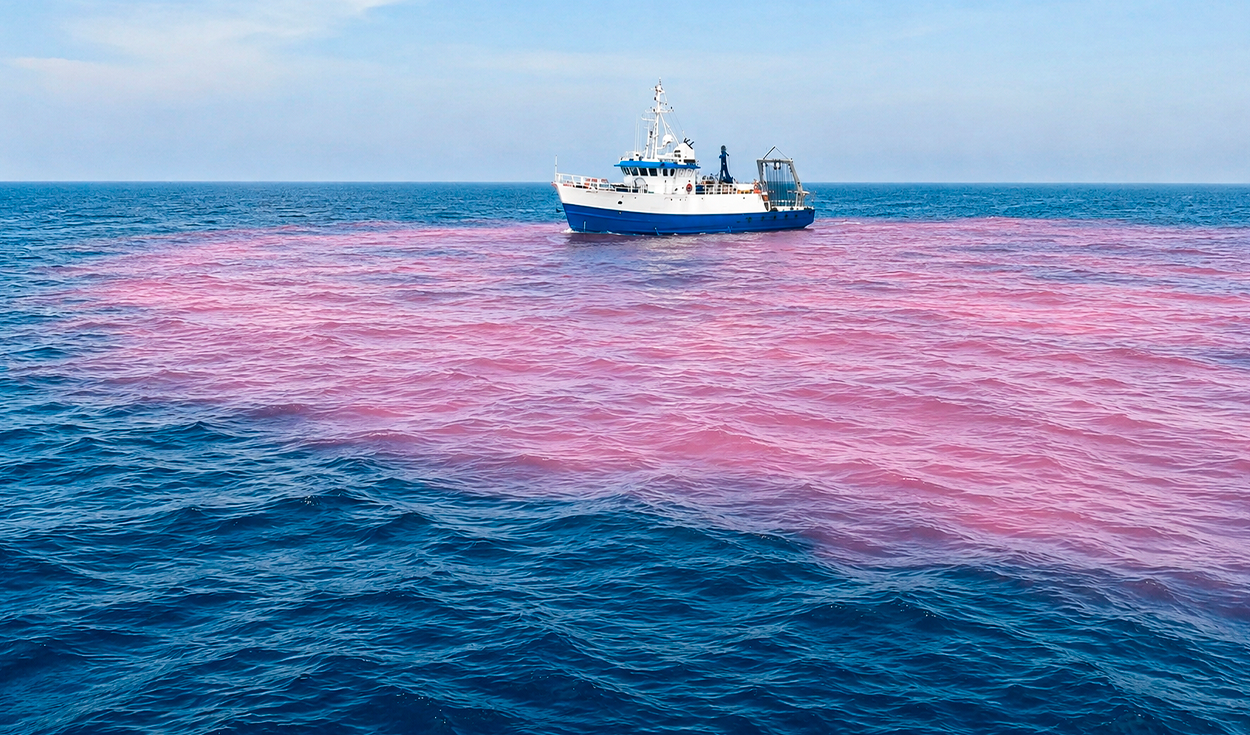
American researchers poured roughly 62,500 liters of high-purity sodium hydroxide into federal waters of the Gulf of Maine and temporarily turned the sea pink in an unprecedented climate experiment, conducted 61 kilometers off the U.S. coast.
The trial, carried out by the LOC-NESS project team, was approved in advance by the Environmental Protection Agency and executed with technical support from the Woods Hole Oceanographic Institution (WHOI). The operation lasted approximately six hours.
Alongside the sodium hydroxide, scientists added Rhodamine Water Tracer, a pink dye with no reactive effects on the marine ecosystem, used solely to track the movement of the plume. Ships, satellites, advanced sensors, and autonomous underwater vehicles monitored the area for five days, measuring pH, temperature, salinity, and carbon dioxide concentrations.
How the technique is supposed to work
The experiment tests a process called ocean alkalinity enhancement, or OAE. Sodium hydroxide was chosen for its alkaline properties: in theory, raising the alkalinity of seawater converts dissolved carbon dioxide into bicarbonate, a stable chemical form that can remain in the ocean for long periods, protecting corals and mollusks from acidification.
The oceans already absorb roughly a quarter of human-caused carbon dioxide emissions. WHOI is evaluating whether OAE can strengthen that natural capacity. International bodies including the IPCC and the National Academies of Sciences, Engineering, and Medicine have identified the approach as a promising avenue against the climate crisis, though they say it requires further research.
Promising but limited early results
Adam Subhas, the initiative's lead scientist, said carefully designed field tests are essential to validate the effectiveness and environmental impacts of marine carbon dioxide removal strategies. He added that such technologies do not replace the need to reduce carbon emissions.
A preliminary report from WHOI described the trial as a successful and controlled dispersal of alkalinity and tracer, demonstrating initial technical feasibility. Water acidity returned to normal ranges with no detected negative effects on bacteria, phytoplankton, or marine larvae.
Researchers cautioned, however, that no conclusive evidence yet exists to validate the technology at large scale. The tests did not assess adult marine fauna or sustained applications over time. Scientists emphasized that cutting fossil fuel emissions remains the priority response to the global climate emergency.


