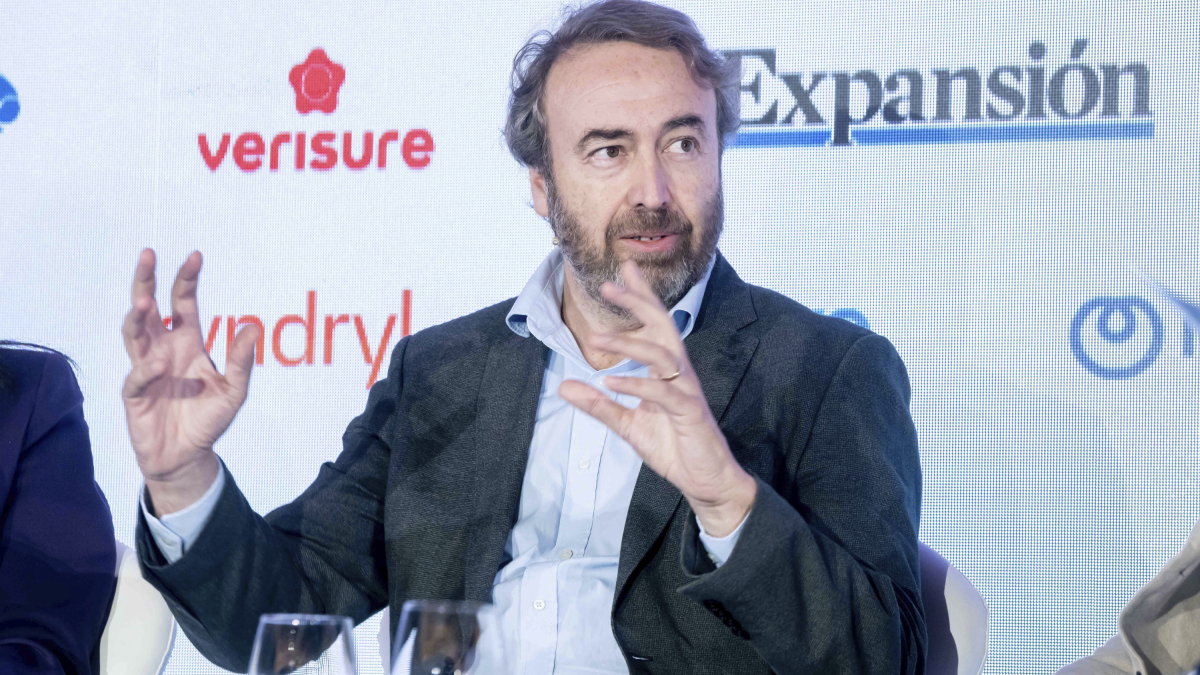
Executives from PwC, Microsoft, Kyndryl, the start-up Velorum and BASF Digital Solutions discussed how companies can move artificial intelligence projects from pilot stage to full production without them ending up unused or unprofitable, during a round table held in Madrid as part of the fourth EXPANSION Artificial Intelligence and New Technologies conference.
Javier Barguno, partner for AI and Data Analytics at PwC, said that for an AI project to work it has to come from the top down, with the pilot or initiative built around a clear business objective, known indicators to improve and the ability to measure them. He added that a company must decide from the start which people across its departments will be involved in the project going forward, to secure their commitment and smooth the path to success.
Juan Jose Cerrolaza, director of artificial intelligence at Kyndryl, said that once an organisation has mapped out how it wants AI to guide and restructure it, the essential next step is processes, both internally and with clients. He outlined three steps: establishing the technological base needed to bring AI to scale, defining the processes, and setting clear cross-cutting governance and adoption guidelines.
Hector Garcia Tellado, Chief Technology Officer for Southern Europe at Microsoft, said the starting point is the self-knowledge a company's board has about its own organisation, including where it stands, what kind of company it is, and its level of digital transformation or data quality.
Capacity and goals
Garcia Tellado said it is essential for a company's executive board to carry out an honest assessment of its own capabilities, and to understand how that transformation of processes aligns with its strategic plan over the coming years, so that tasks across departments stay coordinated and coherent.
He agreed with the other speakers that a company scaling AI needs to be clear about what it wants to achieve, adding that from a technological standpoint security and governance are often the most overlooked factor. He said Microsoft's view is that AI agents should be governed on security in the same way as an employee.
Elena Heredia, chief executive of the technology start-up Velorum, said that beyond processes, companies need to think about context for a personal AI tool to become a core system within a business. She said that in day-to-day tasks, it is the individual who hands over that context and know-how to their tools and agents, and that this works well at scale only when those layers of shared information and knowledge are given coherence and a defined objective. Heredia also stressed the importance of security through so-called guardrails for AI agents, which act as barriers, brakes or filters to prevent unwanted effects.
Juan Buero Viana, head of AI for customer efficiency at BASF Digital Solutions, said his company recognised the role the technology would play a year after the launch of ChatGPT, prompting a literacy drive among employees to turn it into a useful tool for the group. He said leadership was essential to that process and that driving it from the top down was non-negotiable.
Cerrolaza said that, according to data from some consultancies, 64% of companies are already reporting positive benefits from adopting AI or machine learning, but only 24% feel technologically prepared to handle and absorb that kind of internal change, which he said reflects the difficulty of a fast-moving environment that demands experience and resources.
Garcia Tellado agreed, saying the technological explosion over the past year has been dramatic, introducing new concepts such as local inference and hybrid inference that are forcing companies to update their technology architecture very quickly.
All the speakers agreed on the need for guardrails alongside human oversight to guarantee the safety of AI agents and technology, or at least limit their potential risks as much as possible in sensitive sectors such as healthcare, defence and privacy.
Profitability and costs
On the tangible business results of AI, Barguno said companies should look at metrics such as customer retention, satisfaction, improved process times and operational efficiency, not simply how many people the technology allows them to replace.
The Microsoft executive said it is something of a myth that employers using AI are mainly looking to cut staff. In his experience, he said, companies want their employees to do more, faster, increasing productivity and reducing costs, even if that means headcount does not grow at the same pace as the business.
Heredia said companies need to measure whether AI is actually optimising the processes they set out to improve, in order to decide whether it is delivering a genuine advantage or gain.
Test yourself
According to Kyndryl's Juan Jose Cerrolaza, what percentage of companies report positive benefits from adopting AI or machine learning?
What did PwC's Javier Barguno say is essential for an AI pilot to succeed?
What did the Microsoft executive say companies mainly want from AI, contrary to a common myth?
Where it happened
Madrid, Spain