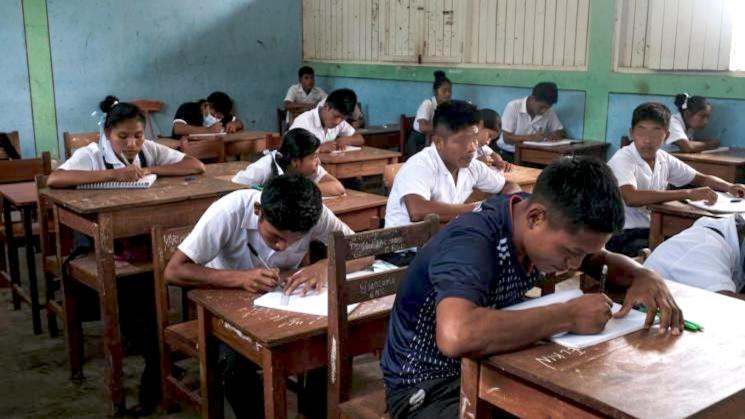
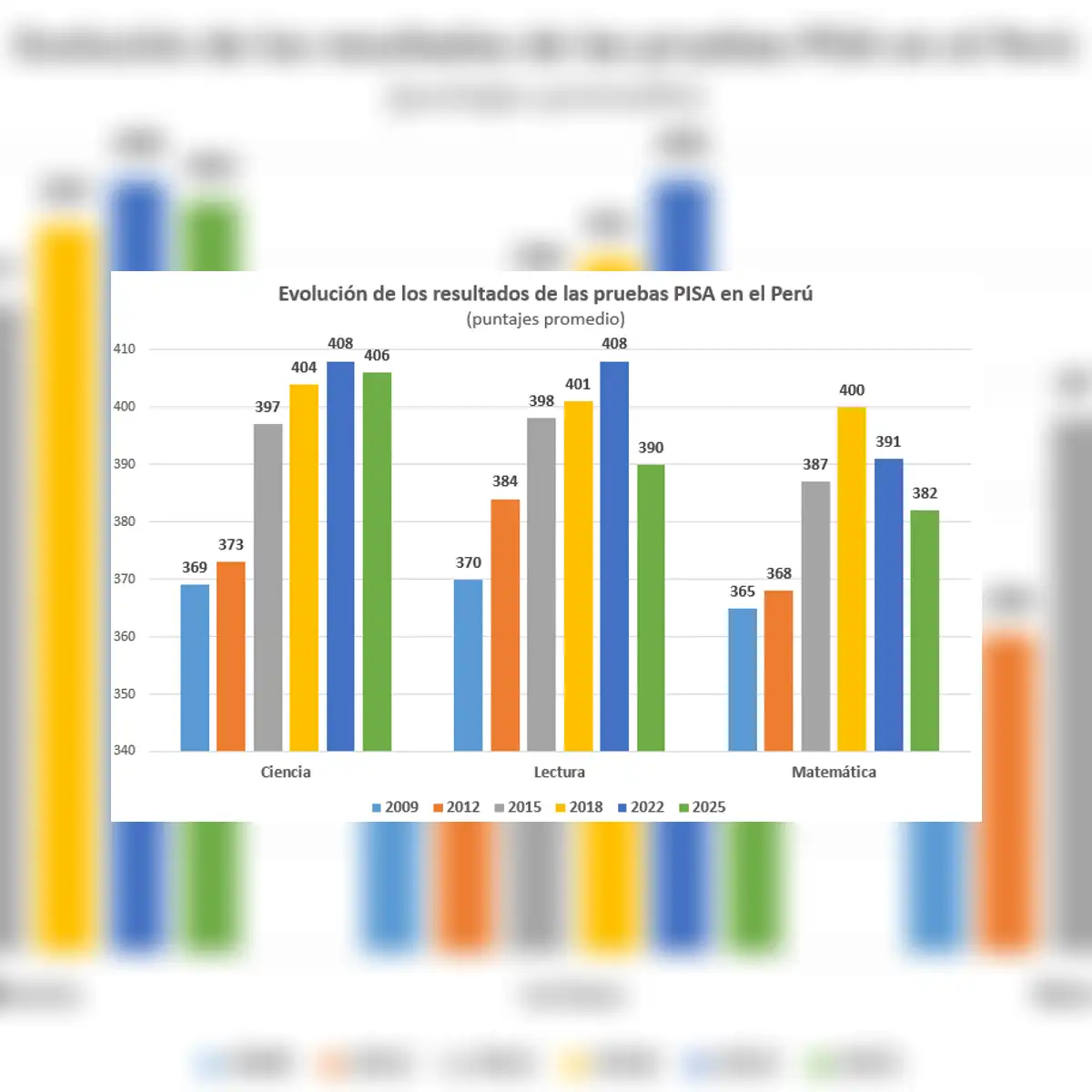
Peru scored lower in the 2025 Programme for International Student Assessment (PISA) tests than it did in 2022, with results dropping below pre-pandemic levels recorded in 2018. Between 2022 and 2025, the country's average score fell by 18.1 points in reading, 8.8 points in mathematics, and 2.2 points in science.
The latest evaluation examined nearly 722,000 15-year-old students across 91 countries. PISA is a global academic benchmark administered by the Organisation for Economic Co-operation and Development (OECD) to evaluate secondary education systems worldwide.
Peru remains significantly below the OECD average, trailing by 71 points in reading, 81 points in mathematics, and 76 points in science. The nation also lags behind several regional peers in Latin America. Chile, for example, outperforms Peru by 46 points in reading, 20 points in mathematics, and 37 points in science.
Writing in an opinion piece for the 247 News Agency, analyst Javier Herrera stated that national ranking positions are less alarming than the large proportion of students failing to achieve basic academic competencies. In 2025, approximately half of 15-year-old Peruvian students did not adequately understand what they read.
The test results also showed that 66.2 percent of Peruvian students failed to meet the minimum benchmark in mathematics, while 52.6 percent fell short in science. Overall, 39.9 percent of students performed at very insufficient levels simultaneously across all three subject areas.
This triple deficiency rate of 39.9 percent in Peru is substantially higher than the rates recorded in neighboring countries. In Colombia, 33.1 percent of students showed severe deficits across all three subjects, compared to 29 percent in Mexico, 27.3 percent in Chile, and an OECD average of 17.1 percent.
Herrera noted that reading comprehension failures are not isolated academic shortcomings. Weak reading skills hinder learning in mathematics, science, and every other subject, creating accumulated learning gaps that restrict future job market success and personal growth.
Socioeconomic Gaps in Academic Performance
The performance drop in Peru is heavily tied to socioeconomic status. Students from the lowest economic stratum scored roughly 20 percent lower in reading and mathematics than those from the highest stratum.
When comparing the bottom 10 percent of performers with the top 10 percent, the performance gap reached approximately 45 percent in reading and 41 percent in both mathematics and science.
Herrera emphasized that these academic gaps follow students into the workforce. Two individuals with the same level of formal education often enter the labor market with vastly different capabilities, which translates into unequal career advancement and income levels because employers reward actual skills rather than diplomas alone.
The causes behind the regression require further research, but major hypotheses focus on the impact of school closures during the COVID-19 pandemic and changes in digital media consumption among teenagers.
School Closures and Pandemic Disruption
Students evaluated in the 2025 PISA tests were around 10 years old when the pandemic began in 2020. The shutdown of schools interrupted a critical development stage for acquiring foundational skills.
The closures disproportionately impacted students who lacked access to remote learning tools or a supportive home environment to offset the loss of structured schooling.
National statistics illustrate the scale of the disruption during the pandemic. In 2020, the proportion of teenagers neither studying nor working increased from 9.6 percent to 20.4 percent, while those engaged exclusively in studying fell from 68.8 percent to 60.9 percent.
School attendance among youth aged 12 to 16 declined from 84.5 percent in 2019 to 80.8 percent in 2020. It was not until 2024 that the proportion of youth dedicated solely to studying surpassed 2019 levels, reaching 69.5 percent compared to the previous 68.8 percent baseline.
Herrera cautioned that physically reopening schools does not automatically resolve learning losses. Classroom attendance can recover much faster than actual educational understanding, leaving a long-term educational debt that can harm student progress through higher education and their future employment.
Screen Time and Digital Consumption
The pandemic does not fully explain the test score decline. Academic results across several OECD countries had been dropping prior to 2020, indicating a broader trend occurring both inside and outside the classroom.
Education experts have expressed growing concern over the increasing amount of time adolescents spend on social media networks.
Data from Peru's National Household Survey (ENAHO) showed that 92.1 percent of teenagers aged 12 to 17 used the internet in the second quarter of 2026, up from 75 percent in 2019. Mobile phones were used to access the web by 89.2 percent of those internet users.
Herrera explained that the core issue is not that teenagers are reading less, as they spend long hours reading digital content. Instead, the problem stems from what and how they read.
Short, fragmented online messages rarely train students to follow complex arguments, comprehend abstract concepts, grasp subtle details, or sustain focus on demanding texts.
However, Herrera argued against banning digital technology or artificial intelligence, noting that mobile devices and AI can serve as valuable educational tools if schools teach students how to use them with clear pedagogical goals.
Funding, Teacher Evaluation, and Economic Growth
Public discussions in Peru often focus on school infrastructure, educational materials, and teacher salaries. While these factors are important, Herrera stressed that policymakers must address what is taught, how it is taught, and how to recover lost learning while accounting for the country's cultural and linguistic diversity.
Although the state has increased financial allocations to public education, student outcomes have worsened. Higher spending has not guaranteed better learning because underlying educational processes have not improved, leaving significant gaps in infrastructure, teaching quality, and contextual teaching adaptations across regions.
Herrera called for expanding effective local educational programs and restoring a clear policy of teacher evaluation and meritocracy. Allowing educators who fail minimum pedagogical standards to remain in classrooms sends a message that contradicts the culture of effort schools try to instill.
Basic skills acquired during school years are vital for continuous learning, adapting to technological shifts, and maintaining national economic productivity as Peru approaches the end of its demographic dividend.
As Peru faces a declining ratio of working-age adults to elderly citizens over coming decades, education quality becomes a critical economic priority. A smaller workforce will need to drive a more productive economy, making student learning today essential for future stability.
Echoing a phrase from The Economist, Herrera concluded that it may be time for education policymakers to begin studying themselves.