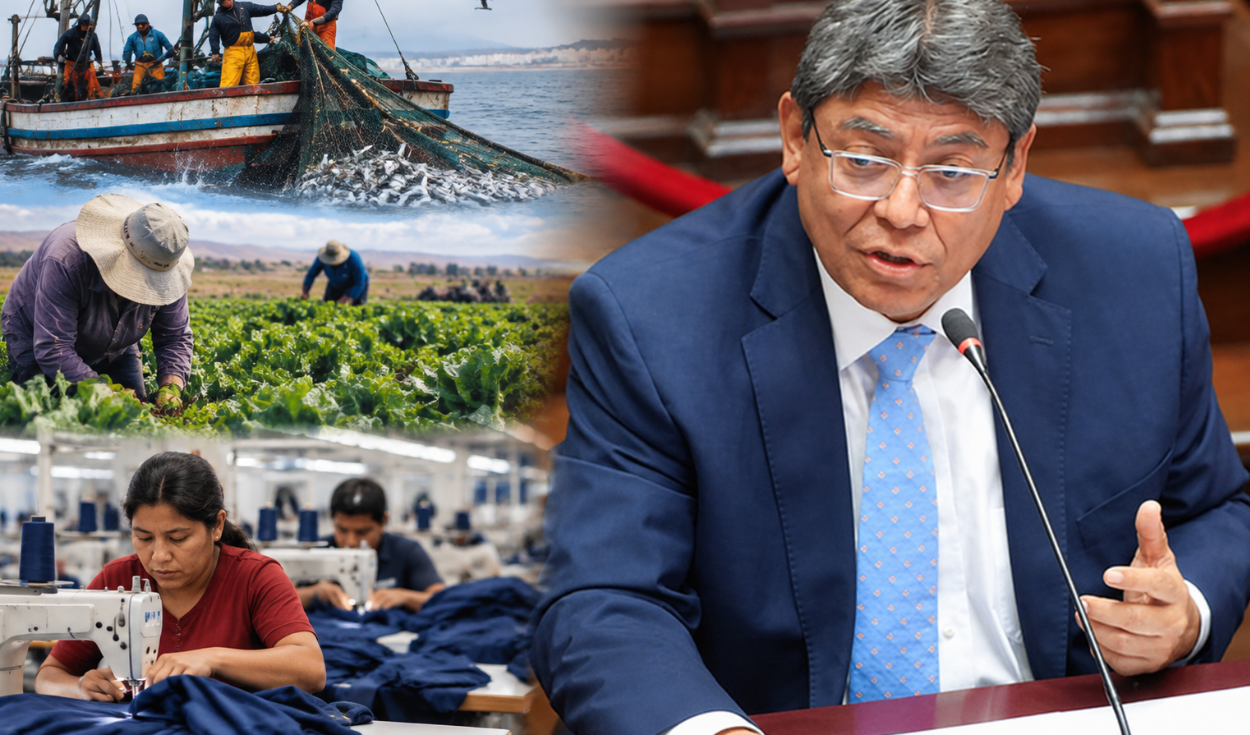
Peru's Minister of Economy and Finance, Elmer Cuba, told the Senate's Economy Commission that the fishing, agriculture and textile sectors are already in a state of recession because of the impact of the El Niño weather phenomenon.
Cuba described the event as strong and of an intensity possibly not seen in 50 years, and said it would keep the economy from reaching 4% growth this year. The Ministry of Economy and Finance (MEF) still projects growth of 3.4% for 2026, though Cuba warned that a worsening of El Niño could hit output in the fourth quarter of this year and the first quarter of 2027.
Peru's national statistics institute, INEI, does not use "recession" as a specific category for those three activities. Its records do show a sharp fall in activities tied to fishing, agriculture and manufacturing, while other branches of the economy keep growing.
Fishing hit hardest
Fishing showed the clearest deterioration. Official data for July show the sector fell 27.44% compared with the same month of 2025, extending a slump that ran through the third quarter.
The main factor was anchovy. Only 2,496 tonnes were caught in July, against 292,148 tonnes in the same month last year, a drop of 99.1%, linked to the suspension of anchovy fishing in the north-central zone.
Anchovy is a key raw material for fishmeal and fish oil production, so the smaller catch also affects the industries that process it.
The scale of the decline had already shown up in the national accounts for the second quarter, when fishing and aquaculture output contracted 48.7% and maritime fishing fell 50%.
ENFEN, Peru's official body for monitoring the El Niño phenomenon, raised to 85% the probability that the coastal El Niño will reach extraordinary magnitude in September in the Niño 1+2 region off Peru's northern coast. The probability stands at 82% for October and 78% for November.
Agriculture: an uneven decline
The picture in agriculture is less uniform. In June the farm sector fell 8.12%, with the decline concentrated in crop farming, which was hit by adverse weather, while the livestock subsector stayed positive. INEI had said climate problems were affecting the development of certain crops.
Cuba's warning is reinforced by ENFEN's forecast of above-normal air temperatures between September and November, and higher chances of above-average rainfall on the north coast. The agency said the unusual conditions could last until the autumn of 2027.
Textiles feel the pressure within manufacturing
The third sector Cuba named was textiles, where El Niño affects producers mainly through production conditions and the availability of raw materials. INEI had already reported a manufacturing contraction in previous months linked in part to climate factors, the availability of hydrobiological species and the production cycles of some industries, including textiles. Manufacturing fell 6.19% in June.
Cuba said he had been in talks with the Ministry of Production to declare an emergency for the textile sector, so affected companies could access mechanisms to ease or reschedule their loans through the financial system.
INEI tracks manufacturing and its branches but does not officially classify the textile sector as being in recession; that description comes from Cuba's own reading of the situation the sector faces.
GDP still growing despite sector strain
The main question raised by Cuba's warning is how a recession in three activities can coexist with positive growth for the Peruvian economy overall. INEI data published this past Tuesday showed national output rose 3.56% in July compared with the same month of 2025, and accumulated growth of 3.13% between January and July, meaning the weakness in some sectors is still being offset by others.
That gap had already appeared in the second quarter, when fishing and aquaculture fell 48.7% while construction grew 8.9% and commerce rose 7.3%. Electricity, gas and water, lodging and restaurants, and other services also posted gains.
Available data therefore do not support saying Peru's economy overall is in recession. Cuba's warning refers to specific sectors facing a considerable downturn while the aggregate result stays positive. The risk, he said, is that the sectors compensating for the losses might not keep up that pace if the weather phenomenon drags on or spreads to more branches of the economy.
MEF eyes risk into 2027
Cuba's concern extends beyond this year. He said a worsening of El Niño could cut growth in the fourth quarter of 2026 and the first quarter of 2027, a warning that matches ENFEN's latest outlook, which raised the odds of an extraordinary coastal El Niño in the coming months and projects the anomalies could persist into 2027.