

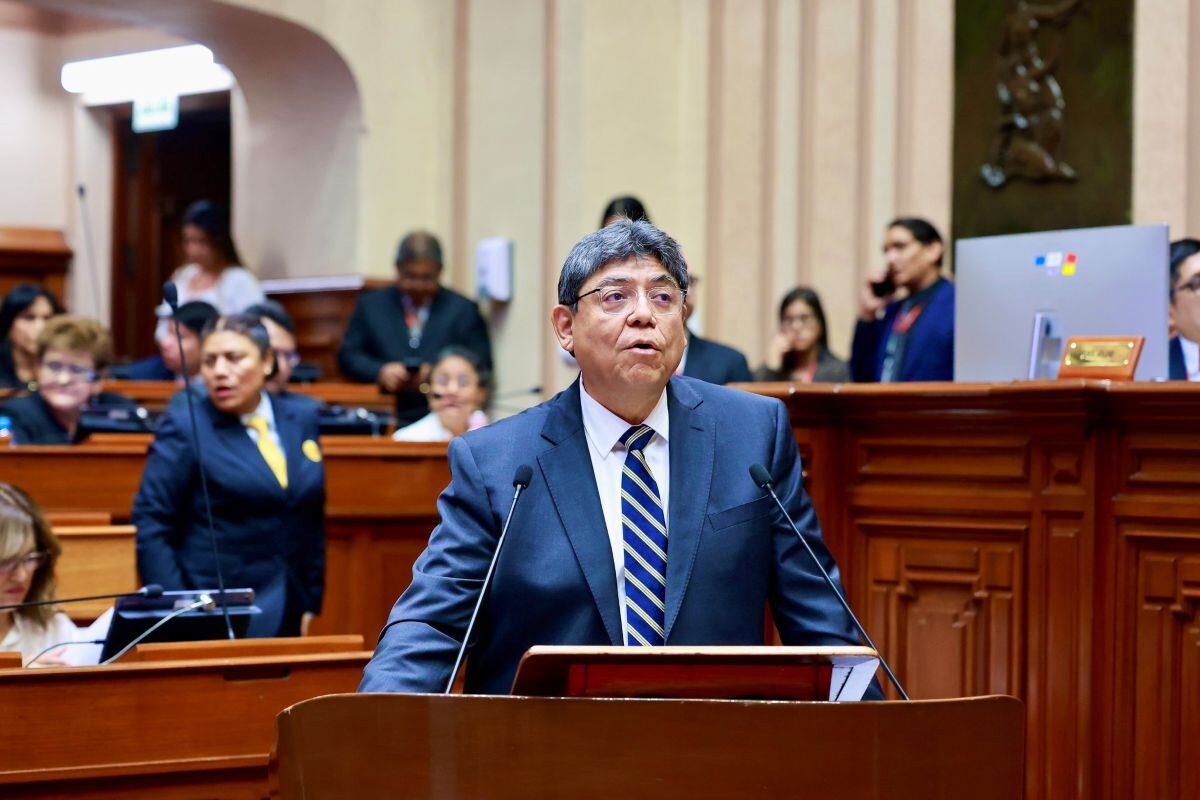
Peru Economy and Finance Minister Elmer Cuba requested delegated legislative powers from Congress on Wednesday afternoon to overhaul the tax framework for small enterprises.
Speaking to the Constitution, Regulations and Foreign Relations Commission of the Chamber of Deputies, Cuba said the proposal aims to resolve business growth stagnation caused by outdated tax regulations.
The measure targets micro and small enterprises, known as mypes, which operate under tax regimes established decades ago. Cuba stated that systems such as the Special Income Tax Regime and the New Simplified Single Regime currently act as isolated compartments that prevent commercial expansion.
According to the minister, growing businesses often remain trapped in restrictive tax tiers, with a single company sometimes operating under four distinct tax regimes. He noted that this arrangement creates significant regulatory risk and discourages enterprise growth.
Cuba explained that while low-earning individuals pay zero percent income tax before stepping up to eight percent and higher rates, businesses face a direct jump from a simplified regime paying 1.2 percent to a 30 percent corporate income tax rate. He said few business owners dare to take that step, making it necessary to broaden avenues for formalisation.
The Ministry of Economy and Finance oversees Peru's macroeconomic policy, public revenue, and taxation rules. Peru's small business sector relies heavily on simplified tax regimes designed to lower initial administrative burdens, but critics have long argued the sharp tax increases discourage companies from reporting full revenue.
Informal employment and labor benefits
Labor and Employment Promotion Minister Juan Sheput also addressed the legislative commission, emphasizing that Peru must urgently address employment because the country lives with almost structural informality.
Sheput reported that micro and small enterprises make up 99.7 percent of Peru's total universe of 2.5 million businesses. However, 88 percent of those small firms operate informally.
The minister stated that more than 10 million Peruvians work in the informal sector without entitlement to paid annual vacations, biannual statutory bonuses, Compensation for Time of Service, or basic labor rights.
Aligning with Cuba, Sheput said the government seeks to establish a modern legal structure capable of extending formal labor rights to informal workers. He added that current rules actively penalise business growth, citing how a small firm with 10 employees that needs an 11th worker would lose its preferential tax regime, forcing owners to create separate legal entities instead of expanding.
Under Peruvian labor law, formal private-sector workers are entitled to statutory benefits including 30 days of paid annual leave, additional salary bonuses in July and December, and Compensation for Time of Service, a mandatory severance fund deposited biannually into worker bank accounts.
Deregulation and public investment projects
Beyond tax and labor reform, Cuba outlined plans to deregulate existing normative frameworks to attract increased private investment into the country. He explained that execution of projects suffers from extensive delays caused by land disputes and utility interferences.
Cuba noted that the economy ministry is coordinating with ProInversión, Peru's private investment promotion agency, to streamline project approval processes.
The minister also proposed expanding the Works for Taxes mechanism to cover Services for Taxes. Following an emergency decree issued to address the El Niño climate phenomenon, Cuba said private companies could assist public administration through service provision while identifying opportunities to mitigate natural disaster risks.
ProInversión is the state agency responsible for attracting private capital to public infrastructure and public-private partnerships in Peru. The Works for Taxes scheme allows private companies to fund and build local public infrastructure projects directly in exchange for credit against their corporate income tax obligations.
Disaster response and emergency legislation
Agricultural Development and Irrigation Minister Marco Vinelli informed lawmakers that important regulatory adjustments remain missing to tackle severe weather risks linked to El Niño.
Vinelli stated that the Executive branch has already authorized around 2,400 million soles through supreme decrees and emergency decrees to respond to El Niño. However, he noted that current statutory limits prevent the central government from taking direct action during rains or droughts, placing initial emergency response burdens on subnational authorities.
Under current procedures, local governments must draft a technical report before central agencies can act. Vinelli pointed out that while these reports could theoretically be completed on day one, they usually take 10 to 15 days to prepare, delaying intervention by the Ministry of Defense and the National Institute of Civil Defense.
Vinelli said the requested delegation of powers would modify the emergency response law, granting the Executive branch legal authority to provide direct assistance to affected populations from day one. He emphasized that this change cannot be accomplished by executive decree and forms a primary component of the legislative request.
El Niño is a major weather pattern driven by warming sea surface temperatures in the Pacific Ocean, causing torrential rainfall, destructive flooding, and severe agricultural droughts along Peru's coast and highlands. The National Institute of Civil Defense, known as Indeci, is the government body tasked with disaster risk reduction and emergency disaster relief.
Multiyear budget reform
Cuba concluded his presentation by proposing reforms to the annual public budget formulation process. He observed that budget preparation in Peru traditionally follows a bottom-up approach, whereas guidelines from the Organisation for Economic Co-operation and Development recommend a top-down model.
The economy minister stated that the government aims to adopt a multiyear budget horizon. Under the proposed framework, officials would coordinate directly with cabinet ministers to define target objectives across a two to three year timeframe.
Cuba added that transitioning to long-term fiscal planning will require the passage of a dedicated special law by Congress.
The Organisation for Economic Co-operation and Development is an international group of 38 countries that promotes international policy standards and economic governance practices. Peru has actively sought full membership in the organization to align its public sector management with international benchmarks.


