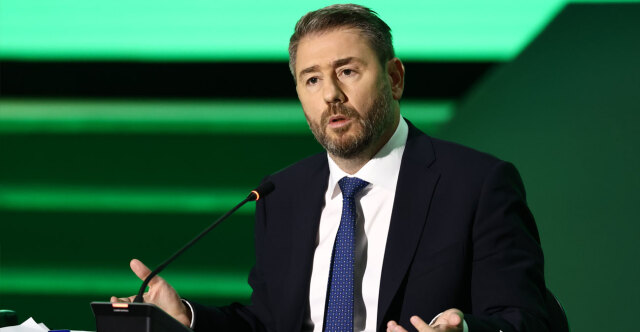
Nikos Andoulakis, leader of Greece's PASOK-Movement for Change party, said at his annual press conference during the 90th Thessaloniki International Fair that his party's goal is to finish first in the next election, arguing that forming a government without the leading party is almost impossible. He said PASOK must be the first party on election day for real political change to happen.
He said his party's proposals are costed and documented and denied promising billions of euros, contrasting it with rain that fell in Thessaloniki the previous day and what he called a "Noah's flood" of promises made by Prime Minister Kyriakos Mitsotakis while in opposition. He said PASOK does not treat citizens as customers and had presented specific social justice measures.
He repeated calls for a 13th pension, a 13th salary and restoration of the EKAS benefit for low-income pensioners, and said cutting VAT on basic goods is a measure other countries have used during periods of high inflation.
No change on cooperation with New Democracy
Asked about cooperation with the ruling party, Andoulakis said PASOK's congress decision against it stands unchanged. He said the decision was taken unanimously by 5,000 delegates at the party congress and described PASOK as a party with structures, bodies and congresses, not a temporary concentration of power that could vanish overnight.
Andoulakis defends his leadership style
Responding to critics who say he lacks the communication skill to lift PASOK's poll ratings, Andoulakis said he lacks the talent to lie with a broad smile or to abuse institutions for seven years while posing as a liberal, pro-European moderate. He said he grew up in a neighbourhood of Heraklion, Crete, attended public school and public university, worked in the private sector after graduating, took no state position, and entered politics on his own without oligarchs, vested interests, political patrons or "unholy alliances" behind him. He noted he was elected twice as a member of the European Parliament and did work in Brussels.
Accusations against opponents' "dependencies"
Asked what dependencies he believes affect his political opponents, Andoulakis spoke generally of oligopolies in healthcare, banking and energy, saying some people benefit when markets go unregulated. He criticised government policy for not regulating real estate amid Golden Visa investment, saying Greeks are becoming "tenants in their own country," and accused the government of allowing what he called a "cartelisation" of healthcare.
On Samaras and Tsipras
Asked about a possible new party led by Antonis Samaras, Andoulakis said that concerns New Democracy "in any version," not PASOK.
He acknowledged a gap had existed in the opposition but criticised Alexis Tsipras for a lack of consistency between words and actions. He said no party had lost an election with 24% of the vote in the 50 years since the restoration of democracy, and asked who had led that party at the time, referring to Tsipras. He said PASOK became the official opposition with 32 members of parliament through hard work, exposing New Democracy's corruption and pursuing institutional battles, and that any resignations from the ruling party came at PASOK's initiative.
Asked about Tsipras's proposed "patriotic tax," Andoulakis said cutting VAT is the real patriotic tax, while a one percent tax is simply a tax, not a patriotic one.
Coalition scenarios and debt relief
Asked why discussion of cooperation scenarios from left and right continues despite PASOK's clear position, Andoulakis said engaging with such scenarios benefits only those with nothing serious to offer the country, and that voters will decide how Greece is governed on election day. He said PASOK's priority is for small and medium-sized business owners to know the party would offer 120 instalments to help settle debts.
Responding to criticism that his proposals for a 13th pension and salary echo policies blamed for pushing Greece toward bankruptcy, Andoulakis said New Democracy "knows those recipes well" because it led the country to bankruptcy, adding that had PASOK's parliamentary group voted the way Mitsotakis did in 2010, Greece would now have the drachma. He questioned how anyone could call Greece's economic record a success when its purchasing power is the lowest in the European Union.
Turkey, Cyprus and the wiretapping scandal
On Greek-Turkish relations, Andoulakis said there would be no ungovernability, only a government chosen by the Greek people, and rejected the framing of "Mitsotakis or chaos" as blackmail, calling "Mitsotakis or Erdogan" a revelation of the government's frivolity. He said PASOK accepts no lessons on national issues, pointing to the Cyprus problem as the most important success since the restoration of democracy, and dismissed the government's "calm waters" approach as a failed communication trick, calling instead for a national strategy toward Turkey.
He called on Mitsotakis to announce a specific timeline for laying the electricity connection cable to Cyprus, saying the government had shown a lack of seriousness in managing a project of such geopolitical and energy importance.
On the long-running wiretapping scandal, Andoulakis said the case would close only when everyone who conceived of building a "parastate" is brought before justice, saying no minister or prime minister can tolerate such a structure.
European defence and fiscal policy
On European Union defence spending, Andoulakis reaffirmed support for a European army, joint procurement, common defence and a common foreign policy. He said he could not accept Greeks paying billions in military spending while Denmark and the Netherlands use comparable funds for hospitals, roads, kindergartens and universities, calling it a longstanding internal injustice within the EU. He said cohesion funds must not be weakened. He called the current European Commission a failure and proposed that forces opposed to the European People's Party and the far right field a single candidate with a joint programme before the 2029 European elections.
On fiscal management, he said public debt must be addressed through growth rather than inflation-driven surpluses, and called Greece's Recovery Fund allocation a missed opportunity to change the country's production model, adding that growth cannot be built on real estate. He said the Fiscal Council should evaluate the real impact of specific policies, such as the cut to dividend tax, rather than only measure spending against the budget.
Party expansion and domestic policy
Asked whether the appearance of Evangelos Apostolakis and Alexandros Avlonitis at his speech signalled further defections to PASOK, Andoulakis said anyone who shares the party's principles and believes the country needs change is welcome, though he stressed that social expansion matters more than recruiting individual figures.
He outlined three measures against waste in unfinished public works: preventive audits by the Court of Audit on high-value contracts, a cap on direct contract awards excluding small municipalities, and stronger use of the Diavgeia transparency portal.
On housing, he said he had warned publicly since 2022 that it would become the country's biggest social issue, and pledged that housing policy would be a first-day priority for a PASOK government.
Asked about the release from prison of far-right figure Ilias Kasidiaris, Andoulakis criticised rhetoric from Donald Trump, Marine Le Pen and other politicians that he said opens the door to intolerance and the far right, saying PASOK has never believed such forces have anything to offer. He said his message to young Greeks was to consider whether supporters of Hitler, who he said "slaughtered the Greek people," deserve even a single social media "like."
Election strategy and candidacy
Asked who PASOK would work with after the next election, Andoulakis said the Greek people would answer that question at the ballot box, and said PASOK's duty is for every Greek to know what the party proposes. Asked about a scenario where New Democracy finishes first without a majority, he said PASOK is fighting for the party's removal from government and that its internal leadership issues are its own to resolve.
He denied any internal cracks within PASOK, saying the party would fight the election united. Asked whether he would again stand as a candidate in the Thessaloniki A constituency, he said that would be announced along with the full candidate list.
On agriculture, he said the Ministry of Rural Development should become a "headquarters, not a client shop," and called for linking primary production with processing and innovation to create higher-value exports. On regional policy, he said people outside the big urban centres feel scorned, pointing to PASOK's regional development record in the 1980s as a model to repeat.
On the lignite phase-out in Western Macedonia, he said an unplanned transition had worsened an existing problem, calling it unjust rather than green, and pointed to Germany's approach as a model for handling the Ptolemaida 5 power unit while offering incentives for genuine productive investment. On the Western Balkans, he said rule of law and human rights matter as much as money and infrastructure in bringing the region closer to European values. He also said his party would reactivate the council for Greeks living abroad, based in Thessaloniki, once it takes office.