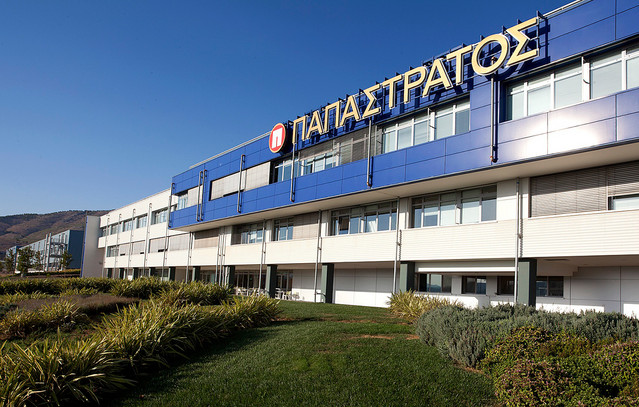
A new study by the Foundation for Economic and Industrial Research (IOBE) has found that the activity of Papastratos, one of Greece's largest industrial companies, is equivalent to 0.42% of the country's gross domestic product. The study also found the company accounts for about 1% of total Greek product exports and has historically contributed an average of 2.7% of the country's tax revenue.
The findings were presented in Thessaloniki as part of the 90th Thessaloniki International Fair, timed to mark 95 years of the company's presence in Greece. Papastratos is a Greek cigarette manufacturer that has been part of tobacco giant Philip Morris International since 2003, with its main factory located in Aspropyrgos, west of Athens.
A company built on continuity and change
Opening the discussion at the fair, Papastratos chief executive Tina Davou spoke about the company's 95-year journey, describing it as one that evolved alongside deep changes in the Greek economy and society. She said the company remained committed to what lies ahead, continuing to invest in innovation, export production, job creation and future generations.
"Staying steady does not mean staying stagnant," she said, according to the company, stressing that the firm's 95-year history was not only a story of continuity but also of constant transformation.
Papastratos vice president Alexandros Hatzopoulos addressed the study's findings through a broader question: how more Greek companies could create similar conditions for growth. He pointed to the importance of continuous investment, technology transfer, stronger exports and new job creation.
He said that during periods of crisis, Papastratos had proven not only resilient but adaptive, highlighting the importance of a company's ability to keep evolving and investing even in times of uncertainty.
Investment growth outpacing the rest of industry
The IOBE study places particular emphasis on the company's investment record. Over a 20-year period in which the Greek economy passed through severe crisis and deindustrialisation, Papastratos investments quadrupled, while investment across Greek industry as a whole rose by just 35%.
The pace accelerated after 2017, when a major overhaul of the Aspropyrgos factory's production began. Total investment since then has reached 700 million euros. Over the same period, the company's turnover rose from 263 million euros in 2017 to about 1 billion euros in 2025, an increase of roughly 280%.
Exports worth 431 million euros to more than 30 countries
Exports form the second pillar of the company's economic footprint. The value of Papastratos exports reached 431 million euros in 2025, up 262% compared with 2017. More than 85% of the company's production is exported, reaching more than 30 countries.
Japan is the company's largest market, absorbing about 80% of its exports. Overall, Papastratos accounts for around 1% of all Greek product exports, a figure the study says reflects the weight of its production activity in the country's foreign trade.
Jobs more than doubled since 2017
The company's impact on employment has also grown sharply. Direct jobs at Papastratos have more than doubled since 2017, rising from 659 employees that year to more than 1,500 direct positions today, according to the study.
The IOBE researchers describe this as part of a wider pattern in which production growth, investment and export expansion moved in step with rising employment at the company.
An exception to Greek deindustrialisation
Presenting the study's conclusions, IOBE general director and Athens University of Economics and Business professor Nikos Vettas described Papastratos as a notable exception to the deindustrialisation Greece experienced over recent decades. He said that during the crisis, the company managed to move with greater momentum than much of the rest of industry, supported by investment, export orientation and the attraction of foreign capital.
To illustrate the scale of that impact, he said that if Greece had 240 companies with a comparable economic footprint, the country's GDP would be double its current size.
Vettas said extroversion and investment in technology were critical conditions for the growth of Greek businesses, noting that a significant share of the products Greece exports is still characterised by low added value and limited innovation. He also stressed the importance of a stable economic environment that allows companies to invest with greater confidence, along with further improvements to infrastructure and to the connections between ports and logistics networks.
Five numbers behind the footprint
Taken together, the IOBE study's picture of Papastratos rests on five figures: 0.42% of Greek GDP, 1% of product exports, 700 million euros in investment, more than 1,500 direct jobs, and 431 million euros in exports in 2025.
Behind those individual figures, the study traces a path in which investment, export growth and rising employment gradually shaped the company's economic footprint in Greece. The full IOBE study on the economic and social footprint of Papastratos in Greece has been made publicly available.