

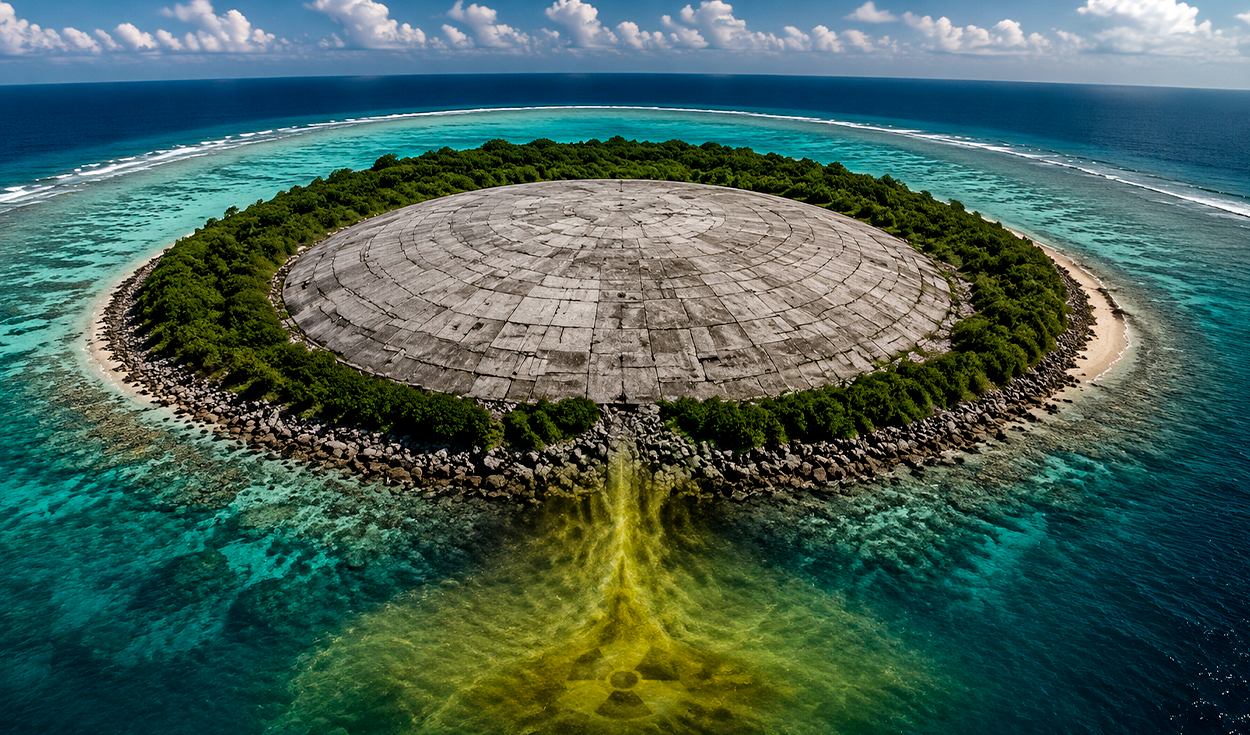
Scientists are warning that a concrete dome built by the United States to contain nuclear waste in the Marshall Islands is leaking radioactive material into the Pacific Ocean, with climate change threatening to worsen the damage.
The Runit Dome, often called the "nuclear coffin," sits on Enewetak Atoll and holds waste generated by 67 American atomic tests conducted in the Marshall Islands between 1946 and 1958. The structure was built over a crater left by an atomic detonation and has no sealed bottom, allowing ocean water to pass through the porous coral ground and displace radionuclides into the surrounding lagoon.
Cracks, Leaks and a Vulnerable Structure
According to reporting by the World Socialist Web Site, more than 120,000 tonnes of plutonium-contaminated debris remain inside the unlined crater. Tidal movement drives groundwater through the site daily, creating a steady flow of water between the structure and the adjacent lagoon.
Ivana Nikolic-Hughes, a chemist at Columbia University, said plutonium remains dangerous for more than 24,000 years and warned that the integrity of the dome could be at risk as sea levels rise. She noted the facility sits just 32 kilometres from populated settlements, adding that the implications are potentially devastating.
Nuclear engineer Arjun Makhijani, president of the Institute for Energy and Environmental Research, pointed out that the deposit has already developed cracks in less than 50 years, which he said illustrates the immediate risk to vulnerable island communities in the Pacific.
Disputed Scale of the Threat
The US Department of Energy has argued that current leakage from the dome is minor compared with the contamination left behind by Cold War nuclear testing on the ocean floor. But Ken Buesseler, a specialist at the Woods Hole Oceanographic Institution, warned that the structure's stability depends on gradually rising seas, violent wave action and future cyclones, factors he said require permanent environmental monitoring of local communities.
Researchers from ScienceAlert and the Australian Broadcasting Corporation have confirmed that ocean water penetrates the coral base and moves radioactive material toward the lagoon. Scientists warn that accelerating climate change could speed up structural damage and trigger a large-scale release of radioactive substances into the Pacific.
A Legacy of Displacement and Illness
The 67 tests carried out between 1946 and 1958 had a combined force described as equivalent to detonating 7,233 Hiroshima bombs over 12 consecutive years. Explosions including Ivy Mike and Castle Bravo vaporised entire islands on Enewetak Atoll and spread lethal radioactive fallout across the region.
Thousands of indigenous residents were forcibly displaced, and military personnel involved in decontamination work suffered severe health consequences. The Bikini zone remains uninhabitable. In the 1970s, the US Army attempted to address the contamination by burying irradiated debris in the Cactus crater, creating the concrete dome that scientists now describe as a serious environmental threat.


